
Change of Qiblah
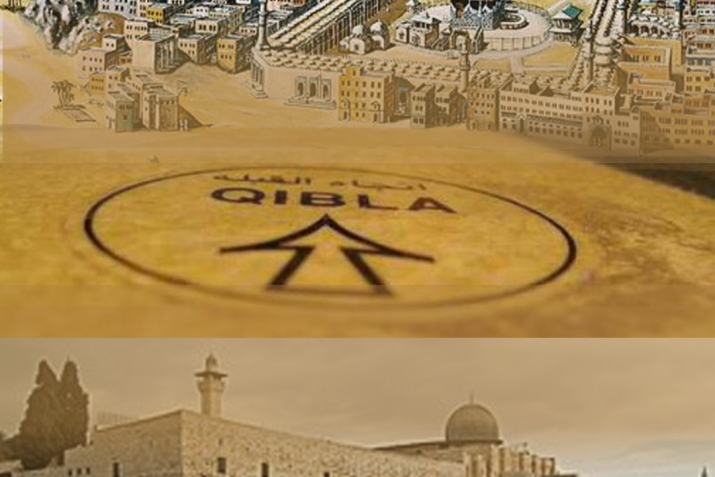
Two momentous events in the life of Prophet Muhammad (peace and blessings be upon him) bear special significance as regards the institution of prayer (salah) in Islam: The Miraj (the Prophet's ascension) and the change of the qiblah from Jerusalem to Makkah.
There is general agreement among Muslim scholars that the Prophet's Night Journey and ascension occurred in the month of Rajab, most probably on the 27th of that month, about a year before the Hijrah (the Prophet's emigration from Makkah to Madinah) and that the change of qiblah happened in the middle of Shaban, about sixteen months after the emigration.
Muslims believe that during the Prophet's Miraj, God instituted the five daily obligatory prayers for believers. And it was in the middle of a congregational prayer in Madinah, that God's command came to the Prophet (peace and blessings be upon him) about the change of qiblah.
We read about it in the Quran (meaning), “The fools among the people will say, ‘What has turned them from the Qiblah to which they were used?’ Say: To Allah belong both East and West; He guides whom He pleases to a Way that is straight.” (Sura Al-Baqarah, ayah 42).
“The fools” in this context are those who criticize the change of qiblah, without any understanding of the matter. Before considering the meaning of the change of qiblah, we need to understand the importance of what is called the qiblah for Muslims. For Muslims, none of the daily prayers can be done correctly without knowing the qiblah. “Qiblah” means orientation or a sense of true direction.
At the beginning of every Prayer, the Muslims face the house of God in Makkah, thereby spiritually connecting themselves along an invisible line that passes through every point on earth, to the spiritual center in Makkah. Whether they pray alone, or in congregation, they do so as part of the greater community of Islam. Thus, five times a day, each Muslim is aligned to the other Muslims who form concentric circles around the Kaabah encircling the earth.
Imagine watching the scene from space; and we may see all the Muslims at prayer like a huge flower the size of the earth, opening and closing its millions of petals. Each of those petals represents a Muslim at prayer. Thus the qiblah (which is unique to Islam) has a significant role in bringing together every nation, race, and tribe on this planet regularly five times a day, so as to link them to the common center at Makkah.
Being central to the worshippers in Islam, the qiblah serves as the heart of the Ummah of Islam, supplying life-blood to the spiritual existence of Muslims all over the world and maintaining the concept of unity in every sense of the term: God is One, the religion is one and the Ummah is one.
Every time we stand in prayer, Muslims may say they make a spiritual journey to the Kaabah in Makkah, somewhat as the Prophet (peace and blessings be upon him) did during his Night Journey to Jerusalem. And from the Kaabah, our spirit travels upward towards God the Almighty just as the Prophet (peace and blessings be upon him) during his ascension from Jerusalem. Therefore, for a pious and sincere worshipper, every prayer he performs involves a Night Journey and an ascension, as it were.
During his ascension, in a mystical experience of immense spiritual significance, Prophet Muhammad (peace and blessings be upon him) led all the earlier prophets in prayer in Al-Aqsa mosque at Jerusalem. This wonderful event symbolised not only the oneness of both the houses of worship - the Kaabah and Al-Aqsa - but also the oneness of the guidance of God given through all the prophets. Because Prophet Muhammad (peace and blessings be upon him) was sent as the final prophet for the whole of humanity consisting chiefly of the children of Abraham by his eldest son Ishmael and his second son Isaac (peace be upon them both). Jerusalem represents the line of Isaac, as Makkah does the line of Ishmael.
The foregoing highlights the significance of both the cities serving as the qiblah of Muslims: First Jerusalem and then Makkah. The final prophet born in the line of Ishmael, the first son of Abraham, at Makkah was commanded to turn to Jerusalem for prayer; and then as a significant turning point in the process of the completion of the religion of Islam, God asks Prophet Muhammad (peace and blessings be upon him) to turn to the first house of God in Makkah for worship.
And God says in the Qu’ran what means, “Thus, have We made of you an Ummah justly balanced, that you might be witnesses over the nations, and the Messenger a witness over yourselves; and We appointed the Qiblah to which you were used, only to test those who followed the Messenger from those who would turn on their heels (From the Faith). Indeed it was a momentous (change), except to those guided by Allah. And never would Allah make your faith of no effect. For Allah is to all people most surely full of kindness and Most Merciful.” (Sura AlBaqarah, ayah 143)
In the above verse the use of the expression, “an Ummah justly balanced that ye might be witnesses over the nations” is particularly noteworthy. Muslims believe that Prophet Muhammad (peace and blessings be upon him) is not to be considered the prophet of just a region, a race or a nation. Rather, he is the prophet of the whole of humanity and the community of believers will be a justly balanced middle nation with Makkah as its center. Jerusalem, representing the earlier versions of the religion, was not the qiblah any more. Makkah, representing the patriarch of mankind Abraham and all his children, was to be recognized as the center of the completed religion of God.
This means that the change of qiblah had far more significance than most people at that time understood.
According to the Qu’ran, Prophet Muhammad (peace and blessings be upon him) and his followers were named “the best of peoples” as well as “a justly balanced society”, deserving of leading the whole of humanity to the path of God. That is to say, the change of the qiblah is a declaration by God of the perfection of the first religion as the final religion for mankind. Through two mystical events in the life of the final messenger, Muhammad, God completes and perfects the religion for humanity and declares the Kaabah in Makkah as the center of the world as well as of His religion.
And those who recognize and accept this cannot be parochial or ethnocentric; they must be above race, region or nation and they have to be at the centre as a justly balanced middle nation serving as “witnesses over nations” as the true representatives of the whole of humanity.