

Piety of imam Abu Hanifa
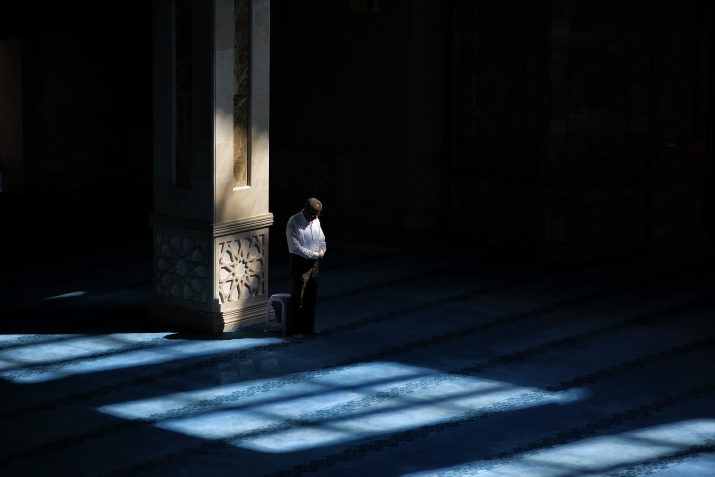
Better known as Imam A’dham (The Greatest Imam), or by his kunyah Abu Hanifah, Nu’man ibn Thabit was born in the city of Kufa (modern day Iraq) in the year 80 AH (689 A.D). He was born into a family of tradesmen of Persian origin as well as descending from the noble Prophet’s companion, Salman al-Farsi. Imam Abu Hanifah’s father, Thabit, had met in Kufa Imam ‘Ali Ibn Abi Talib who made dua for him and his progeny and some say that Abu Hanifah was a result of this dua.
A hadith given by al-Bukhari and Muslim states that Abu Hanifah (may God be pleased with him) narrated God’s Messenger (peace and blessings be upon him) as saying, “If the religion were at the Pleiades, even then a person from Persia would have taken hold of it or one amongst the Persian descent would surely have found it.” Imam as-Suyuti remarked, “It has been communicated unanimously that this hadith refers to Imam Abu Hanifah.”
Kufa at the time of the Imam’s birth was a great centre of knowledge and learning, with many of the noble Prophet’s companions having taken residence there. Due to the presence of these venerable people who had engendered so much interest in hadith and riwayat, practically every house in Kufa had become a centre of these disciples and their disciplines. Abu Hanifah’s piety and devotion knew no bounds. Praying was a delight to him and he used to engage in it with great gusto and sincerity. He was famous for this. Dhahabi writes, “Accounts of his piety and devotion have reached a degree of tawatur (i.e. an unbroken chain of uncontradicted narrations).”
While saying his prayers or reading the Koran, he would be so overcome with feeling that he would start weeping and do so for hours. Ibrahim Basri relates that one morning while he was saying his prayers together with the Imam, the latter recited the ayah, “I do not think that God is forgetful of the conduct of the iniquitous” and in reciting it wept so much that his whole body shook with sobs.
Za’idah relates that having an important question to consult the Imam about he joined the night prayers with him and waited for him to finish his nafls. But the Imam, when in reciting from the Koran he reached the ayah “Waqana ‘adhab al-samum” (Save us from the torture of Hell’s hot wind), went on repeating it until the morning. On another occasion he spent the whole night repeating the ayah: “Judgment Day is the sinners’ promised hour and it is a difficult and unpleasant hour,” and wept while he repeated it.
Yazid b. Kumait, a contemporary of the Imam and famous for his piety, relates that he joined the Imam in the night prayer during which the Imam leading the prayers recited the ayat ‘iza zulzilat’. After the other people had departed, he found the Imam still sitting and heaving deep sighs. Yazid did not want to disturb the Imam, so he also went away, leaving the Imam sitting.
When he went to the mosque on the following morning, he found the Imam sitting, looking very sad, holding his beard in his hands and saying tearfully, “O Thou Who will reward even the smallest virtue and punish even the smallest sin, save Thy slave Nu’man from Hell-fire.”
One day while walking in the street, the Imam inadvertently stepped on a small boy’s foot. The boy cried, “You don’t seem to fear God.” On hearing these words the Imam fainted. Mus’ir b. Kudam, who was with him, stopped him from falling and attended to him. As soon as he came to, Mus’ir said, “Why were you so perturbed by a small boy’s casual remark?” The Imam replied: “Who knows this was not an admonition from the Unknown!”
