

Country of kings
Ancient Ghana derived power and wealth from gold and the introduction of the camel as the Trans-Saharan trade increased the quantity of goods that were transported.
Islam in Ghana is said to have been brought by traders. Much of the information about Ghana comes from the Arab writers. Al-Hamdani, for example, describes Ghana as having the richest gold mines on earth. These mines were situated at Bambuk, on the upper Senegal River.
The Soninke people also sold salt and copper in exchange for textiles, beads and finished goods. They built their capital city, Kumbi Saleh, right on the edge of the Sahara and the city quickly became the most dynamic and important southern terminus of the Saharan trade routes.
Kumbi Saleh became the focus of trade, with a systematic form of taxation. Later on Audaghust became another commercial centre.
Inevitably the traders brought Islam with them. The Islamic community at Kumbi Saleh remained a separate community quite a distance away from the king’s palace. It had its own mosques and schools, but the king retained traditional beliefs. He drew on the bookkeeping and literary skills of Muslim scholars to help run the administration of the territory. The state of Takrur to the west had already adopted Islam as its official religion and established closer trading ties with North Africa.
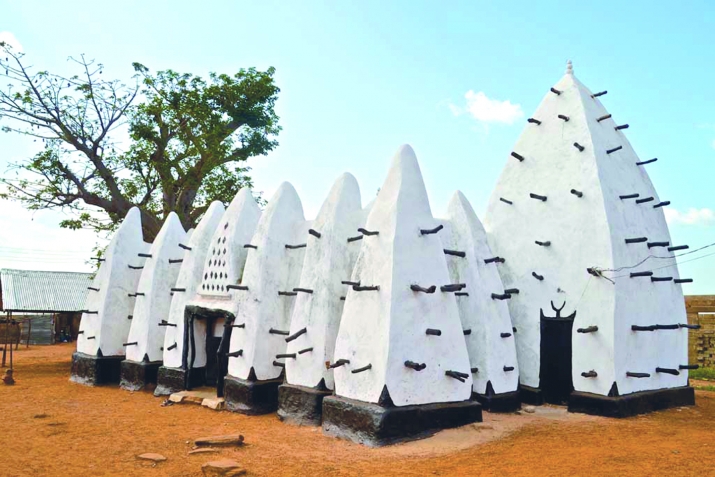
Larabanga, a small town in Western Gonja in the Northern Region, is a predominantly Muslim town. It is the site of the Larabanga mosque, the oldest mosque in Ghana, and one of the oldest in West Africa. A 13th century mosque, it is believed to have been built by Moorish traders, and is said to house an ancient holy Quran. It was built in the mode of buildings in the former Western Sudanese Empires. It has a unique facade which continues to attract visitors. A large, beautiful adobe structure, the mosque is still used daily for prayers.
Each year the mosque has to be renovated due to damage to the mud walls during heavy rains. These yearly renovations can cost up to $1,000 and although the government of Ghana provides monetary assistance to keep up the mosque, here is not always enough money to do the job well.
Larabanga is about 10 miles west of Damongo, and about five miles to the Mole National Park. Damongo is about 2 miles west of Tamale. Just outside Mole National Park is the village of Larabanga. Many prominent Muslims from Ivory Coast, where the people of Larabanga claimed to have migrated from, visit the village.
Strictly speaking, Ghana was the title of the king, but the Arabs, who left records of the kingdom, applied the term to the king, the capital, and the state. The 9th Century Arab writer, Al Yaqubi, described ancient Ghana as one of the three most organised states in the region (the others being Gao and Kanem in the central Sudan). Its rulers were renowned for their wealth in gold, the opulence of their courts, and their warrior-hunting skills. They were also masters of the trade in gold, which drew North African merchants to the western Sudan. The military achievements of these and later western Sudanic rulers and their control over the region’s gold mines constituted the nexus of their historical relations with merchants and rulers of North Africa and the Mediterranean.
Although the rulers themselves were not usually Muslims, they either brought with them or welcomed Muslims as scribes and medicine men, and Muslims also played a significant role in the trade that linked southern with northern Ghana. As a result of their presence, Islam substantially influenced the north. Muslim influence, spread by the activities of merchants and clerics, has been recorded even among the Asante to the south. Although most Ghanaians retained their traditional beliefs, the Muslims brought with them certain skills, including writing, and introduced certain beliefs and practices that became part of the culture of the peoples among whom they settled.
In the broad belt of rugged country between the northern boundaries of the Muslim-influenced states of Gonja, Mam-prusi and Dagomba and the southernmost outposts of the Mossi kingdoms, lived a number of peoples who were not incorporated into these entities. Among these peoples were the Sisala, Kasena, Kusase and Talensi, agriculturalists closely related to the Mossi. Rather than establishing centralised states themselves, they lived in so-called segmented societies, bound together by kinship ties and ruled by the heads of their clans. Trade between the Akan states to the south and the Mossi Kingdoms to the north flowed through their homelands, subjecting them to Islamic influence.
The Republic of Ghana is named after the mediaeval Ghana Empire of West Africa. The actual name of the Empire was Wagadugu. Ghana was the title of the kings who ruled the kingdom. It was controlled by Sundiata in 1240 CE, and absorbed into the larger Mali Empire.
Geographically the old Ghana is 500 miles north of the present Ghana, and occupied the area between Rivers Senegal and Niger.
Some inhabitants of present Ghana had ancestors linked with the mediaeval Ghana. This can be traced down to the Mande and Voltaic people of Northern Ghana - Mamprussi, Dagomba and Gonja.
Anecdotal evidence connected the Akans to this great empire. The evidence lies in names like Danso shared by the Akans of present Ghana and Mandikas of Senegal/Gambia who have strong links with the empire. There is also the matrilineal connection.
Before March 1957 Ghana was called the Gold Coast. The Portuguese who came to Ghana in the 15th century found so much gold between the rivers Ankobra and the Volta that they named the place Mina, meaning mine. The Gold Coast was later adapted to by the English colonisers. Similarly, the French, equally impressed by the trinkets worn by the coastal people, named the Ivory Coast, Cote d’Ivoire.
Archaeological remains found in the coastal zone indicate that the area has been inhabited since the early Bronze Age (ca. 4000 BC), but these societies, based on fishing in the extensive lagoons and rivers, left few traces. Archaeological work also suggests that central Ghana north of the forest zone was inhabited as early as 3,000 to 4,000 years ago. Oral history and other sources suggest that the ancestors of some of Ghana’s residents entered this area at least as early as the tenth century CE and that migration from the north and east continued thereafter.
