
Islamic education of children
Islamic education of children
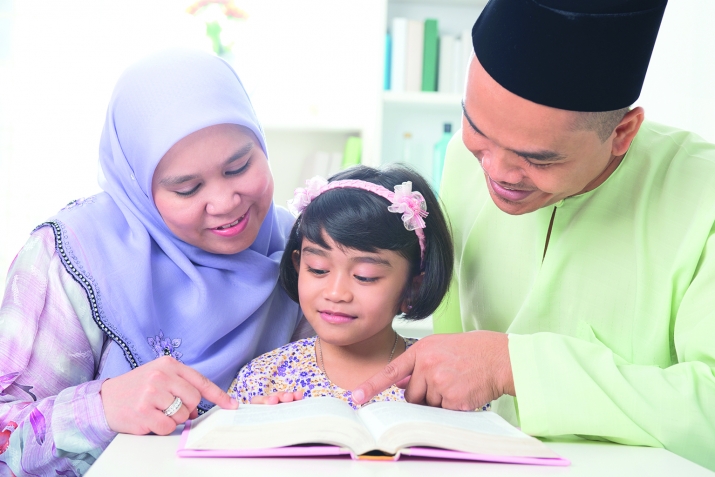
Every parent should start teaching his children about religion from the childhood so as to make them grow up as believers and rich in spiritual and moral values. Here below we would like to share with you the most important questions and answers every person must know.
1. Who are you?
- I am a Muslim.
2. Who do you call a Muslim?
- Those who believe in one God and believe that Muhammad (peace and blessings be upon him) is the Messenger of God and believe that the Holy Koran is the book of God.
3. What is the name of your religion?
- Islam
4. What is the message of Islam?
- La ilaha illallah Muhammadur Rasoolallah. This is called the first Kalima.
5. What is the meaning of this Kalima?
- There is no-one worthy of worship except God, Muhammad (peace and blessings be upon him) is the Messenger of God.
6. When was our Prophet born?
- He was born on the 12 th of Rabbi-ul-Awwal (approx. 20 th April 571 A.D.).
7. Where was our Prophet born?
- He was born in Mecca.
8. What is the name of the Holy Prophet’s father?
- It is Hazrat Abdullah (may God be pleased with him).
9. What is the name of our Holy Prophet’s mother?
- It is Hazrat Amina (may God be pleased with her)
10. What is the names of our Holy Prophet’s grandparents?
- Our Holy Prophet’s grandfather’s name was Abdul Muttallib and his grandmother’s name (maternal) was Wahub.
11. What is the reason for believing in the Holy Prophet?
- The reason for believing in him is that he is a true Prophet sent by God the Most High. Believe in this, believe in every word of our Holy Prophet, love him and never disrespect or speak or think badly about him.
12. What is the Holy Koran?
- The Holy Koran is the book of God.
13. How do we know that the Holy Koran is God’s book?
- There has never been a book that someone could create which was anything like the Holy Koran; this then proves that the Holy Koran is the book of God. If the Holy Koran had been written and created by someone other than God then it would have been easy to create something similar, which, of course, has not been possible.
14. Who was the Holy Koran revealed to?
- It was revealed to our Holy Prophet Muhammad (peace and blessings be upon him).
15. Was the Holy Koran revealed all at once, or in parts?
- It was revealed bit by bit according to the need of the people.
16. Over how long a period was the Holy Koran revealed?
- It was revealed over 23 years.
17. How was the Holy Koran revealed?
A) Angel Jibreel (peace be upon him) revealed chapters and verses to our Holy Prophet, by the grace of God the Almighty. Our Holy Prophet (peace and blessings be upon him) memorized these passages and repeated them to the people. These people then memorized these passages and wrote then down.
18. What is preached in the Holy Koran?
- Everything is in the Holy Koran, i.e. regarding everything in all walks of life and the hereafter.
19. Why was the Holy Koran revealed?
- To show people the right way in life. So people can recognize God the Almighty and his Holy Prophet (peace and blessings be upon him) and so that they can live life in a pure way.
20. Who is Jibreel (peace be upon him)?
- He is an angel who brought messages (wahi) from God the Almighty to the Prophets.
21. What are Angels?
- They are created from light (Nur) by God the Almighty; they are neither male nor female. They do not eat or drink. They worship God constantly.
22. Why are human created?
- They are created to worship God the Almighty.
23. How do Muslims worship God?
- They worship God in the following ways:
a) They pray Namaz (Salat)
b) They fast during the month of Ramadan.
c) Rich Muslims offer Zakat (charity) to the needy Muslims.
d) They perform pilgrimage (hajj)
24. What is the best from of worship?
- Namaz (Salat) is the best form of worship.
25. What is Namaz (Salat)?
- Namaz (Salat) is a form of worshiping God the Almighty which is performed a certain way. A person praying Namaz stands facing the Qibla (Holy Ka’aba), they recite verses from the Holy Koran and bow down before God. They praise God, and they send blessings for our Holy Prophet (peace and blessings be upon him).
26. How many times a day do we pray Namaz?
- Namaz is prayed five times a day.
27. What are the names for these five Namaz?
- Fajr, Zuhr, Asr, Maghrib and Isha.
28. What is the process called when one washes their hands, face, feet and pass water over their hair?
- This process is called wudhu (ablution)
29. How is wudhu performed?
- Wudhu is performed in the following way:
a) Say Bismillah then perform Miswak, a five inch wooden stick, by rubbing this over your teeth: if this is not available then use your index finger.
b) Wash both hands up to your wrists three times (first right then left).
c) Then perform a gargle by washing your mouth out three times (using your right hand).
d) Then pass water into your nose with your left hand little finger in right nostril and left hand thumb in left nostril, this is done three times.
e) Wash your face thoroughly by gathering water in both your palms (form a cup) and start at top of your forehead where there is hair to the bottom of your chin; this is also done three times.
f) Wash your right arm up to and including your elbow, and ensure water passes through your fingers and pass your arms and not the other way round. Perform this three times and do same to your left arm three times.
g) Perform masah (wiping) by wetting your fingers on both hands and then using three fingers (small, next and middle) on the both hands rub over your hair from forehead to back of neck. Use your index finger in each hand to clean your ears (right finger to clean right ear and left finger to clean the left ear). Use your thumbs to clean back of your ears. Clean each side of your neck by passing the back of your hand over it. This masah is only done once.
h) Wash your feet up to and including the ankles making sure that water passes every gap between your toes. Perform this three times with the right foot and then the left.
i) Look up to the sky and read the supplication after ablution and the Sura lnna Anzalna.
30. What is the purpose of wudhu?
- The purpose of wudhu is to ensure that you clean all parts mentioned, and it is important that you get plenty of water over the parts that you are washing.
31. If a part of your body, that you are washing whilst doing wudhu gets wet, but water does not drip from that, then does that wudhu count?
- No, if this happens wudhu will not count. As well as wetting certain parts of your body (as mentioned). water must drip from those parts.
32. At the time of Namaz, a man stands and calls people to prayer, what is this called?
- This called the Azan.
33. What do you call a person who proclaims the Azan?
- He is called a Mu’azzin.
34. When everyone prays Namaz together what is this called?
- When people who pray Namaz together this is called Jamaat.
35. What do you call the person who leads the Namaz?
- The person who leads the Namaz is called an Imam.
36. After Namaz, what do people pray whilst counting on their fingers?
- They pray, Subhanallah 33 times, Allhamdulillah 33 times and Allahu Akbar 34 times. There is a lot of sawab (reward) for praying this.