

Let the month of Ramadan change us forever
Let the month of Ramadan change us forever
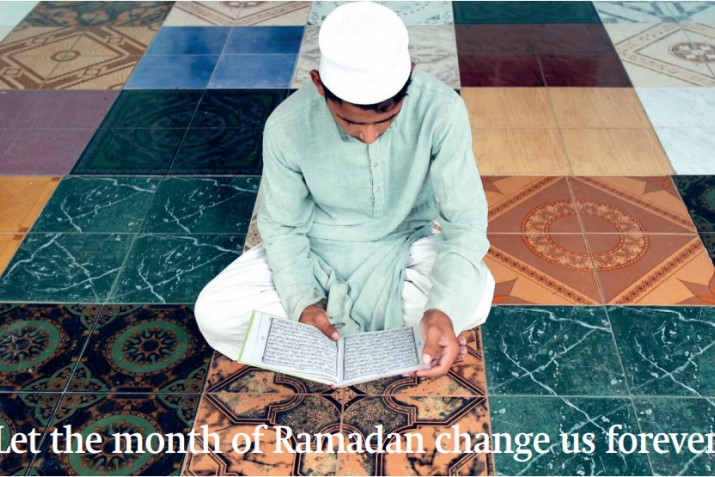
The month of Holy Ramadan once again has entered our lives. Muslims all over the world are fi lled with great joy and pleasure. They are all geared up to inhale the fragrance of the blessed month.
Ramadan is one of the most sacred Muslim religious festivals that is widely celebrated all over the world. The most distinctive feature of this sacred month is the concept of fasting which is the third pillar of Islam.
Muslims become more practicing and religious during this blessed month than at any other time of the year. During the sacred month people all over the globe devote time only to the worship of Allah and the obeying of His commands. During this special month we try to become closer to Allah mentally and physically.
We feel a wonderful sense of peace and satisfaction in our hearts because we feel a deeper sense of awareness of Allah during this blessed month than we do throughout the rest of the year. It truly strengthens our spiritual vigor and shapes our moral bearing.
Are we only bound to do good deeds during the month of Ramadan? And during the rest of the year is there no need to remember and worship Allah and are we are free to commit all kinds of misdeed? Is it really proper for us to behave in this way?
In reality, we become overcome by our habitual routine as soon as the month comes to an end. We return to normal life in terms of our daily habits such as eating and drinking. But we also indulge in committing sins and disobedience to Allah without having learnt any lessons from the month of Ramadan.
It is unfortunate to find that some people worship by doing righteous deeds only during the holy month. They strictly perform their five daily prayers, recite the Koran, behave well with friends and relatives and give charity. But as soon as the month of Ramadan comes to a close, they grow lazy in their worship. Sometimes they even abandon their obligations entirely.
Sadly, most engage in their erroneous activities even during Ramadan just after the evening Maghreb prayer, such as watching forbidden TV programs, telling lies, hurting others, using abusive language, backbiting and so on. People think that they are bound only while they are actually fasting and that after breaking the fast they are free.
Most Muslims are occasional worshippers who only acknowledge Allah on certain occasions or at times of calamity and distress, after which there is no further obedience or worship.
When will one learn a lesson and change for better, if not during the month of Ramadan? How terrible it is that people acknowledge Allah only during the month of Ramadan while being oblivious of Him throughout the rest of the year!
Ramadan is a time to correct and change habits that we have acquired over the year. It gives us an opportunity is to train and inculcate in ourselves piety and devotion to goodness for the remainder of year and in the life to come and to forever edify us in truthfulness and righteousness.
In fact, Allah has provided us with this most blessed month of Ramadan as a mercy when we can train and develop ourselves and improve ourselves as Muslims in order to gain the fear of Allah and become closer to him.
Thus it is the chance for us to gain forgiveness of all of our sins and freedom from the torment of the grave and of the fire of hell whose fuel will be men and stones. This month is to make us practicing Muslims everyday of our lives and not just for a single month of the year in Ramadan.
This is a month of reformation and self reflection, when a believer can ponder over spirituality and piety and bring a change for the better. The Prophet of Allah (peace and blessings be upon him) has clearly stated, “For whoever does not abandon lying and evil actions, Allah is not in need of leaving him his food and drink” [Narrated in Sahih al Bukhari].
However, it is Allah’s mercy that He wants each and every person to reject those things which will lead him to hellfire. By controlling one’s desires throughout this month it is expected that one will be able to control oneself throughout the rest of the year as well.
The noble month is a true school of transformation in which we should try to change actions, habits and manners that are in variance with the laws of Allah.
Muslims should make Ramadan an opportunity to turn over a new leaf by repenting, turning to Allah, persisting in worshipping Allah and always being aware that Allah is watching us at every moment.
The end of Ramadan reminds us of the closeness of death and the saying of the Prophet (peace and blessings be upon him), “Live in this world like a stranger or a passerby”.
Ibn Umar (may Allah be pleased with him) used to say, “If you wake up, do not wait for the evening, and if you reach the evening, do not wait for the morning. Take advantage of your good health and your life.”
In fact, the dearest of deeds to Allah are those that are continuous, even though they be small.
The Messenger of Allah (peace and blessings be upon him) said, “O people, you must do whatever you can of good deeds, for Allah does tire until you get tired. The most beloved of good deeds to Allah are those which are continuous, even if they are small.”
This firm stance should continue from one Ramadan to the next, because the Prophet (peace and blessings be upon him) said, “From one prayer to the next, from one Ramadan to the next, from one Hajj to the next, this expiates for whatever (sins) were committed from one to the next, so long as you avoid major sins.”
We should not forget that Allah has blessed us with this pious month and Allah has blessed us with giving charity, Allah has blessed us with fasting and Allah has blessed us with dua which are accepted.
Since Ramadan is the month of mercy, forgiveness and freedom from fire, we must nurture these good deeds and always obey Allah and do not let them be annulled by bad deeds.
May Allah grant us the ability to change ourselves for the better during this blessed month and not be among those who are denied His Mercy and Forgiveness! Indeed He is the One who Hears and He is the One who Responds.
MARYAM HEDAYAT
