

A unique corner of the world: Yemen
Yemen (officially the Republic of Yemen) is an Arab state in Southwest Asia, located in the south of the Arabian Peninsula. The population, according to the results of the 2011 census, is more than 25 million people; the territory is 527,970 square kilometres. The capital of the state is Sana’a. The state language is Arabic. The vast majority of Yemenis are Muslims (99%).
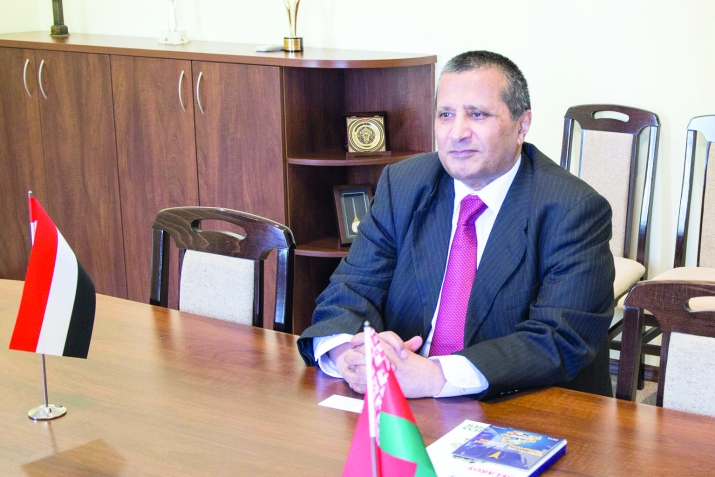
Here below we would like to share with you a recent interview with the Ambassador of the Republic of Yemen to the Russian Federation, Ahmed Salem alWahishi.
- Assalamu aleikum, Mr. Ambassador! We are very grateful to you for taking the time to talk with us during your busy work schedule. Our readers will be very interested in learning more about the Republic of Yemen and its people.
- Wa aleikum assalam! I am very pleased that you do not forget us in the difficult political situation we have in our country.
The Yemeni people have their own history and civilization. It all started with the formation of the ancient state of Saba, which existed from the end of the 2nd millennium BC up to the end of the 3rd century AD in the southern part of the Arabian Peninsula, in the territory of current Yemen (at the very beginning of its history the state had a colony in Ethiopia).
The heyday of the kingdom fell between 900 and 450 BC. Saba served as a transit point in sea trade: it imported goods from India and East Africa and then caravans went from there to Mesopotamia, Syria and Egypt. Along with the transit trade, Saba received income from the sale of locally produced incense.
The Sabean civilization is one of the oldest in the Middle East. Apparently it arose due to the migration of the Sabaeans from northwestern Arabia, associated with the formation of the Trans-Arabian Way of Incense.
The earliest reference of the Sabaean kingdom dates back to the 8th century BC, and the beginning of its heyday was during on the 7th century BC. A huge dam was built near Saba, that helped to irrigate a vast, previously barren territory to turn the country into a rich oasis.
- Please describe the nature of Yemen. What is it famous for, and how many tourists visit your republic?
- If we are talking about nature and the landscape, then Yemen is a mountainous area, but at the same time it is a very fertile land thanks to the combination of sunny and rainy weather. I do not mind saying that all the fruits that exist in the world are grown in our republic.
We have a great variety of grape. And, particularly, I want to note our coffee, which is considered the best in the world. It is our famous brand “Mocha Coffee”.
- Mr. Ambassador, I think our readers will be interested to learn more about Yemen’s coffee ...
- Yemeni coffee is rare, and therefore very expensive, but the cost is justified by its high quality. It is still considered one of the best, and thus Yemen became the world’s first supplier of the product. The world knew only Arabic coffee until the end of the 17th century, and only then the New World began to establish its own plantations. From the homeland it was transported to Turkey through the port of Mokha (Al-Mukha), whereafter the cargo was sent to Europe and America. According to legend, Sheikh Shaddi considered the commercial part of coffee and began to expand the plantations. Trade communication went through the very port of Mokha (its name was imprinted on the bags), so the Europeans began to call the goods that arrived “Mocha coffee”.
- Could you, please, point out other sights of Yemen to surprise and delight the readers.
- Socotra, the island of happiness, is one of the most isolated places in the world. First of all Socotra Island is interesting for its nature; you will never find the same anywhere else. Moreover it is very difficult to get there: planes do not fly there, and ships also do not sail there because of Somali pirates.
I can also tell you about the city of clay skyscrapers in the Shibam Desert. It was built upon the rocky spur, near the border of the connection of several rivers; from three sides the city is surrounded by date groves. Shibam was built in a limited area, and therefore was forced to grow not in breadth, but upward.
There are about 500 mud skyscraper houses in the city, and most of them appeared in the 16th century. Most of them have from five to eight floors and a height of up to 30 metres. The buildings are built close to each other to provide shade and protection from the desert heat. All the houses are located inside a huge city wall made of mud bricks.
The peculiarity of the architecture of these buildings is that their walls at the base are no more than a metre thick. On the ground floor there are storage rooms without windows; flat roofs are whitewashed, so as to make it cool inside the house.
Shibam was once an important city on the caravan routes: there was a large trade in dates, fabrics and incense. Today, the city mainly depends on tourism. Shibam is listed as a UNESCO World Heritage Site.

- Indeed, the world is diverse, and Yemen can be called a unique place on the planet. Mr. Ambassador, what connects our countries and what are the prospects for cooperation?
- Yemen was one of the first states in the Middle East to establish diplomatic relations with the USSR. The signing of the Treaty of Friendship and Trade between the USSR and the Kingdom of Yemen took place in Sana’a on November 1, 1928.
I was fortunate enough to write a book about the history of relations between Republic of Yemen and the Russian Federation. It is called “Yemen and Russia: 90 years of friendship”, it was translated at MGIMO (Moscow State Institute of International Relations). I described in the book how your country helped to build seaports, airports and roads in Yemen.
There is a proverb that says: “Do not give me a fish, rather teach me to fish.” And your country has educated a lot of personnel for us, who became good specialists in the food and military industries and technical areas. By the way, our president is a graduate of one of the Moscow military academies.
There are a lot of works of your poets and writers that have been translated into Arabic and published in our country. In particular the works of Rasul Gamzatov are freely available. We also have a lot of mixed marriages between Yemenis and Russians. As for the prospects for cooperation, we have a great many of projects that, I hope, will come true.
- What would you wish to our readers?
- Of course, a wish for peace and security. Our people remember the heroic deeds of your people during the Great Patriotic War. They did it not only for your state but rather for the whole world!
RUSLAN MAGOMEDOV
