
Killing time is killing yourself
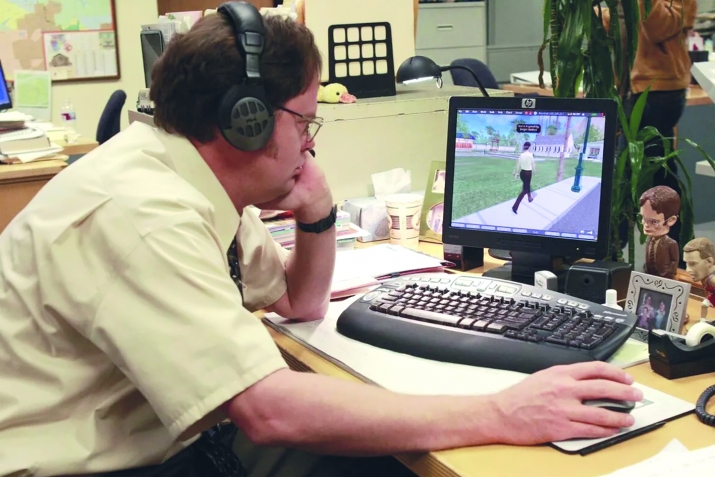
What is the origin of sin? Youth and leisure. A person who is young and carefree person surely starts to sin.
The Koran has an ayah about the Prophet Yusuf (peace be upon him). An official’s wife fell in love and harassed him. Other women found out that. What was wrong with that woman? This happened to her because she was idle and carefree. Therefore, we should not neglect our daughters. They must always be busy doing something. If there is no work, let her learn foreign languages, computer skills, needlework, driving; although we are not used to women drivers. She must be occupied with something useful. You can never leave a woman without work, for idleness is the source of all sins and all shortcomings. Our Ummah was built by the people who valued time, by the scholars, who wrote books day and night.
How many companies, factories, enterprises were in the red because their workers neglected their duties or did not show up at work! It happens so, that out of 8 or 6 hours of a work day a person works only 15 minutes. The rest of the day is just chitchat, browsing magazines, etc. Do you think this man will not be punished for getting the salary he did not earn on the Judgment Day? He earned money only for those 15 minutes. On the Judgment Day he will have to account for the money paid for the hours he did not work. Do not assume this money is Halal (permissible), this money may be forbidden (Haram). Time should be appreciated, especially in youth. At an old age a man no longer has the same strength and he cannot do what he did in his youth.
One day a person saw an old man coming into a mosque with his staff. Children ran up and entered the mosque before him. When he saw these children, he began to cry. Then the man asked him: “Father, why are you crying, what happened?” He replied: “I am crying because in my youth I did not go to the mosque, did not appreciate prayer. I see these kids running into the mosque and I cannot return this time. It hurts and I cry.”
A religious person surely values time. If a person does not value time, it means he is not pious and religious enough. Some people just kill time. Young people commit wrongdoings out of idleness, they call it ‘killing time’. What they kill is not time, but themselves. They will pay a bitter price for that on the Judgment Day.
What are their current problems? Everybody is crazy about mobile phones: what screensaver one has got, what one downloaded or did not download, etc. they are mostly concerned about these phones, chatting, texting, etc.
I want to point out the people in our history who have been the light of the Ummah, who illuminated our Ummah, built it and who valued time. There was a great scholar Al-Muhasiby, who said, “I wish that time could be acquired with money. If so, I would buy time… so that I could spend it serving God.” When he was asked who he would buy time from, he sai,: “From wasteful and ungrateful people.”
There was a well-known scholar, Imam al-Nawawi. He died at 40, never married and wrote 500 works. He spent most of his time writing books. He said that he ate and slept only when he was totally exhausted. Once he was doing science and writing a book. His mother cooked him a meal and said, “Son, I made a meal for you to eat”, he said, “Mother, I cannot, I am very busy.” Then his mother came up to him and fed him. He did not even notice this. By dawn he had finished his work and said, “Mother, what about food?” She replied, “Son, I fed you.” He said, “By God, I did not notice that.”
There was a scholar Ibn al-Jaza. One day a man stopped him and said, “Let us play a game”, and described the rules. The scholar replied, “Stop the sun instead, these games are not for me.”
Ibn Aqil wrote a book composed of 800 volumes. No such book had ever been written in the history of mankind. And when Ibn Aqil was 80 years old, he said, “By God, I feel the same energy and determination as at 20.” He said, “Truly, I do not eat as you do.” They asked him, “How do you eat?” He replied that he took a piece of bread or wafer, moistened it with water and ate it very quickly. Moistened food does not need thorough chewing. Hence it did not take time and he practically swallowed it. He was unwilling even to spend time on chewing.
The history of Islam has seen very young people who, nevertheless, reached very high. For example, the Prophet (peace and blessings be upon him) appointed his 16-year-old Companion Usama bin Zayd a general and the commander of the army, which consisted of experienced Companions. The Prophet (peace and blessings be upon him) said that he was even worthy to be the ruler.
Muhammad Al-Fatih was a famous leader of Islam, who conquered Constantinople at 23.
Our master Sa’d bin Ma’az, a Companion of the Prophet (may God be pleased with him) accepted Islam when he was 30 and died at 37. When he died, the Prophet (peace and blessings be upon him) said, “Indeed, the throne of the Almighty shook when Sa’d bin Ma’az died.” What special deeds could Sa’d bin Ma’az (may God be pleased with him) do, after he accepted Islam at 30 and before he died at 37? How did he manage to make use of time so wisely, that his death shook the throne of God? When the Companions of the Prophet (peace and blessings be upon him) carried him to the cemetery, they wondered why he was so lightweight, and the Prophet (peace and blessings be upon him) said, “Indeed, the angels were carrying his body, which is why you did not feel the weight.”
Our master Umar Ibn Al-Khattab (may God be pleased with him) said these famous words about the value of time, “When could I sleep, oh Umar? If I sleep during the night, I will not fulfill my duties towards my Lord, and, if I sleep during the day, I will not fulfill my duties towards my people!”
When the great scientist Abu Yusuf, a student of Imam Abu Hanifa, was on his deathbed, he fainted. Then he woke up and called his student, “Let us discuss with you a Sharia question: what do you think is the best way to perform the Hajj, on foot or riding a horse?” The pupil was bewildered, “Teacher, this is not the best time!” meaning he is on his deathbed. Suddenly, Abu Yusuf became indignant and said, “By God, even if a single moment of my life was left, I would spend it serving Muslims!”
The history of Islam is full of stories about Islamic scholars, who spent their lives writing books. There were those who wrote 2000 books. There was Imam al-Ghazali and others who wrote plenty of books. It was these people who helped to build the Ummah, which lasted 1,400 years. Unfortunately, the last 100 years, the Ummah has been a society of people who do not progress, develop the Ummah or give it impetus. We live only by the efforts of these great men. Even if there are young people who allocate their time for the worship or try to comply with the Shariah, they still do not value time.
One day a scholar was approached by two young men. Apparently, they were footballers or fans. They asked him a question, “Is it permissible when playing football to expose the Awrah (intimate parts of the body, for both men and women, which must be covered)?” The scholar replied, “My children, the Awrah of Islam has already been uncovered for years.” Thus he talked about the priorities that exist in Islam and need more attention.
When fasting, young people can sleep the whole day. Why? To kill time and not to feel hungry. It is also wrong. Every minute spent in vain is gone forever, and they will be very remorseful on the Judgment Day for having wasted allotted time.
The Prophet (peace and blessings be upon him) said, “The most excellent fast after Ramadan is in God’s month, Al-Muharram, and the most excellent prayer after what is prescribed, is the prayer during the night (Tahajjud Prayer).” The Prophet (peace and blessings be upon him) said that fasting on the Day of Arafat washes away the sins of the last two years, and every day of fast in Muharram is equal to 30 days of fasting. The 10th day of fasting is the day of Ashura and it is also advisable to fast on this day, as it also washes away the sins of the past. Also on this day, breaking fast after the sunset should be a celebration and it is desirable to cook a plentiful meal for the family.
Let the Almighty fill our hearts with the love for time. May God make us value time. Of course, we cannot be like Imam al-Nawawi or Imam al-Ghazali. The times are different and we are very weak. But we cannot sit in front of the TV for several hours in a row. We can spend at least an hour reading every day. We can be good professionals in our field and update our work skills. If every person evolves and pursues knowledge, the Ummah will recover and will not lag behind other world communities.