
Mosques of the Baltic Tatars: Six Centuries of Islamic Worship in North-Eastern Europe
“The mosques remind us of what we are, of what we have gone through.”
The late 14th century was a time of great upheaval in southern Eurasia – in the lands where the Khans of the Mongol Golden Horde had developed a remarkable urban/steppe civilization. In 1395, Amir Timur invaded much of the Caucasus, vanquished Khan Tokhtamish on the River Terek and proceeded to ravage the Golden Horde cities of the lower Volga. Out of this disruption of Mongol hegemony, arose the opportunity for a khanate to be established centred in the Crimean peninsula but also ruling large areas of the steppe from the north-western periphery of the Black Sea to the Caspian.
The first khan of the Crimean Khanate, Haci I Giray (1397-1466), however, was not born within its territories but far to the north - in Trakai in the Baltic region in what was then the Grand Duchy of Lithuania. Ruled by Grand Duke Vytautas (1350-1430), this powerful state stretched from the Baltic to what is today the southern Ukraine and it was with Vytautas’ military support that Haci I Giray was eventually to gain control of the Crimea. In Vytautas’ conflicts with his neighbours, particularly the aggressive Christian Teutonic Knights to the west, a group of Tatar warriors from southern Eurasia had joined him. In gratitude, Vytautas rewarded them with land stretching from Trakai (his capital near modern- day Vilnius) south to what is now the Polish city of Bialystok in the west and the Belarusian capital of Minsk in the east, with freedom to practice their Islamic faith and customs – a freedom extended to all other faiths as well, Jewish, Karaite, Catholic, Protestant and Orthodox Christian. The Tatar community grew and flourished, becoming an integral, productive and honoured part of the society of the Polish-Lithuanian Commonwealth, the political entity which succeeded the Grand Duchy and which lasted until the late 18th century until partitioned between Russia, Prussia and Austria.
In the forested lands of this part of the Baltic region, the Sunni Lipka Tatars (‘Lipka’ - ‘Lithuania’) established their villages and simple wooden mosques, whose forms and materials replicated those of similar areas in Tatar homelands in the south-east Balkans (Thrace or Rumelia as this was known to the Ottomans) and the northern Anatolian periphery of the Black Sea. Because of the nature of the readily available materials from which it was made, this Muslim vernacular architecture shared many features with the indigenous wooden architecture of the Baltic.
A manuscript of 1558, the “Risale-i Tatar-i Leh” (‘Leh’ was the Ottoman name for Poland- Lithuania), composed inthecourt environment of Sultan Suleiman I the Magnificent (1495-1566) by three Lipka Tatars undertaking the Hajj pilgrimage, documents their perception of their modest mosque architecture, its origins and the local particularities of their worship:
“For one who has had the good fortune to see the magnificent shrines of the Sublime Porte (Istanbul), it is a sad task to describe our sanctuaries of prayer … Instead of those magnificent mosques, whose vaults reach the heavens, minarets lost in the azure heavenly spheres, whose pillars, like burnished mirrors, reflect the most beautiful objects, whose cloisters and courtyards are orchards, their pavements adorned with the most sumptuous patterns … here our mosques are poor and lowly, built of wood, similar in form to some of the mosques of Rumelia, without minarets or imarets, although in every large city (in our land) there are mosques … Ezan (azan) is called in front of the mosque. In some places, strange in this regard, one of our community walks through the streets calling out that it is time for prayer. In these mosques there is a special place in the form of a chamber (reserved) for women, which is separated from the men, and where (the men) are not allowed to enter, so as not to violate the law that prohibits (men) from praying with women … the creation of grander mosques is quite difficult here, for it is illegal to build new mosques without the approval of government.”
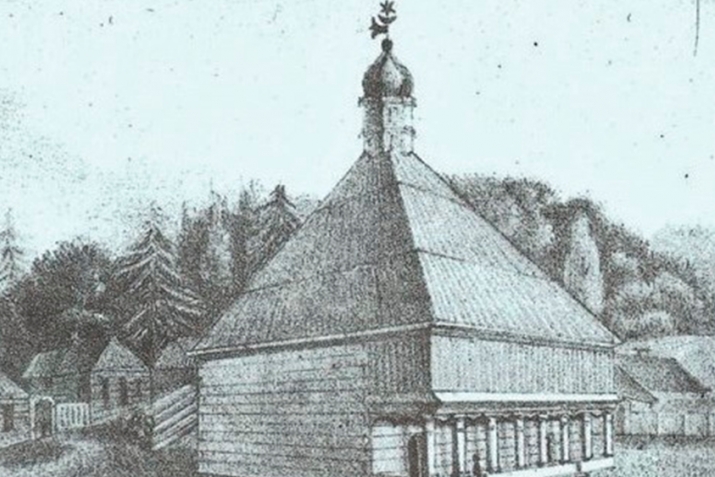
The earliest depiction we have of a Baltic Tatar wooden mosque is an 1830 print of the ‘mecete’ of Lukiskiu, a village founded in the 16th century which later became incorporated within Vilnius. It was replaced in 1867 by another mosque which was razed to the ground in 1940.
The image provides enough detail of form and of its sawn log wall construction to confirm the above statement of the relationship of Lipka Tatar mosques to those in Rumelia/Thrace. It is clearly an antecedent of later surviving Baltic mosques.
While retaining their Muslim beliefs, by the 18th century the Lipka Tatars had lost their original Kipchak language, adopting the languages of the larger communities within which they lived, (although they did write Polish and Lithuanian in Arabic script). The 19th century Tatar Orientalist, Muhammad Murad al-Ramzi, described the situation thus, “It came pass that the “spiders of forgetfulness” spread their webs over their customs and their tongues with the passing of the ages. Yet, despite that, they have never lost their faith in Islam, though they have no scholarly knowledge of their faith.”
After five centuries during which dozens of Muslim communities were established in the region, the period of the late 19th and first decades of the 20th century was one of considerable poverty in this area of the Baltic, compelling many of all faiths to emigrate, many to the United States of America, where Lipka Tatars were to establish the oldest surviving mosque in America in Williamsburg, Brooklyn in 1931. Many Muslims remained, however - in the 1920s about 6,000 believers were recorded in nineteen communities, worshipping in seventeen mosques. In 1925, they established the Muslim Religious Association and the Cultural and Educational Union of Polish Tatars which endeavoured to unite all Muslims in Poland and support social and cultural activities. In 1930, a unique mosque of masonry construction (in a hybrid Ottoman-Mamluk style with dome and minaret) was also built at Kaunas in Lithuania to commemorate the 500th anniversary of the death of Grand Duke Vytautus.
The situation dramatically changed as a consequence of World War II. As a result of the shifting of Poland’s eastern border, most Tatar settlements remained within the Baltic territories annexed by the Soviet Union. In accordance with the Soviet administration’s anti- religious ideology, much which was materially representative of Tatar Islamic culture - its mosques, its graveyards and its libraries - was destroyed. The mosque at Kaunus (the seat of the Mufti) became used as a circus. In the absence of forbidden religious leadership, it was up to mothers to teach their children about their faith. Throughout this difficult time, the Tatar mosque in far distant New York city was seen as a sole, reassuring beacon of their faith by Baltic Muslims.
By the time the independence of the Baltic states was restored in the early 1990s, the Islamic faith community had survived – but most of its traditional wooden mosques had not. Lithuania now has just three historical mosques (in the villages of Keturiasdesimt Tatoriu, Raiziai and Nemezis), Poland two (in the villages of Kruszniany and Bohoniki) and Belarus two (in the villages of Navahrudak and Iwie) - all communities relatively close to one another.
In Lithuania the Muslim community of Keturiasdesimt Tatoriu (“Town of the Forty Tatars”), near Vilnius, was mentioned for the first time in 1558. The mosque serving its Tatar population today is the oldest functioning place of Islamic worship in the Baltic region and its cemetery contains the oldest identifiable Lipka Tatar grave: Allahberdi was buried there in c. 1621. Its streets are laid out like an ancient Tatar military encampment. Nearby Raiziai is an important centre for Lithuanian Tatar festivities. It was founded in the 15th century and a mosque was reported there in 1556.

The current mosque, which was the only one permitted to function throughout the Soviet period, is of later construction: inside is a rare Tatar wooden minbar dating from 1684, formerly in the village of Bohoru. Also nearby is the village of Nemezis. Its mosque, built in 1909, was used as a storehouse for arms and ammunitions during the Soviet era and is the most ornate of all surviving Baltic Tatar mosques. A mosque has stood there since the 17th century.
In rural north-eastern Poland just across the border, the interiors of both the mosques of Kruszniany and Bohoniki continue to display their original construction (whereas most of the other Baltic mosques have been covered internally and externally with later woodwork paneling and window framing). Each structure has men’s and women’s prayer rooms with high ceilings and gallery separated by a wall. The mosque of Kruszniany has a rectangular plan with two square towers at its north end and was likely built in the late 18th century though refurbished in the 19th. It has recently been restored. The current mosque of Bohoniki with its square plan and high cupola was built in the 19th century - a mosque is recorded there as early as 1717. Both buildings lack minarets: Lipka Tatars traditionally did not call the azan from on high, a custom already reflected in the 16th century “Risale-i Tatar-i Leh”.
However, one of the two surviving wooden mosques in Belarus, that of Iwiye built in the 18th or 19th century, is unique in having a minaret at the peak of its roof instead of the lantern which was a common feature of Baltic wooden mosques. The village was founded in the 16th century. The mosque of Navahudrak was the largest in the region, became a residential building during the Soviet period (it also had a minaret which was destroyed), and was re- opened in 1997.
Following the restoration of independence to the Baltic states, these seven surviving mosques became foci of Lipka Muslim religious observance, festivities and culture. Although today’s Lipka Tatar population represents only a minute percentage of the overall populations of Lithuania, Poland and Belarus, today these places of worship are respected and visited as important components of the Baltic cultural heritage as a whole. In particular they are perceived as important symbols of religious tolerance towards all faiths manifested by the Grand Duchy of Lithuania over six centuries ago (when religious strife was rampant in other parts of Europe) and to which ideals the modern Baltic states continue to aspire.
Perhaps the most poignant symbol of the ecumenical co- existence of which the region was capable is a lone tall Ottoman-style masonry minaret still standing in the Lithuanian town of Kedainiai – the sole relic of a mosque built there in 1880 by a local Russian Imperial Army general, Edouard Totlesau, for his beloved Turkish wife to pray in. A plaque at the base of the minaret bears an inscription in Arabic from the Koran: «Who is it that can intercede with Him except by His permission?” (Koran 2:255).
GUY (GHAYDAR) PETHERBRIDGE PROFESSOR, EXPERT ON CULTURAL HERITAGE AND HISTORY OF ISLAM, AUSTRALIA, RUSSIA