

Sheikh Abdullah Quilliam, the Liverpool Muslim Institute and the Caliph
Sheikh Abdullah Quilliam, the Liverpool Muslim Institute and the Caliph
The scene was the St. George’s Great Hall in early 20th century Liverpool, Britain’s second-largest port after London. In this most impressive of all architectural symbols of British power an imperial pageant was taking place. A slight, turbaned English gentleman in long robes was standing beside Liverpool’s Lord Mayor to officially greet foreign dignitaries: maharajas, royalty and world leaders. He was Sheikh Abdullah Quilliam Bey Effendi, appointed as the first Sheikh-ul-Islam and leader of British Muslims by the Caliph and Ottoman Sultan Abdul Hamid II.
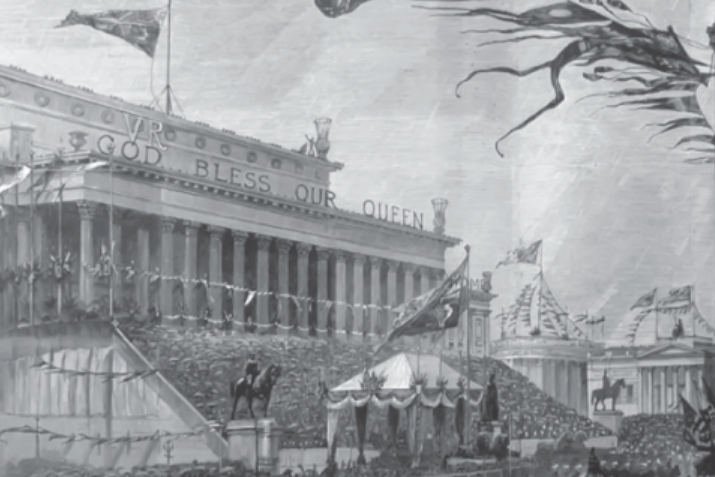
Something most unexpected was about to happen. As a local newspaper reported, “Hundreds of guests had gathered in the Great Hall, in the Empire building, including foreign [Indian Army] troops. When they saw him, the whole regiment rose and offered him – not the British military salute – but the Islamic “Allah Akbar, Allah Akbar”.
The British Sheikh officiating at the imperial civic reception in Liverpool and so spontaneously applauded by Muslim soldiers was born as William Henry Quilliam in 1856. He was brought up as a devout Christian and became a nationally-prominent solicitor specializing in criminal law.
In 1887, he converted to Islam, taking the Muslim name Abdullah. He described the circumstances prompting his conversion thus, “… my doctor advised me to take a rest for the sake of my health and to spend some time in Gibraltar. After I had arrived in Gibraltar, I boarded a ship to Tangier to see the lands of Morocco. While I was on the ferry, I saw some Moroccan Hajjis scooping up water from the sea and using it carefully and scrupulously to wash themselves. The ship set sail and as soon as it left the port, these Hajjis stood neatly together in a line and started to do the prayer, in full submission and tranquility – they were not at all troubled by the force of the strong wind, or by the swaying of the ship. I was deeply touched by the look on their faces and their expressions, which displayed complete trust and sincerity. I was intrigued and became very interested to acquire knowledge and learn about their religion and those who believe in it.”
Following his conversion, Abdullah Quilliam started holding lectures on Islam in Liverpool and in 1891 he used funds from by the Emir of Afghanistan to buy three adjoining houses in Brougham Terrace, Liverpool to accommodate the Liverpool Mosque and Muslim Institute.
There an area.
The Liverpool Mosque, however, although a modest space in an adapted building, was the first in Britain where Muslims (mainly English-speaking) regularly performed heir devotions. Friday prayer sermons were held in both English and Arabic. While prayers and prayer times were strictly according to the Shariat, Abdullah Quilliam also organized other gatherings which adapted the devotional practices of potential Christian converts to an Islamic context. The Koran was read in English and Abdullah wrote hymns with an Islamic message but in a conventional Christian style which were sung to a harmonium.
The congregation grew with an estimated six hundred conversions taking place over twenty years. While many worshippers were English converts (some were important national figures), the Institute reached out to all Muslims who lived in or visited Liverpool. A local journalist of the time described the mosque congregation as “gorgeously clad Indians, Turks or negroes.”
In 1894, the title of Sheikh-ul-Islam, Leader of Muslims in the British Isles, was formally conferred on Abdullah Quilliam by the Ottoman Sultan and Caliph Abdul Hamid II (1842-1918).

Although the Liverpool Muslim Institute was modest in physical scale, Abdul Hamid II perceived its capable leader, its highly placed converts and its international outreach as key elements in his vigorous campaign to develop the pan-Islamic authority of the Caliphate. The spiritual plight of Muslims in the British Empire was a particular concern to the Caliph, especially those of India who constituted more than half the world’s Muslims and a quarter of the population of the British empire. In 1858 Britain took control of the Mughal Sultanate whose emperors for centuries had fulfilled the role of de facto Caliph for all of India’s Muslims - an obligatory component of Islamic society according to the Shariat. In 1876, Queen Victoria assumed the title of Empress of India – but she was not a Muslim. By the end of the 19th century Indian Muslims increasingly looked to the Ottoman Caliphate to fill the vacuum thus caused in supreme spiritual guidance.
The Emir of Afghanistan and the King of Morocco also recognized Abdullah as the Sheikh-ul-Islam of Muslims in Britain and he was appointed Vice-Consul of Persia by its Shah. His erudition as an Islamic scholar was acknowledged by the title of Alim being accorded him by the venerable Islamic University of Al-Qarawiyyin in Fes, Morocco.
As the congregation of the Liverpool Muslim Institute grew, it established a Muslim college, a library and reading room, a museum and a science laboratory, and provided lectures and evening classes for Muslims and non-Muslims alike. A boarding school for boys and a day school for girls were founded and in 1896 the Medina Home for orphans and unwanted children of any faith was opened. The Institute also undertook social work within the wider local community.
A major focus of the Institute was the dissemination of printed information about Islam through articles in the local press, monographs and two journals, the weekly ‘The Crescent’ and the monthly ‘The Islamic World’, both of which had an international circulation and a significant impact.
Those who knew Sheikh Abdullah well have left us a picture of his personality: “he was a famously charismatic man. Usually he dressed very simply. During his lectures he was like a river of knowledge and learning.” Khalid Sheldrake, an English convert to Islam, wrote, “He was a charming personality, full of wit and repartee, kind and patient. He was known in Liverpool as ‘The Poor Man’s Solicitor’, as on scores of occasions he fought cases for men who were penniless and charged them no fee”. Likewise, he was a strong supporter of poor working women, and was particularly respected for legally enforcing child support from fathers who abandoned them.
While many responded positively to the eloquent calls of Sheikh Abdullah and his co-religionists to the faith of Islam, others expressed their opposition. “As his successes increased, so did the level of harassment. The muezzin was often pelted with snowballs, stones and dirt. Firecrackers were thrown at the mosque and glass ground into the carpets to cut the feet of worshippers. The church and elements of the media in particular were quite antagonistic”.
Eventually Sheikh Abdullah’s activities as a solicitor of English law clashed with his belief in Shariat law. His preferred observance of the Shariat in a technical legal process led to his being barred from practicing law in Britain. He felt honour-bound to leave the country and in May 1908 travelled to Istanbul, the home of his patron the Caliph, never to return to Liverpool. His departure led to the dismemberment of his beloved Institute, although members continued their activities for some time. The building in Brougham Terrace which housed the mosque served as the Liverpool Registry Office until 2002.

Sheikh Abdullah’s arrival in Istanbul coincided with the Young Turk Revolution. In April 1909, Sultan and Caliph Abdul Hamid II was deposed and sent into captivity in Thessalonika. The Young Turks replaced him as Sultan and Caliph with his brother Mehmed V Reshad, who had no real power. Without his patron and no longer entitled to be called Sheikh-ul-Islam, Quilliam eventually returned to Britain under the name of Haroon Mustapha Leon (he changed his surname in response to the terms of an inheritance) to play a part, not as the leader of British Muslims, but less noticeably as a scholar and participant in the life of the Muslim community centred on the Shah Jahan Mosque at Woking near London, the first purpose-built mosque in the British Isles.
The Abdullah Quilliam Society was formed in 1996 to commemorate the Liverpool Mosque and Muslim Institute and to restore the historic mosque. In 1997, a plaque commemorating its founding was unveiled at Brougham Terrace by Patricia Gordon, granddaughter of Sheikh Abdullah Quilliam Bey Effendi, who recalled, “My greatest memory of him is being compassionate at all times, a man of great courage and way ahead of his time and a credit to Islam. He gave me an understanding of human emotions and frailties, in fact a catalogue of everything one would wish to see in us all.”
GUY (GHAYDAR) PETHERBRIDGE
