

Morocco’s Inspiring “Green Mosques” Programme
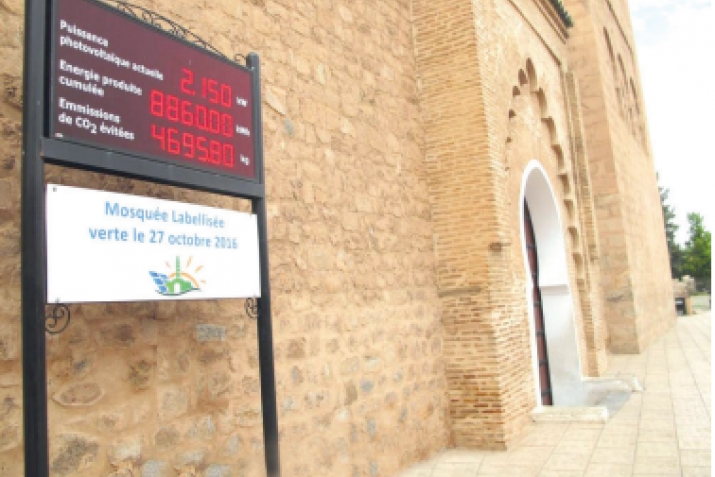
In striving to meet these goals Morocco is becoming a world leader in the integrated application of renewable energy sources and energy efficiency measure. These initiatives are being spearheaded through its pioneering Green Mosques Project in partnership with the German Federal Ministry for Economic Cooperation and Development (BMZ).
In Morocco, as elsewhere in the Islamic world, local mosques occupy a central place both spiritually and practically in the life of their communities. They are hubs, as it were, of social infrastructure, cohesion and collaboration unique public places where people congregate for devotion, guidance, mutual support and acquisition of learning and from whence in turn information and support is disseminated throughout the community at the grass roots level. Metaphorically speaking, community energy flows both in to and out of the mosque.
In our contemporary world with our addiction to buildings lit, cooled and heated through electricity and gas our mosques are significant consumers of energy derived from nonrenewable fossil sources, and add their part to the burdens on society, economy and the environment caused by their use. In Morocco it has been calculated that the average individual mosque electricity consumption is 90 kW a day. Throughout Morocco there are some 51,000 mosques, of which the Ministry of Habous [Waqf] and Religious Affairs is responsible for energy and water in approximately 15,000.
Through the Green Mosque Project Morocco is harnessing the multivalent roles of mosques as community infrastructure hubs to launch its national energy policies into practice. Germany is assisting in both the rationalizing of energy use in the country’s mosques and to make them local centres of renewable electricity generation as a sustainable contribution to Morocco’s energy transition.
The ultimate overall aim is:
- (a) to provide solar power and energy conservation modifications and regimes for all mosques in the kingdom;
- (b) to train specialists in renewable energies and energy conservation; and
- (c) to create a sustainable market for private services in the fields of energy efficiency.

The project was launched in 2014 by the Moroccan Ministry of Energy, Mines, Water and the Environment, the Ministry of Habous and Islamic Affairs, the National Agency for the Development of Renewable Energy and Energy Efficiency and the State Energy Investment Company, assisted by the Deutsche Gesellschaft für Internationale Zusammenarbeit.
In the Green Mosques Project’s first phase, completed at the end of 2016, 100 mosques were audited and equipped with energy efficient technologies. This activity is being complemented by a workshop programme (supported by printed guides) to raise the environmental awareness of some 400 imams, morchidates (madrasa trained male preacher counselors) and morchidines (madrasa trained female preacher counselors 94 took part) and officials in the Ministry of Habous and Islamic Affairs.
Muslim clerics explain to their congregations how green energy works and how energy efficiency and green technologies can go hand inhand with the values of respect, restraint and moderation encouraged by Islam Islamic Shariat precepts and texts already provide a rich platform of believers’ knowledge of our responsibilities to safeguard the planet as stewards of Allah’s creations.
The Green Mosques Project also offers workshops and disseminates information through television and radio programmes. These broadcasts are also aimed at promoting long term consumer demand for new energy technologies and generating further business opportunities for energy service providers.
There were two initial pilot projects: an urban one in which the two largest mosques in Marrakesh (Moulay Yazid and Kutubiyya) underwent comprehensive energy audits and were fitted with energysaving LED lighting and photovoltaic (PV) electricitygenerating solar panels and thermal heating systems and (2) a rural one in the mountain village of Tadmamt not far from Marrakesh where its old mosque was replaced with a new structure entirely built to eco principles.

The 12th century Kutubiyya Mosque (Mosque of the Booksellers) is one of the most esteemed religious buildings in the Kingdom of Morocco. It was chosen as one of the first to be converted because of its public awareness raising potential. While such large religious complexes only fulfill their own energy needs, village mosques like Tadmamt can generate energy in excess of their consumption which can be distributed for a range of communal purposes.
An innovative sustainable business model is being implemented for the practical roll out of the Green Mosques Project. Mosque energy modification is financed by companies investing their own capital to make the buildings energy efficient through a contract guaranteeing energy savings of 40% over a period of 5 years.
The business’ earnings come from these energy savings, which the mosque administration agrees to pay it for an agreed period. Thus the more efficient the building, the more money it earns, while at the same time developing further business opportunities, which in turn boost green job creation.
In November 2016, Marrakesh hosted the 22nd Session of Conference of Parties to the United Nations Framework Convention on Climate Change, whose main theme was ways of mitigating and adapting to the impacts of climate change.
The Green Mosques Project was showcased at this important global conference. Besides implementing the innovative Green Mosques Project the kingdom has constructed the massive Ouarzazate Concentrating Solar Power Station, which is the world’s largest with a total capacity of 2 gigawatts (GW). It has also initiated large wind farm electricity generating projects.

This is happening as perceptions of eco friendly power are also changing across the Middle East. The Islamic world’s first and fullyfledged green mosque, the Khalifa Al Tajer Mosque in Dubai, was opened in 2014 and a programme similar to Morocco’s is now being implemented for all of Jordan’s mosques.
At a critical time when one of the world’s largest energy consumers is no longer supporting the 2016 Paris Climate Accord, Morocco and other Islamic states are pioneering the way to protecting the environment of the planet on which all humanity depends.
GUY (GHAYDAR) PETHERBRIDGE
Professor, expert on cultural heritage and history of Islam, Australia, Russia
