
Adorning the Hajj: Mahmal and Kiswa. Part 1- The Pilgrimage Journey as Sacred Procession
Adorning the Hajj: Mahmal and Kiswa. Part 1- The Pilgrimage Journey as Sacred Procession
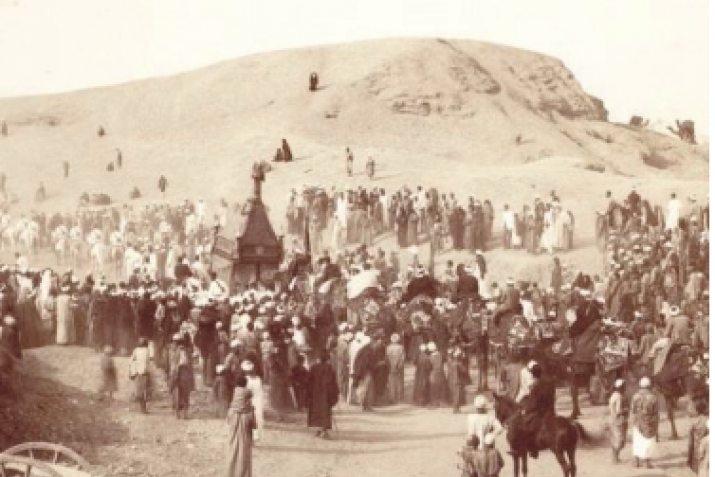
While the religious rites of the Hajj connected with the Holy City of Mecca have not changed since the Prophet Muhammad e made his first and only pilgrimage there in 632, the character of the pilgrim’s journey en route to the Hijaz has changed radically over the course of the last 150 years. Prior to the second half of the 19th century, most Hajj pilgrims travelled to Mecca and Medina from assembly points in Egypt or Syria in great annual pilgrimage caravans organized and subsidized by the supreme rulers of the times.
This two part article examines the mahmal and the kiswa the two principal ritual components of these pilgrimage caravans throughout pre modern times. The mahmal was an imposing elaborately embroidered camel borne palanquin which represented the authority of the sponsoring Muslim ruler and was the principal focal point of the caravan. Under the leadership of a powerful Amir al Hajj, appointed by the sultan to organize and guard the pilgrimage caravan to and from the Hijaz, the mahmal (‘that which is carried’ in Arabic) formally escorted the kiswa fine embroidered textiles which were produced annually to drape and adorn the Kaaba and other important holy places in Mecca and Medina.
Prior to the late 19th century, pilgrims from all corners of the Muslim world first directed their journeys to prominent centres of Islamic authority where great official state caravans were assembled in which participants of all social levels journeyed together to the Hijaz under the ruler’s protection.
Over the course of the centuries these annual caravans left from Damascus, Kufa, Baghdad, Basra, Istanbul and Cairo. After Sultan Selim I incorporated Syria, Egypt and the Hijaz into the Ottoman empire in 1517, two great Hajj caravans left each year, one from Cairo and the other from Damascus (which was joined by an imperial caravan from the Ottoman capital, Istanbul).
The approach of the time of preparation for the Hajj journey was celebrated in Cairo and Damascus by an eagerly awaited ceremonial procession through the city streets of the great mahmal, embroidered in gold and silver with Koranic inscriptions and emblems of the ruler, borne on an enormous camel of the purest breed. In each city in these joyous annual parades the mahmal was preceded on foot by leaders of the most prominent Sufi tarikat to the accompaniment of the music of drums and wind instruments.
Two months before the date of the Hajj in Mecca itself the pilgrimage caravan departed from Cairo and Damascus. The mahmal were once again paraded through the streets to join the caravans on the cities’ outskirts. From there they led the long Hajj journeys as the caravans’ visual and ceremonial core. The Egyptian mahmal escorted a set of new kiswa for the Kaaba made in the Cairene textile workshops of the Dar al Kiswa
The Istanbul mahmal which joined the Damascus caravan carried the Alayi Surre, the Sultan’s ‘Purse’ (annual monetary subsidies to the Holy Cities), together with other gifts and offerings.
The oldest surviving depiction of a pilgrimage mahmal is in an Iraqi Abbasid period manuscript executed by the master calligrapher al Wasiti: the Maqamat of al Hariri of 1237 which relates various tales of the Hajj journey. It shows a gold embroidered camel borne palanquin with its mounted escort advancing festively to the beating of drums and the waving of colorful banners, beautifully capturing the spirit of the pilgrimage journey as it was to continue for centuries.

Twenty one years later Baghdad fell to the Mongols in 1258 and the Abbasid dynasty which had ruled since 750 met its end. This was a period of intense Muslim struggle against both Mongols and Christian crusaders for control of the Middle East, with power eventually being consolidated under the Mamluks who ruled from Cairo (1250-1517).
Their famous leader Sultan al Zahir Baybars (1223-1277) conquered the Hijaz and started the Mamluk practice of sending an annual mahmal in 1266, together with kiswa textiles made in his capital, a custom continued by his successors and ultimately by the Ottomans also.
During much of the Mamluk period the Rasulids of the Yemen (1229- 1495) were competing with their neighbours for territory and prestige. Successive Rasulid sultans also sent their mahmal, as other rulers of lands not under Ottoman control also sometimes did through the centuries.
To protect the luxurious Ottoman mahmals covering on the long Hajj journeys they were replaced by plainer appliqued covers. Prior to entering Mecca the formal covering was put on again and the mahmal was ceremoniously paraded through the streets to an ecstatic welcome. On the ninth day of the month of Dhu al Hijja the new kiswa coverings were draped over the Kaaba to replace the old and the other textiles for the shrine were also installed.
On that day the Cairo mahmal was paraded to the foot of Mount Arafat to take its place next to the Damascus mahmal for the principal ceremony of the Hajj. As surrogates of the sultan and caliph, the two mahmal were positioned at the centre of the rite. On conclusion of the Hajj, the imperial caravans with their mahmal, escorts and pilgrims returned to Cairo, Damascus and Istanbul, where they were paraded with welcoming fanfare through the city streets.
These yearly caravan pilgrimages were repeated with little variation until 1869 when the opening of the Suez Canal allowed many pilgrims to travel by sea to the Hijaz. Steamship travel quickly became popular and the number of pilgrims travelling by the annual land caravan from Cairo dwindled rapidly; the last major Hajj caravan set out in 1883 with only 1,170 pilgrims.
Henceforth, the primary raison d’etre for a Hajj land caravan from Cairo was the delivery of the kiswa escorted by the mahmal with an official and military retinue.
By the turn of the 19th century the annual city parade culminated at the city’s railway station where the mahmal and kiswa were loaded onto a special train to Suez on the Red Sea from whence it was shipped to Jeddah. From the port the mahmal journey continued by camel to Mecca where it was welcomed with joy in the centuries’ old traditional way. After the Hijaz Railway from Damascus to Medina was opened in 1908, the overland camel caravan pilgrimage from the capital of Syria became redundant.
Following the dissolution of the Ottoman empire as a consequence of World War I, much of the Arabian peninsula was united by the Saudis, culminating in early 1926 with their dominion over the Kingdom of Najd and the Hijaz, which became the Kingdom of Saudi Arabia in 1932.
On 24 June 1926, as the annual Egyptian mahmal caravan approached the valley of Mina outside Mecca, a deadly armed confrontation occurred when it was attacked by angry Najdis objecting to the sounding of its trumpets in a sacrosanct precinct (following more than a century of Wahhabi objections to the mahmal customs as heresy).
Although the incident was quickly resolved and glossed over by both Saudi and Egyptian royalty, with the former offering an apology, it was the prelude to further misunderstandings and reactions on the part of both Egyptians and Saudis, resulting firstly in the abandonment of the Egyptian mahmal journeys and ultimately in the cessation of kiswa production in Cairo.
In 1927 the Saudis established their own Dar al Kiswa in Mecca employing expert Indian Muslim textile craftsmen. In 1932 the Saudi and Egyptian governments were reconciled and Egypt again provided the annual kiswa until 1962 when the Egyptian president Gamal Abdel Nasser finally discontinued the practice.
The Meccan Dar al Kiswa recommenced production of fine traditional adornments for the Kaaba and other holy places in Mecca and Medina remarkable work which continues today assisted by advanced technological aids.
GUY (GHAYDAR) PETHERBRIDGE PROFESSOR, EXPERT ON CULTURAL HERITAGE AND HISTORY OF ISLAM, AUSTRALIA, RUSSIA