
QALA QURAYSH AS A FAMOUS QURAYSH CITY IN DAGESTAN
QALA QURAYSH AS A FAMOUS QURAYSH CITY IN DAGESTAN
Up to the 5th century A.D. all the territory of Dagestan was part of Caucasian Albania but later its southern part became under the dominion of the Persians, while the Khazars conquered the northern part.
In the middle of the 7th century the Khazars formed their own state known as the Khazar Khanate. This change of government lasted till the Arabs came to Dagestan.
Qala Quraysh (Quraysh fortress), is a unique historic monument located in a mountainous region of Dagestan called Dakhadaevskiy which is situated a few kilometres from the famous goldsmiths’ village of Kubachi. For several centuries it was the capital of the large territory of the Kaytag utsmystvo and was an administrative, political and cultural centre. It was from this place that Islam expanded to the North Caucasus.
Qala Quraysh was founded by Arabs from the tribe of Quraysh who came to the mountainous region at the end of the 8th century B.C. Prophet Muhammad ﷺ by origin was from this tribe. That is why Qala Quraysh was given its name, meaning the fortress of Quraysh. It became a big city and had a well-fortified fortress.
In the 40th year after Hijra Salman bin Rabi’ and his companions came to Derbent with four thousand brave warriors. Caliph Muawiah reigned at that time. When they approached the city, its ruler Hakan was afraid of the power of the Muslims and surrendered its fortress without a fight. It was the companions’ second military campaign. They first arrived in Dagestan during the 22nd year after Hijra (644 A.D) during the reign of the second Caliph, Umar Ibn Khattab. Arabs learned that here there was neither a united state nor capital. They decided to establish a strong presence in Derbent in order to expand the religion of Islam to the rest of Dagestan.
However, the local government did not want to give power to the strangers and could not accept their rule. As a result there were periodical revolts and petty conflicts. During one of these periods there was a battle of Muslims and the united forces of Khazars, Turks and Dagestani nations and the brave commander Salman ibn Rabi’ with forty soldiers died the death of martyrs.
Only at the end of 7th – 8th centuries did Arabs resume their invasion of the Caucasus. During this period the Transcaucasian ruler Caliph Maslama came here. After capturing Derbent, Maslama established Sharia rules and laws. When he had accomplished this and appointed a governor of Derbent, he returned to Sham. But over time disbelief began to increase again. And in the 200's Hijra (the 9th century of the Christian era) the Tabi'een took up arms again. At that time their army was led by Abumuslim Abdurahman. He captured the town of Derbent and fortified it. Abumuslim conquered almost the whole of Dagestan, spreading Sunni Islam and appointing rulers in different regions. Then Abumuslim equipped a huge army and went to Haydak (Kaytag principality) and Zerihgera (modern Kubachi). When he arrived in Haydak, he overthrew the prince who was then in power, Gazanpara.
Later Emir Chupan, a descendant of the Prophet Muhammad ﷺ, became the first governor of the newly-formed Kaytag utsmystvo with Qala Quraysh becoming its first capital.
Qala Quraysh is a highly fortified ramparts settlement, located strategically in a very convenient place on the crest of the rugged mountains reaching 1,000 metres in altitude. The settlement is surrounded on three sides by mountain streams, steep cliffs and rocks that make it unassailable. The length of the Qala Quraysh fortress is 400 m with a width up to 200 m. It was surrounded by high walls around the whole perimeter. Even now the walls - which reach a height of 4-5 m - are still preserved. Only the western side of the fortress is connected to the surrounding mountains by a narrow bridge system 5m in width, reinforced on the sides of retaining walls. This is the only direction from which it was possible to enter the territory of the fortress. It would be difficult to choose a more convenient location for the safety of the settlements.
At various times the borders of the utsmystvo reached Kayakentskiy and Sergokalinskiy districts and even came close to Tarki (Makhachkala village located about 150 km from Qala Quraysh), that is, to the Caspian Sea. From these sites the Qurayshits controlled the trade routes coming from the Middle East, including those of the Silk Road).
Ahmed Khan and his grandfather Rustam Khan were the most powerful utsmys. Rustam Khan was the author of one of the old statutes (“Code of Laws”) which were composed for the settlement of relations between different classes and villagers. The “Code of Laws” was drafted in the 1630s. It reads, “There should never be a state without a governor, Dargo without trial, herds without a shepherd and an army without a reasonable head.”
In 1812, Adil Khan, the last utsmy of Kaytag and honoured elders of all Dargin society came to Derbent to swear allegiance to Russia. After 1821 the title utsmy was no longer used.
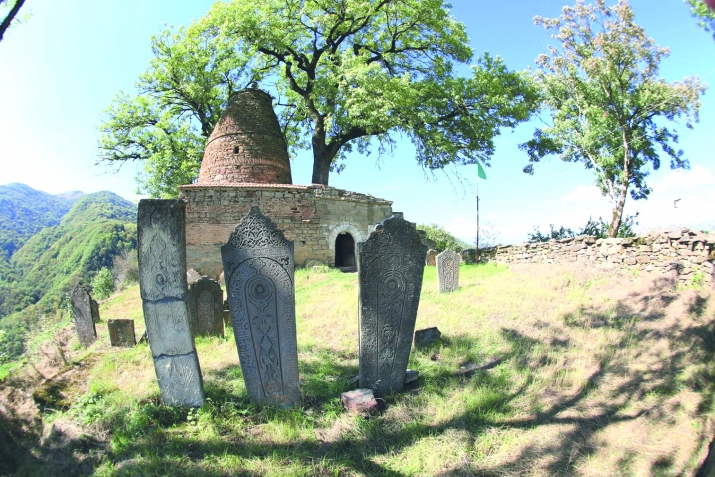
There are a large number of monuments of material and spiritual culture in Qala Quraysh. Over several decades these were almost completely destroyed. More than a half of the mosque which was once adorned with perfect decorative motifs was destroyed too. Here were superb examples of monuments of the art of stone-cutting, such as the mosque mihrab, grave markers, the family cemetery of the Kaytag utsmys and sarcophagus-style tombstones. The mosque standing in the centre of the settlement is one of the oldest in Dagestan. Today it has been restored as much as possible to its original form.
The fortress was defended against possible enemy invasions by steep mountains and a well-designed layout, including the defense system itself. Remains of the residential areas of the fortress are divided by a winding main street, from which runs narrow side streets. These passages divide the territory into small blocks, including a complex of residential and business premises.
Guarding signal towers formerly stood on the main peaks around the castle. From these alarm signals could be transferred faster than by telegraph in the case of any impending danger.
The period of the 18th century was inscribed with bloody letters in the history, not only of the Dakhadaevskiy district, but the whole of Dagestan. In 1741 the Iranian leader, Nadir Shah, with a strong army of twenty-four thousand soldiers invaded Dagestan.
In moving across the Kaytag utsmystvo they ruined a number of villages. Some had offered a decent resistance and some had surrendered to prevent bloodshed. The villages of Kalkni and Dibgaschi were glorified because of their desperate resistance: both villages were taken by storm, the Persians gathered the adults and the children who remained were trampled by cavalry. This terrible massacre is still preserved in human memory.
After a series of setbacks, in October 1742 Nadir Shah moved his main forces to Qala Quraysh. After few weeks of siege the fortress submitted. As soon as Nadir and his army managed to climb to the top of the fortress, its brave residents repulsed the attack and forced the army into retreat. The Iranians were surprised by the resistance of the people of Qala Quraysh, by their bravery and courage. But stocks of food and water were exhausted and hunger compelled the elders of the village to negotiate with Nadir Shah on condition that the Shah would leave their homes and fields and cancel taxes. Instead, he demanded delivery of 200 hostages. After much debates elders found 80 captives and vagabonds, dressed them in national highlander dress and gave them to the Iranians to avoid bloodshed.
The people of Dagestan fought heroically against the enemy; even women fought against the invaders alongside their husbands, brothers and fathers. This terrible war contributed to the unity of the people of Dagestan.
_______________________________________
* Utsmy, usmi, - hereditary title of the ruler of Kaytag (a historical region in Dagestan).
* Kaytagskoe utsmystvo - one of the most powerful fiefs of Dagestan in the 16th-17th centuries.