
Worship and learning in Gidatli: a microcosm of dagestan highland culture
Deep among the high peaks of the Caucasus in the northwest of the Republic of Dagestan is the Shamilsky Region. Historically part of the traditional territory of the Avars, its regional administrative centre is Khebda. Situated on the left bank of the Avarskii Koisu (river), the town is 167 km by road from Makhachkala, Dagestan’s capital.
Not far from Khebda on the opposite side of its deep valley is a fertile basin of a tributary relatively wide for the mountainous interior of Dagestan and with an amenable climate. There a group of villages developed (Khotoda, Tadib, Nakitl, Urada and Khujada) ringed by others higher up in the mountains (Goor, Kakhib, Genta, Machada and Tlyakh) which provide summer pastures. Collectively these communities are today known as Gidatli (historically the name referred to an even wider region). Nestled against the Great Caucasus range, its secluded position provided a degree of natural protection but it also had regular connections through mountain trails to the Transcaucasus to the south.
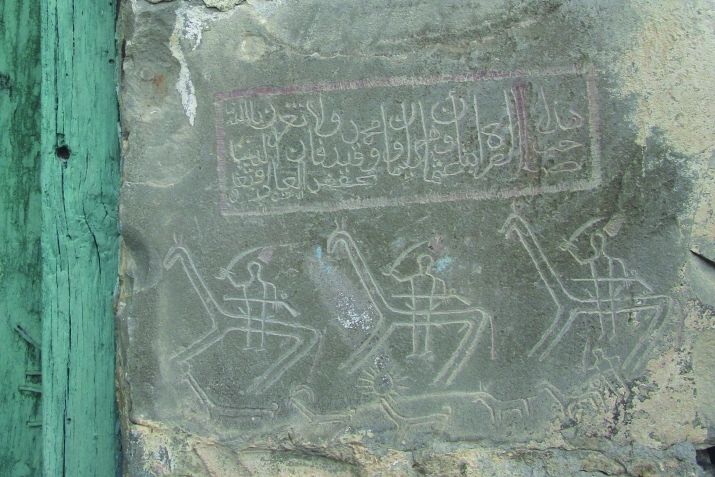
In the Middle Ages this was a Christian area. A little downstream from Khebda in a little ravine near the hamlet of Datuna is a well-preserved little 10th – 11th Georgian church built of carefully cut stone and the ruins of the little community it served. Carved Christian symbols in stone used in constructions prior to the eventual Islamisation of Gidatli were re-used in many later buildings in its territory. A major figure in the area’s adoption of Islam in the 15th – 16th centuries was Sheikh Haji-Udurat of Machada, who died there in 1475 and whose descendants still live in the village. Two 17th century figures, Sheikhmuhammad-sheikh and Hadiz-sheikh, are also remembered locally as important in the regional history of the faith.
In various parts of the Muslim Caucasus, neighbouring villages sharing a common geographical territory and customs frequently joined together in a self-governing union. Such an association was formed in Gidatli: its written constitution, the “Adat Gidatlya”, still survives in a manuscript of the second half of the 18th or early 19th century.
By the 17th and 18th centuries Gidatli had become a flourishing centre of Islam devotion and learning with an impact far beyond its territory and in relation to its small population (less than 4,500 for the whole area in the 19th century). It produced a remarkable number of influential religious leaders, teachers and thinkers, who composed a wealth of written works.
Some were engaged in the leading Islamic centres of their day – Cairo, Damascus, Aleppo, as well as Mecca and Medina). Here the Sufi tarikats flourished, primarily the Naqshbandi but also the Shazali. The tasawwuf (Sufi path) continues to be interwoven in local religious life. The Halvetiyya appear also to have active to a degree in the 18th century.
While the Gidatli area may seem to us to be quite remote, this is a modern perception based on its distance from today’s principal urban centres. But social geography and sense of location were markedly different in Dagestan in the 18th and 19th centuries prior to Tsarist colonization and the growth of Makhachkala as the overwhelmingly focus of society to which everything eventually became relative.
In the 18th and 19th centuries the interior of Dagestan was occupied by a diverse range of independent polities each of which had a regional centre with which its rural communities were intimately interconnected. The regional centres of the various ethnic entities were themselves interconnected through religion and trade. The result was a little like the socio-political structure of Switzerland today
The 18th and early 19th centuries occupy a special place in the history of the written culture and spiritual life of Dagestani society. For Dagestan this was a period of universal scientific thought and of the appearance of distinct scientific schools with a heightened interest in non-Koranic sciences – arithmetic, mathematics, medicine and practical astronomy – as well as languages other than Arabic and those indigenous to the Caucasus.
As contemporary scholars of Dagestan’s rich Islamic history have emphasized, this was a time of significant growth of written culture – with a particular orientation to the Dagestani village. As never before, large settlements became the crucibles of culture and leaders of intellectual activity, playing in the life throughout their micro-region the role which cities did elsewhere.
In many settlements large mosques and madrasas had significant libraries. Leading religious figures established their own madrasas where they themselves taught. To the Dagestani alim (religious scholar) both the attainment of scientific knowledge and the responsibility to teach it was natural, enhanced by the widespread practice of capable students transferring from teacher to teacher across the breadth of the Caucasus.
At times Gidatli spiritual leaders also played a broader role as political representatives of the Avar Khanate: Sheikh Ibragim-Haji of Urada (1683- 1770) in particular is remembered for his diplomatic skills in deflecting the incursion of the Iranian Nadir-Shah into Avar territory during his ravages of the Caucasus in the first half of the 18th century.
The people of Gidatli actively supported the 19th century Imamate movement: the paternal ancestors of two of its leaders, Imam GaziMuhammad (his house still survives next to the ancient mosque of Tlyakh) and Imam Shamil were both from Urada. It was one of the Imamate’s twenty administrative divisions.
Among the sheikhs from the 18th to the 20th century from Gidatli and its environs who are particularly remembered are:
Ibrahim-Haji of Urada (1683-1770);
Abdurahman-Haji of Assab (1834-1905);
Habibulakhaji Afandi of Kakhib (1844-1924);
Hasan Hilmi Afandi of Kakhib (1852 –1937);
Husenli Muhammad Afandi of Urib (1862-1967);
Khumaid Afandi of Andikh (1874-1952);
Khamzat Afandi of Tlyakh (1892- 1978); Muhammad–Arip Afandi of Kakhib (1901-1976);
Mesalasul Muhammad Afandi of Kuchada (1909-1987);
Hajiyasul Muhammad Afandi of Batlukh (1915- 1995) and Muhammad Ibrahimkhalil Afandi of Tidib.
However, this simple listing of their names in no way conveys the true extent to which leading religious figures of Gidatli were connected to the spiritual life and history of Dagestan and the Caucasus - particularly through the teacher-student relationships (as murshid-murid or in the madrasa) noted above. For instance, Sheikh Hasan Hilmi Afandi of Kakhib was a student of Sheikh Saifulla-Kadi, Sheikh Abdulhamid Afandi of Inkho (grandfather of Sheikh Ahmad Afandi, Mufti of Dagestan) was a student of Sheikh Husenli Muhammad Afandi of Urib, and Sheikh Said Afandi of Chirkei, who is particularly venerated today in Gidatli, had ancestral roots in the area.
Gidatli religious figures of the late 19th and 20th century played a major role in the perpetuation of religious observance and teaching in Dagestan during the late Tsarist and Soviet periods in spite of tremendous political pressures. The graves of sheikhs who died locally have become revered ziyarats – some are not well known beyond the region.
In recent years many old mosques have been restored and new mosques built in the Shamilskii region. There are now forty two Juma and thirty five neighbourhood mosques, two Islamic institutes and fourteen madrasas. New construction has occurred in some of the region’s ziyarats with the sponsorship of devotees (e.g. that of Sheikh Khamzat Afandi of Tliakh). A study centre incorporating the rich manuscript library of Sheikh Ibrahim-Haji has recently been established in Urada (other important manuscript collections are understood to exist in Gidatli but have not yet been documented).
Along with its strong tradition of faith observances, Gidatli preserves other aspects of its heritage to a remarkable degree, with important survivals of its built heritage, material culture, customs and traditional ways of life. The documentation, preservation and promotion of the cultural heritage of the area and the Shamilsky region as a whole are receiving systematic attention nowadays from the Regional Museum in Khebda of the Dagestan Department of Culture, Sport, Youth and Tourism under its Director, Gafur Abdulmagomedov.
Joint projects in this regard are currently being developed with regional, national and academic authorities by Dagestan Muftiyat specialists, including the production of a detailed illustrated regional guide to the spiritual heritage and ziyarats of Gidatli and the translation into English for an international readership of key writings of the revered Sheikh Hasan Hilmi Afandi of Kakhib.
Translations into Russian of two of his works have already been produced under the auspices of the Muftiyat of Dagestan. The English translations are intended to be part of a broader “Spiritual Pathways of Dagestan” programme to translate the writings of other Dagestani inspirational spiritual leaders, including Sheikh Said Afandi of Chirkei and Sheikh Ahmad Afandi, now in publication.
These initiatives - and the methodologies employed in disseminating information through modern communication technologies - have the potential to serve as stimuli and templates for other regions of the Republic of Dagestan and the broader Russian Caucasus which also have rich spiritual and cultural heritages.
GUY (GHAYDAR) PETHERBRIDGE