

George the Victorious – Jarjis: the righteous man on the coat of arms of Russia
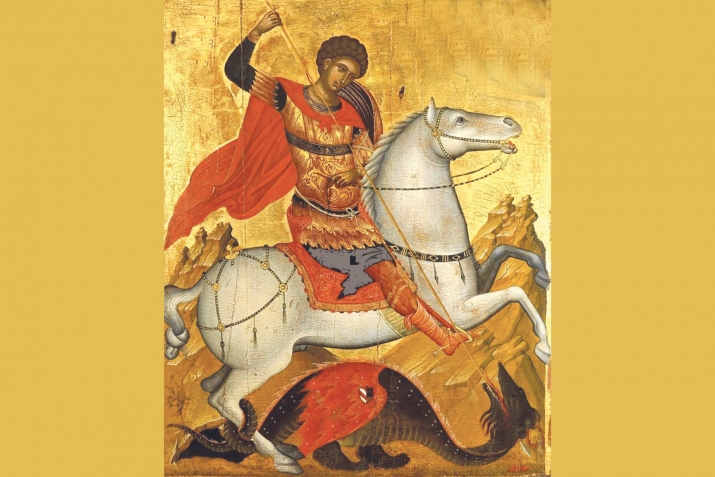
George the Victorious (Saint George), known in Christianity as a great martyr, revered for his spiritual fortitude and miracles, is mentioned in the Islamic tradition under the name Jarjis.
His story, preserved in Arabic sources, has unique features that reflect the Islamic understanding of holiness and the struggle for faith.
In Islam, Jarjis is a righteous man (wali), close to Allah ﷻ thanks to his piety and steadfastness in trials. His life, like the Christian tradition, is associated with opposition to tyranny and martyrdom.
Life of Jarjis in Islamic sources
According to Arabic texts, Jarjis was a wealthy merchant from Palestine, a follower of the prophet Isa (Jesus) and a zealous defender of monotheism. He went to the city of Musil (modern Mosul in Iraq), where the tyrant Zadanah ruled, worshiping the idol Aflunu. Seeing how the inhabitants were forced to pagan rituals and the disobedient were burned in fire, Jarjis publicly denounced the king: “How can one worship an idol deprived of power, will, hearing and sight?”
For this, he was subjected to monstrous torture. Over the course of seven years, Zadanah killed the righteous man four times, but the Almighty Creator resurrected him, demonstrating His power. The fourth time, Jarjis died, having converted many inhabitants to the faith and the tyrant king was overthrown.
Jarjis refuses to renounce his faith despite torture.
The defeat of the serpent in Christianity and the victory over idolatry in Islam reflect the triumph of faith over tyranny.
Mosques and temples in honor of Jarjis - St George the Victorious
Syria. Mar-Jirjis Humayra is an ancient pilgrimage centre. According to legend, this is where Jarjis fought a serpent, similar to the “Miracle of the Serpent”. Mosques in Damascus and Aleppo contain relics associated with his name.
Iraq. The Jarjis Mosque in Mosul is a 14th-century monument destroyed in a terrorist attack in 2014. According to Islamic chronicles, it was here that the saint was executed for the last time.
Azerbaijan. There is a sanctuary to St Georgia in Beylagan.
Palestine. The Qubbat al-Sakhra and al-Aqsa mosques (Jerusalem) include sections associated with his name. In Nablus, there is a bathhouse where, according to legend, Jarjis performed ablutions.
In addition, there are hundreds of temples around the world named in his honour.
The Almighty’s favorite on the coat of arms of Russia
Few people think that George the Victorious, depicted in the center of the coat of arms as a horseman slaying a dragon, is revered not only in Christianity, but also in Islam. This fact makes him a unique figure symbolising spiritual unity.
Jarjis - George the Victorious - personifies the indestructibility of faith and demonstrates how universal values are refracted through the prism of different religions: courage, justice and devotion to God.
The coat of arms of Russia, like the coats of arms of a number of other countries, depicts St. George the Victorious, a figure deeply rooted in history and culture. This symbol evokes associations not only with the Christian tradition, where St. George is the defender of the faith, but also with Islam, where he is also revered as an image of courage, nobility and, most importantly, obedience to the One Creator and steadfastness on His path.
Thus, St. George the Victorious has become not just a religious symbol but a universal image that can unite people of different faiths and cultures.
It is important to note that, despite religious differences, the values that St. George the Victorious represents are relevant to everyone: courage, justice, readiness to defend one’s Fatherland and those around.
In this context, it is important to remember that a strong society is built on respect for each other and mutual understanding, and the coat of arms with the image of St. George the Victorious - Jarjis - reminds us that unity is our strength.
