

Distant Pathways: Islam in Colonial and Contemporary Latin America
Distant Pathways: Islam in Colonial and Contemporary Latin America
When Christian Spain colonized large areas of the Americas from California to the southern tip of South America in the 15th and 16th centuries, it introduced a culture which already had significant features inherited from the period when the Iberian Peninsula was dominated by Islam. In the early years of American colonization the south of Spain (Andalusia) was still Islamic territory – it was not until 1492 that the Muslim Kingdom of Granada finally succumbed to Christian forces.
After four centuries of Islamic rule of of the peninsula and the subsequent five centuries of its gradual Christian “Reconquista”, Spanish culture generally had incorporated many aspects of Islamic material and popular culture: its particular and distinctive forms of art and architecture, agriculture, technologies – and cuisine. Even today a large proportion of words in the daily Spanish vocabulary derive from Arabic.
During the Reconquista, the name Mudéjar (from the Arabic ‘mudayyan’ – ‘subject who remained’) was given to those Muslims who remained in Christian territory and conserved their religion, language and customs. Particularly valued were the skills of Mudejar craftsmen involved in building and architectural decoration and in the making of fine crafts such as textiles, metalwork and ceramics in a distinctive regional Islamic idiom to which the term Mudejar was also applied.
Eventually Christian craftsmen working alongside Muslims also acquired skills in the most esteemed of these specializations - those involved with architectural decoration, especially highly intricate woodwork used in the ceilings (artesonados) of religious and civil buildings. By the time southern Spain (Andalucia) excluding Granada came under Christian rule in the 13th century, the Islamic Mudéjar style was fully assimilated into the general Spanish aesthetic.
The ruling establishment appropriated it – including prominent inscriptions in Arabic - as expressions of luxury, authority and grandeur in its palaces, religious buildings and public spaces. Pedro I (1334- 1369), for instance, even requested craftsmen who had worked on the Alhambra from Muhammad V (1338-1391), Sultan of Granada, to contribute to his extensions of the formerly Muslim Alcazar of Seville which he had made one of his royal palaces.
Following the defeat of Granada, relationships between the three principal faiths living in the peninsula - Christian, Muslim and Jewish - became increasingly unstable. The obligatory conversion of Muslims inhabitants was instituted, those forcibly converted being called Moriscos. However, most continued to practice their faith away from the public eye and finally in 1609 the Inquisition decreed that all Muslims be expelled from Spain. Many Moriscos were given safe haven by their brothers in religion, the Ottomans – moving to the Balkans, Istanbul and elsewhere in Anatolia, while others settled in North Africa and south of the Sahara.
Mudejar and Moriscos were generally not permitted to emigrate across the Atlantic to the Spanish colonies. Nevertheless, the reality was that Muslims of peninsular origin were Spanish speakers and possessed many occupations and skills in demand in developing and sustaining the colonies of the New World. Many did settle there – legally and illegally.
Some, for example, served as soldiers, while others were employed in agricultural endeavours requiring expert knowledge and experience (as in the development of a new silk industry in Venezuela or ranching in Argentina). In most demand, however, were those with the specialized building skills needed to execute the ambitious civil and religious construction projects across the Spanish Americas.
Although there were large numbers of Muslim slaves from West Africa in the colonies, they were generally exploited solely as instruments of raw manual labour. A colonial cultural environment thus arose in which there was much long absorbed from the Islamic world and much that was the result of the actual presence and activities of Muslim immigrant settlers.
Most obvious was the impact of architectural idioms and practices of Islamic origin on the colonial built environment. New cities were built and Spanish religious orders founded monasteries and churches in order to preach to, teach and control the indigenous population and serve the colonists themselves. In all the principal centres of the colonial viceroyalties religious buildings were constructed in the 15th and 16th centuries to plans drawn up by renowned Spanish and Italian architects, but incorporating ceilings and other features of fine Mudejar woodwork.
Many buildings, religious and domestic, also used azulejos, colourful glazed tiles with Islamic motifs and produced using Islamic technologies. They were imported from Seville initially and later made in the colonies themselves. While the Mudejar idiom became less popular in the Iberian Peninsula in the 16th century for Christian religious buildings in favour of the Renaissance manner, in the Americas both it and the Christian Gothic style with which it was often associated acquired new momentum in colonial architectural projects.
Mudejar woodwork became popular also with indigenous inhabitants in many regions of the Americas (with whose arts there were aesthetic affinities), who incorporated it into many of their local churches, some remote from any colonial centres of authoriity. As a succession of new popular styles (the Baroque, Rococco, etc.) emanating from Europe in the 17th and 18th centuries influenced architecture across the Americas, Mudejar forms did not vanish but were fused with imported elements to create localised Hispano-American Mudejar modalities, unifying geographically and culturally disparate peoples through a common visual language.
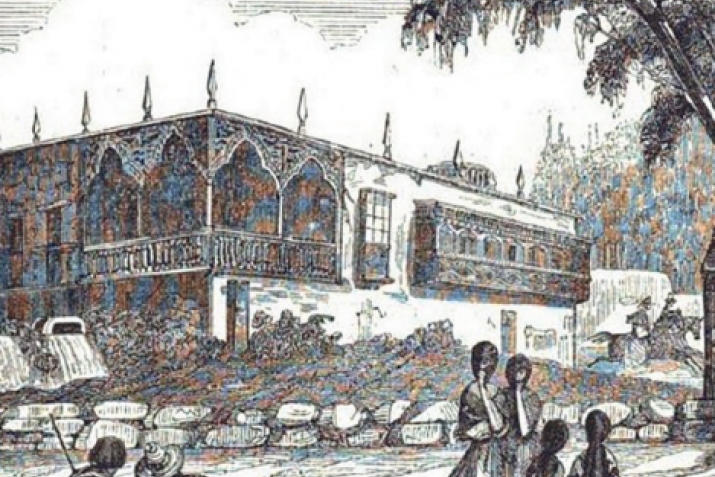
Across Latin America the blank street facades of the domestic quarters of colonial settlements, interrupted by occasional ornamental portals, reflected the environment and lifestyles of the towns and villages of former Islamic Spain. The streetscapes of Lima, the capital of the Viceroyalty of Peru, had a particularly distinctive Islamic architectural flavor with elaborate projecting wooden closed balconies (derived ultimately from the Middle Eastern musharabiya). Secluded within, women could observe the bustle of public life outside.
At the beginning of the Spanish settlement of Peru, Moriscas were brought from Spain as consorts and servants of the conquistadores. Some acquired lineage and fortune, but continued to observe strict peninsular Muslim dress requirements in public, resulting in all colonial women of Lima wearing a distinctive severe black overall attire, known as ‘tapada’. The custom was to continue until well into the 19th century, until giving way to the influence of European dress styles.
To be continued…
GUY (GHAYDAR) PETHERBRIDGE Professor, Expert on cultural heritage and history of Islam, Australia, Russia
