

Devotion, Dhows and Donkeys: The Island of Lamu, Kenya – a Precious Reservoir of Living Islamic Traditional Culture
Devotion, Dhows and Donkeys: The Island of Lamu, Kenya – a Precious Reservoir of Living Islamic Traditional Culture
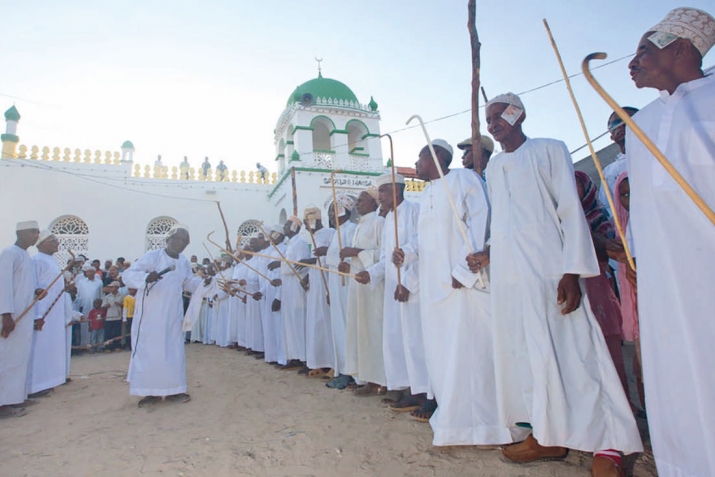
Lamu Island has twenty three mosques, including the late 19th century Riyadha Mosque (Sunni) and the Ithna'asheri Mosque (Shia). Most are modest vernacular structures recognizable by their distinctive whitewashed conical minarets. Sheikh Al-Habib Swaleh ibn Alawi Jamal al-Layl (1853-1936), a sharif (descendant of the Prophet Muhammad [pbuh]) with family and Alawiyya tarikat connections to the Hadramaut, Yemen, settled on Lamu in the 1880s, and became a highly respected religious teacher. He was a reformer who encouraged education among ex-slaves and the marginalized and had great success in gathering students around him. In 1892 he built the Riyadha Mosque and its associated madrasa. After his death, his sons continued to maintain the madrasa, which is now the longest continuously functioning and one of the most influential Islamic teaching institutions in the Swahili world. Sufi tarikats are an integral aspect of Islam in Lamu (and the entire Swahili coast) and Sheikh Al-Habib Swaleh is the most venerated Sufi leader in the archipelago – his descendants are keepers of his tomb.
The Riyadha Mosque has an important manuscript collection - the richest in the region - which includes important texts in Kiswahili ajami (the Swahili language written in Arabic characters). It forms a unique part of the Kenyan, East African and African Islamic heritage and has recently been digitized and catalogued with the support of the British Library Endangered Archives Programme and in collaboration with the University of Cape Town, South Africa. Access to the entire collection is now freely available through the internet.
As is the custom along the entire Muslim Swahili East African coast, the celebration of the birth, life and lessons of the Prophet Muhammad (pbuh) is a major aspect of both personal devotion and public worship in the Lamu archipelago. The Prophet (pbuh) is venerated as «the binding force of religion» (kifugo cha dini) and «the intercessor at the Day of Judgment» (mwombezi wa kiyammi). The Riyadha Mosque is the centre for the Lamu Maulidi Festival, held every year during the last week of the month of the Prophet's (pbuh) birth.
Besides its mosques, other historic buildings in the Old Town of note are the early 19th century Fort of the Sultan of Pate on the seafront, the excellent Lamu Museum and the Swahili House Museum (which gives visitors an inside glimpse of traditional life in a local home). A number of important archeological sites in the archipelago also shed light on local history and culture. Excavations in the 1980s at Shanga on Pate Island indicate that Muslims lived here from the late 8th century - early 9th century onwards. Here also are the ruins of one of the earliest coral stone mosques on the Swahili coast, dating from the first half of the 11th century. Ruins of an Islamic settlement dated 15th –16th century are located at Takwa on nearby Manda Island.
Lamu has a well-developed hospitality infrastructure and comprehensive information for visitors is readily available on the internet. Much of its tourist accommodation is comprised of sensitively refurbished traditional Swahili houses run as reasonably-priced guesthouses. There are also private boutique style villas and resort properties and secluded high-end holiday retreats for the internationally rich and famous (Barack Hussein Obama honeymooned here). Visitors enjoy a great range of places to savour the local culinary treats derived from the diverse cultures which have blended in the island over the centuries - with an emphasis on fresh seafood (inherently halal), coconuts and tropical spices and fruits and rice.
Lamu can only be accessed from within Kenya. From Nairobi there are daily flights either direct or with a short stop in Malindi. Flights also leave from Mombasa. One flies into a little airstrip on Manda with transfers to and from Lamu (just opposite) by boat.
In spite of pressures of development and the inevitable intrusion of politics, Lamu today remains as mystical, exotic and serene as ever - culture, history and custom are blended into a truly unique way of life. Here the wisdom of its Muslim past plays a part in the present, the pace of life measured by the progress of the graceful dhows that sail among its islands and whose predecessors first brought Islam to these shores.
