

Travel notes of the Arab traveler Ibn Battuta
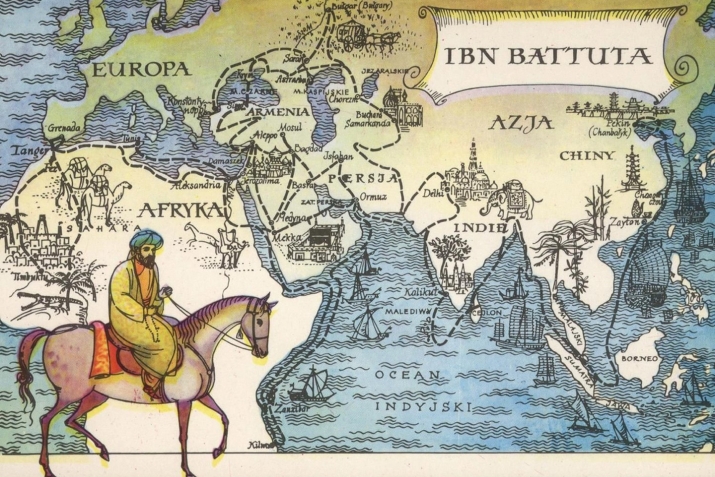
The names of such famous explorers as Columbus, Magellan and Vasco da Gama are familiar to many. But has anyone heard of Abu Abdullah Muhammad Ibn Battuta?
His name is less well known but more than six centuries ago this Arab traveler traveled vast territories: his routes rank first among medieval explorers. He walked about 130 thousand kilometres, which is four times the length of the Earth’s equator.
Ibn Battuta was born in 1304 in Morocco, West Africa. In 1325, at the age of 21, he went on a pilgrimage to the holy places of Mecca and Medina. However, fate decreed that he devoted almost thirty years of his life to traveling. Ibn Battuta visited the countries of the Arab East, Iran, the Golden Horde, India, Ceylon, China, the East African coast and the western parts of Africa, as well as the Arab territories in Spain. In his travel notes, he described the amazing life of the Muslim world, compared to Europe, which suffered from wars and epidemics. His book is called “A Gift to Those Who Contemplate the Wonders of Cities and the Miracles of Travel”.
In his notes, Ibn Battuta described not only the rulers and their luxurious palaces but also the life of ordinary people, their customs, traditions and even cuisine.
In Damascus (now the capital of Syria) he was impressed by the generosity of the locals. Muslims donated money for various good deeds: buying wedding dresses for poor girls, helping pilgrims and even improving the streets. Ibn Battuta shares an incident: he saw a small slave drop a Chinese dish and the people who gathered around helped him, telling him who to contact and he received money for a new one. This charitable behavior surprised the traveler, because without such help the boy could have been subjected to the wrath of his master.
In Mecca, he witnessed another good custom. In the bazaar, orphans offered to help customers by delivering their purchases for a small fee. This allowed the children to earn a living and earned the trust of the townspeople, who were not afraid to leave their things in the hands of those young couriers.
When Ibn Battuta visited Turkey, one of the local rulers surprised him with a story about a stone that fell from the sky, and even showed him the “cosmic” object itself, which the servants tried to work on and break off at least a piece but were unable to split it. The Sultan was proud that he was able to amaze the traveler with a large celestial black stone.
Baghdad, the capital of Islam and the Abode of Peace in the 14th century, made a strong impression on Ibn Battuta. With a population of about a million people, this city was one of the largest in the world. Despite the destruction caused by the Mongol invasion, Baghdad retained magnificent buildings and mosques, as well as an extensive system of stone bridges.
Ibn Battuta was especially impressed by the baths of Baghdad. He described them as magnificent buildings with well-kept washrooms, pools, and hot and cold water supply systems. For him, as a 14th-century traveler, this was an amazing level of personal hygiene. “No city in this regard could compare with Baghdad,” he recalled after seeing half the world.
