

The best-preserved Ottoman period town in Europe
After the death of Hoxha in 1985, a gradually more tolerant stance was taken and in 1990 the ban on religious observances in Albania was lifted. Sheikh Hafiz Sabri Koci spelling (an imam who had been imprisoned for twenty three years) lead the first prayers in Shkoder Mosque, the first to reopen, and became the Grand Mufti of Albania. With the wave of general collapse of authoritarian state socialism in the early 1990s, Albania became a parliamentary secular state with no official religion. Albanian nationalism is now conceived and experienced as not being tied to any particular faith, instead promoting harmony between the different confessions through shared Albanian language, history and ethnic customs.
Although most mosques and some madrasas had been destroyed after 1967, by 1996, following the reinstatement of religious rights, most had been restored or reconstructed on their former locations. The Muslim Community of Albania became the main administrative organization for the Sunni Muslim community in Albania and administers most of the country’s mosques (official website in Albania, Arabic and English – www. kmsh.al).
In 1992, Albania became a full member of the Organization of Islam Conference (now Organization of Islamic Cooperation) and is actively engaged with the broader Muslim world. An inter religious organization called the Interreligious Council of Albania was created in 2009 by the country’s four main faiths to foster religious co-existence in Albania.
Government policy and practice together contribute to general free exercise of religion without censorship. Muslim dress is not prohibited in Albania. Halal slaughter of animals and food preparation is permitted. Halal products are mainly available in large urban centres and eating places and are becoming more and more popular, especially among practicing Sunni Muslims.
Nevertheless, decades of communist-style propaganda on the perceptions and practices of believers of all faiths led to a significant secularization of society and a sharp decline in religious practice, the result being that many of those of Muslim affiliation no longer fulfill all the faith’s devotional requirements and thus practice a form of ‘secular’ Islam.
The period following the collapse of the socialist regime was one of considerable social and economic transitional stress throughout the newly independent Albania. With other more pressing preoccupations, little was done to care for Gjirokastra’s heritage. However, by the turn of the 21st century, political and general economic stabilisation led to a revived interest in and attention to the conservation of this historic town.
Experienced international bodies, such as UNESCO, the Aga Khan Foundation and the European Community itself, have become closely involved, particularly in supporting local organisations and specialists in this endeavor.
A range of professional conducted restoration and revitalization projects has been undertaken, ranging from the rehabilitation of the citadel and abandoned or decaying buildings to the creation of hiking trails along traditional country shepherd paths around the nearby (14 km) ancient Greek site of Antigone.
The latter project allows the visitor to appreciate both the natural beauty of the area and its material and historic significance. Training programmes are in place for artisans in a range of crafts traditional to the region, such as wood and stone working, tailoring, embroidery and textile production, and already have had a significant impact on craft production in the region.
The Gjirokastra Museum Project has been one of the most challenging, and at the same time most rewarding, initiatives, resulting in one of the most modern museums in Albania, housed in the castle where the town’s early population once lived.
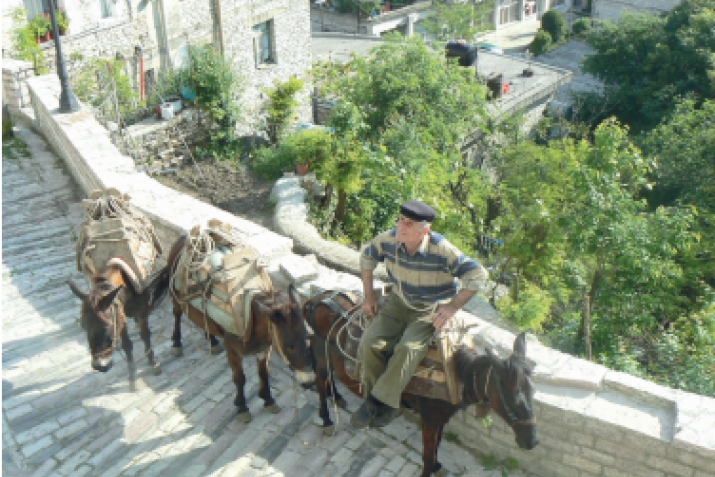
Because of Gjirokastra’s small size and contained town plan, its sights are easily accessible while wandering through its pretty streets, with their cafes, craft workshops and multitude of little shops serving the local inhabitants as well as domestic and international tourists.
The environment is beautiful and the locals hospitable Albanians have an international reputation for religious and cultural acceptance born of centuries of symbiotic existence. Southern Albanian cuisine is delightful, blending as it does Balkan, Greek and Turkish elements. Quality heritagestyle accommodation is available; nowadays easily booked and payable through the internet. Readers are recommended to watch on Youtube, the Japanese NHK World, “Somewhere Street: Gjirokastra, Albania” video; it will give you an excellent idea of what it is like to slowly explore this town.
Of the many fascinating things to see, once could start with the central bazaar area itself, with a visit to the Babameto House and Centre for Culture and Heritage. This is an elegant two story dwelling built in 1885 and 1887 to accommodate two branches of a single family.
It was expertly restored in 2013 and is used as an example for both visitors and locals of the revitalization and modern use of a typical Gjirocastran house. It hosts both cultural and tourist events, as well as providing hostel accommodation in a traditional ambience.
One of Gjirokastra’s most splendid houses is Skenduli House, which was built by a wealthy landowner in 1823 during the town’s greatest period. It is a large, fortified house built both to defend its owners (it is outfitted with embrasures and loopholes) and to impress guests with the family’s wealth particularly the guest reception room (oda) with its elaborate painted plaster and carved woodwork. Of course, a visit to the Citadel is a must with its new museum and vast views across the town and countryside.
Visitors can easily guide themselves through the town, using excellent information resources provided through by local organisations via the internet, or take advantage of professionally and enthusiastic guided tours of one to seven days duration provided by the Gjirokastra Conservation and Development Organisation, which is very active in the town’s conservation activities.
Their Gjirokastra experiential “Expe Tours” are made possible by Risi Albania, a sustainable tourism development project funded by the Government of Switzerland. Through them the visitor can experience at first hand the town’s living traditions, by being introduced to its ways of life and heritage, its artisan traditions, and its traditional cuisine; longest weekly tour gives you the chance to be a Gjirokastran for a while. (Visit: www. gjirokastra.org/expe-tours/)
This organization also runs Gjirokastra’s Tourist Information Centre, which is located in the very heart of the bazaar. It provides excellent information on Gjirokastra and regional attractions, bookings, accommodation, restaurants, events and entertainment. It can be contacted by email at tic@ gjirokastra.org.
Every year in August, Gjirokastra hosts a popular National Fair of Crafts, Heritage and Tourism in which craftsmen and specialists from across the country participate. Superb beaches are also only an hour’s drive away at Saranda a popular weekend destination for Gjirokastra’s residents.
For those with an interest in ancient history, two important Greek classical sites are both only 14 km away: Antigone, founded by King Pyrrus of Epirus in 295 BC, which became an important economic, cultural and political centre; and Hadrianopolis, where there is a well preserved theatre from the 2nd century BC.
Through the centuries, the Muslim community of Gjirokastra has numbered both Sunni Muslims and members of the Bektashi Sufi tarikat, as well as adherents of other Sufi “minority” orders. The Bektashis were extremely influential across the Ottoman Empire, and have close devotional affinities with Shiism. Today, the town retains a large population of both Sunnis and Bektashis who will welcome your visiting and worshipping with them in the mosque and tekkes.
Gjirokastra with its surrounding region is not only beautiful, instructive and relaxing to visit but is also quite affordable for a tourist in European terms. The town has an excellent range of tourist heritage style accommodation (mostly ranging currently from US$25.00-US$55.00 to per night per person although such prices can also be found for double rooms). Food is excellent value both in range, quality and prices.
There are multiple daily flights from Moscow to Tirana, the capital of Albania requiring a single change in Istanbul or Athens (shortest one way flight duration from 5-7 hours). There are currently internet round trip prices of about $300.00. One can also fly from Kazan, Grozny or Makhachkala directly to Istanbul and onwards to Tirana.
When flying into Tirana, you will probably have to overnight there, but on returning there are late night flights onward to Russia. Tirana is 225 km by good road from Gjirokastra. The trip takes about 3.5 hours by car or 5-7 hours by bus or “furgon” (a ticket costs about $10.00).
Tourists wishing to visit Albania must obtain a visa from an Albanian diplomatic mission unless they come from a visa exempt country or are qualified for visa free entry. The website of the Embassy of Albania in Moscow currently indicates that Russian nationals are visa exempt for stays of short duration. Although Albania is not a member state of the European Union, short stays are permitted to those with valid, multiple entry Schengen visas which have been previously used in one of the Schengen states or foreign citizens who have a valid permit of stay in one of the Schengen states.
GUY (GHAYDAR) PETHERBRIDGE
PROFESSOR, EXPERT ON CULTURAL HERITAGE AND HISTORY OF ISLAM, AUSTRALIA, RUSSIA
