

Islamic Festival Pageantry: Kano and northern Nigeria
Islamic Festival Pageantry: Kano and northern Nigeria
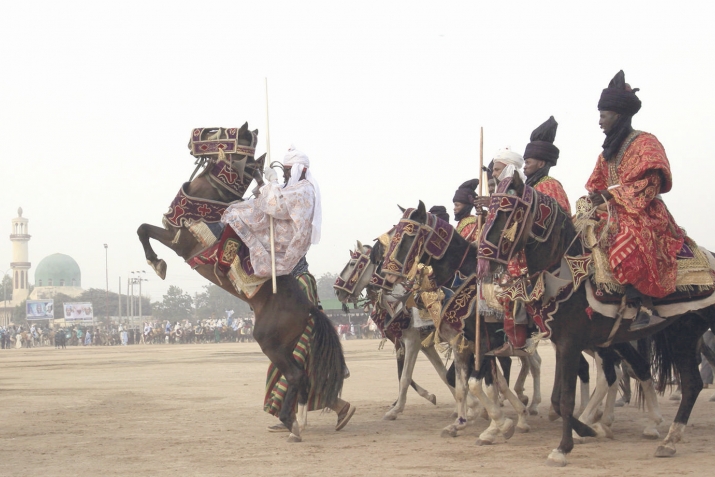
Further ceremonial processions take place on the third day, the Emir riding out of the city through the Nassarawa gate in the east, making a stop at the Nassarawa palace and riding on to Government House to pay a courtesy call on the state government. Similar ceremonies take place on the fifth and last day of the Sallah celebrations, the Emir leaving Kofar Kwaru early in the morning and riding to the palace of Dorayi. The convoy of horse-riders to the sound of fanfare and clad in ostentatious costumes stays there until evening when they will be joined by multitudes of people to once again cheerfully salute the Emir.
While all Kano Sallah festivities are similar in general character, there are myriad varieties of venues and events. Noteworthy is the ten day long Tashe Festival, which starts on the tenth day of the ninth lunar month of Ramadan. It commences with the arrival of ‘Nalako’, the chief of the festival who hoists its flag and then mounts a donkey accompanied by about a hundred horsemen, drummers and buglers, while he himself blows a horn. He exits the city through the Kofar Mata city gate to renter the city again through Kofar to the Kurmi market and returns to his residence near the Emir’s palace. Children and adults wearing funny costumes move from house to house through the streets and market places entertaining people with songs and stage dramas, highlighting issues of social and community concern. Kano is also noted for its traditional Hausa wrestling and boxing competitions which take place during festival days. As an ancient centre of Islamic learning, it also an annual Koranic competition and book fair, as well as two days of popular festivities when Kano’s two major Sufi tarikats, the Qadiriyya and the Tijaniyya, celebrate and visit the ziyarat of revered Muslims.

It is no coincidence that today’s equestrian pageants in Kano and other cities of norther Nigeria celebrating the festive days of the Muslim calendar continue to resemble those of mediaeval Cairo. There were strong trade and spiritual links across the Muslim centuries linking the two great Islamic centres – Kano was the second largest city in Africa after the capital of Egypt. Although most of its inhabitants are of the local Hausa people, many other ethnic Nigerian groups and others from across West Africa together with Arabs and Syrians, Lebanese, Yemenis and Pakistanis live both in the city and in Kano’s myriad villages to form a great ethnic rainbow whose colours burst for all to enjoy through its exuberant Islamic festivals.
Thus Islamic Africa continues its unbroken links with the heartlands of Islam in the sort of festive enjoyment recorded by al-Bukhari of Aisha watching an Eid celebration together with the Prophet (peace and blessings be upon him) “… It was the day of the Eid and Africans were performing with their shields and spears. Either I asked him or the Prophet (peace and blessings be upon him) asked if I would like to watch them (I don’t recall now). I replied yes. At this the Prophet (peace and blessings be upon him) made me stand behind him and my cheek was against his. He was saying, ‘Carry on, O tribe of Arfadah,’ until I tired. …’”
