

The Essence of the Place of Communal Prayer: The Open-Air Mosque
The Essence of the Place of Communal Prayer: The Open-Air Mosque
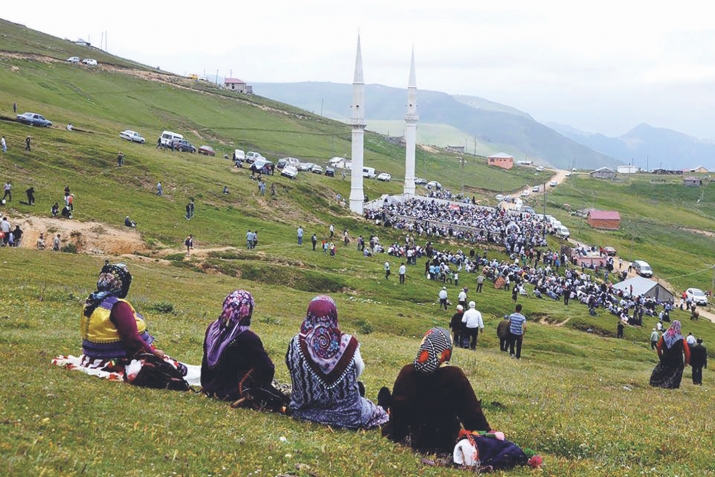
In recent years there has been a revival in interest and nostalgia for open air mosques. Thus thousands of local worshippers gather on important religious holidays in a great open air mosque high up on the Kadirga plateau behind Trabzon in Turkey. Fatih Sultan Mehmet II is believed to have performed Juma namaz here with his troops when visiting the ziyarat of the revered Kadir Aga. The mosque is unusual in having two tall permanent minarets of classical Ottoman style.
In other places new formal outdoor prayer spaces are being built in reverence of this ancient tradition. In Turkey’s capital, Ankara, a splendidly carved marble mihrab and minbar have been built on a platform adjacent to the Haci Bayram Mosque and overlooking the city below. Similarly placed on a terrace overlooking the community is a new outdoor mihrab in the heritage city of Safranbolu in north-central Turkey. Beautiful simple - but extensive - outdoor mosques of traditional local materials have been built in Oman - in Nizwa, for example.
Among the many new ventures in mosque design across the modern world of Islam, an open air mosque planned for Dubai in the United Arab Emirates has provoked much interest. Named the Vanishing Mosque, it was conceived by the New York-based group, Rux Design, winning an international design competition ‘Mosque through Architecture’ in 2010. Its key feature is an open air raised triangular prayer plinth whose apex points in the direction of Mecca. Its floor and walls decrease in size towards its apex creating an illusion of heightened vanishing perspective in the qibla direction. Below the raised prayer plinth and in its shade is an ablution pool.
As awareness is growing of the spiritual legacy of Islam’s surviving historical places of open air worship, local initiatives are energizing to preserve them. The Goa Heritage Action Group in Bicholium, for example, is working to save its elegant namazgah from the encroachment of a nearby mine. In the Bodrum region of Turkey local heritage activists are working to preserve its simple roadside namazgah. In Prizren, capital of Kosovo, restoration work on its first namazgah built just after the city was conquered in 1455, the city’s earliest Islamic monument, has recently been sponsored by the Turkish Cooperation and Coordination Agency (TIKA).
Turkey’s first six Ottoman sultans resided in Bursa where an open air mosque had been built soon after its conquest. Although many splendid religious buildings were to be constructed in Bursa, it was in this namazgah that Ottoman army troops continued to pray before and after military campaigns. It survived - long neglected though largely intact - until municipal and local efforts to revive the historic identity of the city resulted in the first communal prayer to be held there for 600 years – the tarawih namaz of the first day of Ramazan in 2011.
