
ISLAM HADHARI IN MALAYSIA
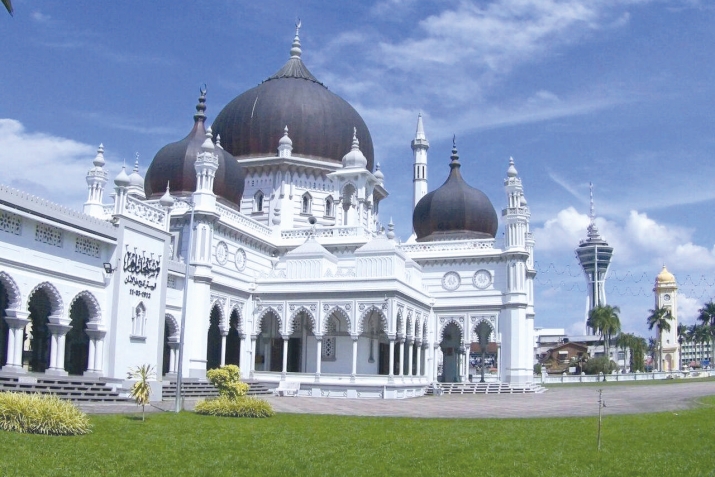
Malaysia is a multiracial country with a population that currently stands at 33 million, of which approximately 63 percent are Muslims. Islam is constitutionally the country’s official religion, with the freedom to practice other religions. The Sharia Law in Malaysia is only applicable to Muslims and is used to resolve conflicts relating to creed and family matters.
Malaysian Muslims generally follow the Shafi`e school of thought. Mosques are part of the ordinary scene in Malaysia and are as much a cultural icon as a religious one. It is also the norm to hear the azan on loudspeaker five times a day. On Fridays, government offices and banking institutions are closed for two hours during lunchtime for the Friday prayers.
Islam is an integral part of the Malaysian Malay culture, so much so that many Islamic rituals and practices are associated with the Malay culture. Many words in the Malay vocabulary are borrowed from Arabic words, such as ‘dunya’ and ‘haram’. It is also quite common to see Malay women donning the hijab or headscarf.
The Arrival of Islam in Malaysia
Islam was introduced to Malaysia, a prime centre of trade and commerce since the 10th century CE,by Arab and Indian traders who controlled trade on the Strait of Malacca. For the most part the process was peaceful; the people who brought Islam were traders first and missionaries second.
It is believed that Islam first arrived in Malaysia sometime between the 13th and the 14th century CE. It arrived in the region gradually, and became the religion of the elite before it spread to the commoners, ending the age of Hinduism and Buddhism. Islam became widespread in the region with the arrival and conversion of Parameswara, a Hindu prince and Singapore’s last king, who had established the Sultanate of Melaka in the 15th century CE. Since then Islam continued to flourish in the peninsula, greatly influencing the Malay lifestyle and culture as can be seen until today.
The earliest evidence of the arrival of Islam in Malaysia was discovered in Terengganu, in the form of an ancient inscribed stone ‘Batu Bersurat’. Dated 1303 CE, the stone tablet with Jawi script on it stands as proof that Islam had arrived in the east coast region of the peninsula long before Parameswara embraced Islam.
Other evidence like a 15th-century tomb and three inscribed pillars in Negeri Sembilan, as well as intricately carved grave markers ‘Batu Aceh’, found in most states in the peninsula, also provide important clues to the early history of Islam in the country.
Almost all Muslim Malaysians are Sunni Muslims and are regarded as moderate Muslims. Malays are by definition Muslims and are not allowed to convert. Malaysia along with Indonesia and Turkey are regarded as the most liberal and open Muslim countries. In some towns and cities one can find Sufi (Naqshbandi) brotherhoods.
Malaysia “combines traditional principals of justice with more modern secular forms of government and society.” It is the personal mission of Prime Minister Anwar Ibrahim to bring Malaysia into the modern world while keeping its religious values. Unlike some Muslim countries, Islam and modernity seem compatible and exist side by side.
The Constitution guarantees freedom of religion, but when it comes to Islam, the country’s official religion, only the Sunni sect is permitted. Other forms, including Shiite Islam, are considered deviant and are not allowed to be spread by the Constitution.
Since the 1960s, Malaysia has hosted the international Koranic recitation competition, where participants compete to see who can read the Koran most melodically and accurately based on linguistic rules. Since then, revivalists have found new ways to combine Islam with popular culture. In the 1980s, for example, the number of women wearing headscarves grew exponentially, and tudung has now become a fashion industry and a standard marker of Malay identity. In the 1900s there was the promotion of Islamic pop songs and culture through nasyid, which continue to be popular today. Lately, the concept of hijrah - has been extended to the spiritual journey of Muslims who become more religious and pious. Often, the decision to use a headscarf is a standard marker of the hijrah. Islamisation has also entered the entertainment scene where artists who become more outwardly religious are celebrated and praised for their successful hijrah, and for women, their decision to wear the headscarf.
Islam Hadhari
The former prime minister of Malaysia Datuk Seri Abdullah Ahmad Badawi, promoted his vision of Islam - Islam Hadhari - as a model for development in Malaysia. According to Badawi, Islam Hadhari, or civilizational and comprehensive Islam, is not an inclusive concept as it also emphasizes the importance of progress - with an Islamic perspective - in the economic, social, and political fields. Islam Hadhari emphasizes the need for balanced development, which covers both physical and spiritual development. Hence, Badawi proposes a holistic development approach for Malaysia. This means a shift in development approach from a “secular paradigm” to a “tawheed paradigm,” which emphasizes developing a thinking society, social harmony, and economic progress.
“Badawi mentioned that Islam Hadhari is not a new religion. It is not a new teaching, nor is it a new madhhab. Islam Hadhari is an effort to bring the Umma back to basics, back to the fundamentals, as prescribed in the Koran and the hadith, that form the foundation of Islamic civilization. If Islam Hadhari is interpreted sincerely and understood clearly, it will not cause Muslims to deviate from the true path.
“Badawi explains that Islam Hadhari is merely an approach to foster an Islamic civilization built upon the noble values and ideals of Islam. It places substance over form. It is practical and pragmatic. It emphasizes development that is consistent with the tenets of Islam and that focuses on enhancing the quality of life for every citizen, regardless of his or her religion. This approach is also inspired by the Malaysian Muslims’ firm belief that the tide of radicalism and extremism can be checked and reversed with good governance, healthy democratic practices and employment of the citizenry through education, as well as equitable sharing of the benefits of economic growth.
“Islam Hadhari, as introduced by Badawi, aims to achieve ten main principles, which Muslim nations and communities must demonstrate: 1) Faith and piety in Allah; 2) A just and trustworthy government; 3) A free and independent people; 4) Mastery of knowledge; 5) Balanced and comprehensive economic development; 6) A good quality of life; 7) Protection of the rights of minority groups and women; 8) Cultural and moral integrity; 9) Protection of the environment; 10) Strong defenses.
These principles have been formulated to ensure that the implementation and approach does not cause anxiety among any group in the multiracial and multi-religious country. These principles have been devised to empower Muslims to face the global challenges of today.
To be continued…