

The train to Mecca
The train to Mecca
“… I follow the way of love, and where the path of love’s caravan goes, there is my religion, my faith.”” Muhyiddin Ibn Arabi (1165-1240), Tarjuman al-Ashwaq, poem 11.
The sun is rising after the Fajr dawn prayer in late August 1908. The clear desert air is still cool before the onsurge of the intense heat of the day. Just a short walk from the grand new railway station of Medina, young Turkish soldiers are securing rails using heavy hammers wrapped in cloth to muffle the sound - out of respect for the soul of the Prophet Muhammad (sas), whose tomb is not far away.
The Hejaz Railway linking Damascus and Medina is busily being completed. It will be inaugurated on 1 September in honour of the anniversary of the accession to the throne and the caliphate of the Ottoman Sultan Abdulhamid II (1842-1918), whose vision it was to build a railway to service the annual Hajj pilgrimage to the cradle of Islam, the Hejaz region.
The Hajj pilgrimage is one of the five pillars of the Islamic faith; a religious duty for Muslims to be carried out at least once by all who are physically and financially capable of undertaking the journey. The first Hajj caravan was in the lifetime of the Prophet (sas), when in 630 he instructed Abu Bakr to lead 300 pilgrims from Medina to the Kaaba and other holy sites of Mecca.
For more than a millennium thereafter the journey was on foot, by boat, on the backs of horses, mules, donkeys, camels and in vehicles drawn by them. The main intermediary destination of those from central and eastern Anatolia, the Caucasus, Iran and the Middle East itself was Damascus, where they gathered before moving south with the great annual Hajj caravan. Pilgrims from the Balkans, Russian, Ukraine and the Crimean Khanate traveled to Istanbul where they joined the caravan which would join that starting from Damascus. Pilgrims from Africa joined another great caravan which departed from Cairo.
In the 19th century European innovations in transport revolutionized the pilgrimage journey and made some stretches quicker, less costly and more convenient. This was a period of opening up of the Ottomans to the west and its new technologies and its evolving notions of governance, economy and education. Technological and institutional “modernisation” and “innovation” were changing the face and dynamics of society across much of the globe.
Photography was becoming common place and the electric telegraph was revolutionizing long-distance communications. Marine travel by steamship great advanced the connection of peoples and goods, as did railroads with their steam locomotives which could transport heavy, bulky freight quickly, securely and at low unit cost. By the late 19th century, Muslim pilgrims from many parts of the Russian Empire and the Ottoman Balkans travelled from Istanbul to the Hejaz by steamship to the ports of Jeddah (serving Mecca) and Yanbo (serving Medina) via the Suez Canal, which had opened in 1869.
Large numbers of pilgrims continued to converge on Damascus by overland routes. As Caliph and custodian of the Two Cities, Sultan Abdulhamid II was aware of the potential benefits of a railway which would serve the annual Hajj pilgrimage, while at the same time helping to physically unite his empire and facilitate its economic development and defense. A line starting in Damascus could connect through the port of Haifa with steamship traffic from Istanbul and to railroads being built in Anatolia to the north-west. It thus would function as a key artery of the Ottoman world, linking Istanbul with distant Arabia.
Throughout Islamic history, one of the concepts uniting the Muslim world had been the caliphate. Sultan Abdulhamid II saw the construction of the Hejaz Railway as a religious project which would help revitalize the role of the caliphate and promote panIslamic unity internationally. It would be funded through Muslim donations from across the world. He was adamant that he did not want “unholy alliances” with western countries to participate in this holy project and insisted that the Hejaz line must be built using only the financial and technical resources of Muslims and materials from Ottoman domains.
Across the Muslim world, the appeal met with great enthusiasm. A medal, the Hejaz Railway Medal, was distributed to donors. In the international Muslim press the railway became the foremost topic, while European journalists acclaimed it as “the first great industrial project of the 20th century” and reported that, thanks to the initiative, the sultancaliph, “was the most popular in all the Muslim world and the hero of the day” However, the British in India, which had a massive Muslim population, took a contrary position, the colonial authorities even forbidding the bestowing of the Hejaz Railway Medal.
The Tsarist government did not put such obstacles in the way of its Muslim citizens. Indeed, the Kazan Tatars in central Russia stood out as prominent supporters of the holy railroad appeal. Their embrace of the project is reflected one of the brightly coloured prints iconic of Tatarstan. Entitled “Hejaz Railway”, this depicts a train emblazoned with the Ottoman imperial crest from which patriotic flags are flying as it steams across a newly built railway viaduct in an Arabian rural desert townscape towards a newly-opened railway station.
Construction of the 1320 km long Hamidiye Hejaz Railway started in 1900 and was officially inaugurated in Medina in 1908. Trains travelled daily between Haifa and Damascus and thrice weekly between Damascus and Medina (a three days journey). The train was popular immediately; four years after its completion, the railway was already carrying 300,000 passengers per year.
During World War I the railway became a target of hostilities and, apart from certain stretches, became no longer technically or politically viable. Thus pilgrims continued to travel the 450 km from Medina to Mecca as they had for centuries; on camel back, commonly seated in deep plaited basketry palanquins, which provided some protection from desert sandstorms and the sun. In 1924, King Abdul-Aziz ibn Abdurrahman al-Saudi took control of the Hejaz.
The Saudis were not then in a financial position to improve the pilgrimage, although a limited air service for pilgrims commenced in 1937. World War II then disrupted the region but subsequently modern roadways were built and in the late 1940s motor transport companies were created to service the Hajj. By 1950, camel transport for pilgrims virtually ended. Most foreign pilgrims arrived by sea. With its oil revenues burgeoning in the 1970s, Saudi Arabia commissioned a massive upgrading of the Hejaz pilgrimage infrastructure.
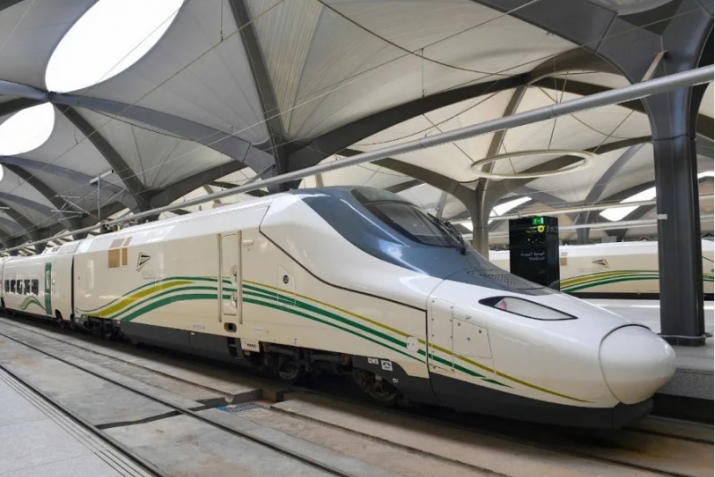
Although there was a modern highway network, the last major gap in Hajj infrastructure development remained a rail link between Medina and Mecca. In 2011 a Spanish-Saudi consortium began constructing the Al Haraiman High Speed Rail Link - a high-speed, intercity rail transport system, which connects Mecca and Medina, passing through Jeddah and the King Abdullah Economic City. The Haraiman Express achieves speeds of more than 320 km per hour, reducing travel time between Medina and Mecca to as low as 90 minutes.
The rail link is expected to carry nearly three million passengers a year, and when fully operational as many as 60 million passengers annually. The new Mecca railway station can service 19,500 passengers per hour. Partial operations commenced in December 2017 with the line opening in March 2018.
Just as the Hejaz Railway project was the largest infrastructure project in the Middle East at the beginning of the 20th century, so the Haraiman high-speed rail network is the largest regional infrastructure project of the beginning of the 21st century. The month of Rabi Al-Awwal , when all Muslims celebrate Mawlid an-Nabi, the birthday of the Prophet (sas), was a fitting time for the Haraiman Express to commence its journeys.
As Prince Khaled al-Faiusal, Governor of Mecca, rightly observed on the initial trial journey from Jeddah to Mecca, “These projects are not meant for show-off or boasting, they come about because we are entrusted with the care for this homeland which embraces the most sacred spots on earth.” The desert Bedouins called the Hejaz train, “the Iron Camel”.
Now a new mount has been provided to carry us to the holy sites. Perhaps in availing ourselves of this means of transportation, we should reflect on the words of an Islamic scholar regarding the Hajj, “when the pilgrim mounts on the animal he should remember that his body is the only mount during his journey to the hereafter.” Although the worldly train may take us to its physical destination quickly, the journey of the spiritual “train” never ends.
GUY (GHAYDAR) PETHERBRIDGE Professor, Expert on cultural heritage and history of Islam, Australia, Russia
