

UNESCO and the Islamic Written Cultural Heritage
UNESCO and the Islamic Written Cultural Heritage
The world’s peak intergovernmental body assisting in the safeguarding of mankind’s cultural heritage is UNESCO – the United Nations Educational Scientific and Cultural Organisation. UNESCO has instituted three programmes which together address this important mandate:
1. The World Heritage Programme
2. The Memory of the World Programme
3. The Intangible Heritage Convention.
The best-known is the World Heritage Programme, which documents, formally names, and conserves World Heritage Sites of outstanding cultural or natural importance to humanity. It was created in 1972 through the UNESCO Convention Concerning the Protection of the World's Cultural and Natural Heritage. World Heritage Sites include many important to the Islamic faith, including a number in Russia, Azerbaijan, Kyrgyzstan, Kazakhstan, Uzbekistan and Turkmenistan. (Visit: www. whc.unesco.org)
The UNESCO Memory of the World Programme was established in response to a growing awareness of the regrettable state of documentary heritage in various parts of the world. It works to facilitate preservation of this heritage and universal access to it, and to increase awareness of its existence and significance. (Visit: www.en.unesco.org/programme/mow)
The Memory of the World Register is an important aspect of the Programme. It lists documentary heritage of outstanding universal value. MOW Register listings include important elements of Islam’s written heritage from Uzbekistan, Kazakhstan, Tajikistan, Iran, Morocco, Tunisia, Malaysia and Egypt.
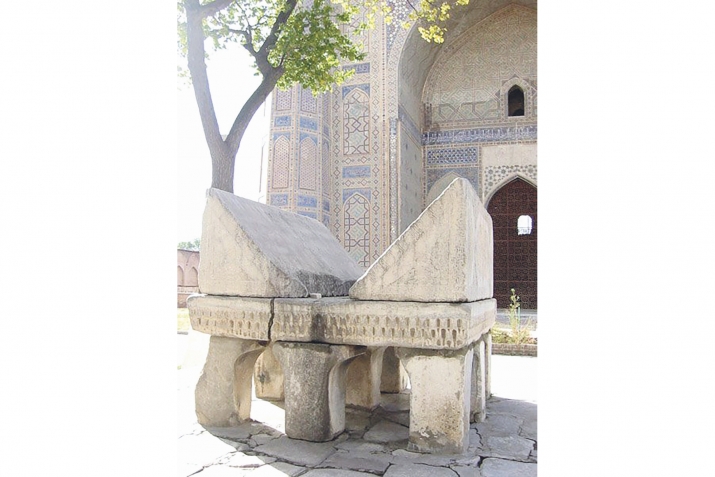
The most important item in the Islamic context is in Uzbekistan – it is understood to be part of the Holy Koran Mushaf of Uthman on parchment, which is held by the Muslim Board of Uzbekistan in Tashkent. After the death of the Prophet ﷺ, the first Caliph Abu Bakr (632-634) had all known suras written down. Later, the third Caliph Uthman (644-56) ordered them to be gathered into a book with the help of the best Koranic scholars of the time. The definitive version of the Koran, known as the Mushaf of Uthman, was prepared in Medina in 651 and was declared as the standard, superseding all other versions. This original or early copy may have been brought by Amir Timur to Samarkand from Damascus. He had a massive marble Koran stand made for it (when opened it is 1m 24cm wide) in his great Bibi Khanum Mosque, where it must have been displayed on special festival days.
Other important manuscripts of the Koran from the National Library of Egypt are included in the MOW Register: a collection of 140 dated Korans from the Mamluk period (1250-1517) when Cairo was the cultural, religious, and intellectual centre of the Islamic world.
Other important religious manuscripts on the MOW Register are writings in the medieval Turkic language (chagatai) by Khoja Ahmed Yasawi (1093-1166) and his followers, which are housed in the National Library of Kazakhstan. Ahmed Yasawi exerted a powerful influence on the development of Sufi orders throughout the Turkic-speaking world and was the earliest known poet to compose poetry in Middle Turkic. Amir Timur was a devotee of Ahmed Yasawi. The mausoleum complex he built for him in Yasi (Turkestan) is a UNESCO World Heritage Site.
Also of great interest is the MOW Register listing from Saudi Arabia of the earliest dated Islamic Arabic inscription so far identified. It is in Kufic script and mentions the date of the death of the second Caliph of Islam, Omar bin al-Khattab, who died on the last night of the month of Dul-Hajj of the year 23 Hegira, and was buried next day on the first day of Muharram of the new year 24 Hegira (corresponding to 644). The inscription is pecked into a sandstone rock face in the north west of Saudi Arabia - on an ancient trade and pilgrimage route.
Another inscription on stone is Malaysia’s Batu Bersurat Terengganu. The inscriptions (dated 702 Hegira) on a natural stone pillar are the earliest evidence of Jawi writing (Malay script based on the Arabic alphabet) in Muslim South East Asia. The inscriptions praise Allah and the Prophet ﷺ and state that the land of Terengganu was the first to receive Islam. They proclaim Islamic laws regarding indebtedness, the giving of alms and tithes, adultery and dowries.
Besides individual “landmark” Islamic documents like those above, the MOW Register also includes whole collections of items, which are grouped together because of their thematic or regional research significance. Uzbekistan’s collection of the Al-Biruni Institute of Oriental Studies, for example, is one of the most important collections of Central Asian manuscripts. Another impressive group listing is Egypt’s collection of deeds of the princes and sultans who ruled Egypt, from the Fatimid era to the end of the Mamluk era. From Tunisia is a revealing collection of archival documents documenting the practice of privateering and the international relations of the Regency of Tunis in the 18th and 19th centuries.
Another listing from Malaysia is the Sejarah Melayu (The Malay Annals), the sole indigenous account of the history of the Malay Sultanate in the 15th and early 16th century. Among Iran’s multiple MOW Register listings is an enormous collection of administrative documents from the Safavid era (1589-1735), which encompass a vast geographical area including Iran, especially Khorasan province, and Afghanistan.
The growing MOW Register includes work by some of the most famous Islamic historical authors. Morocco, for example, has listed a famous manuscript by the great historian, Ibn Khaldun (1332-1406), Kitab al-ibar, wa diwan al-mobtadae wa al-khabar, which is considered as a pioneering treatise on political philosophy.
One of the great epic tales of the Muslim world is the Shahnameh (Book of Kings) by Ferdowsi (941 -1020). Written in Persian, the Shahnameh became an immensely popular text throughout Central Asia, India and the former Ottoman Empire. The copy inscribed in the MOW Register, was made for Prince Bayasanghor (1399-1433), a grandson of Amir Timur. It is kept in the Imperial Library of the Golestan Palace in Tehran. Two other classics of Tajik-Persianate literature are combined in a unique manuscript in Tajikistan, which contains the earliest extant versions of both the Kulliyat of Ubayd Zakoni (1300-1371) and the Gazalliyt of Hafiz Sherozi (1315-1390).
Just as the Shahnameh was a classic epic tale in the world of Persianate culture, across the Indonesian archipelago the Hikayat Hang Tuah (The Epic of Hang Tuah) is probably the most loved Malay literary classic. Two manuscripts of this work in the National Library of Malaysia are included in the MOW Register.
The MOW Register also includes precious manuscripts relating to Islamic science. From Iran we have the Al-Tafhim li Awa'il Sana'at al-Tanjim, a Persian language work by the renowned scientist, abu-Rayhan al-Biruni (973-1048), which is the oldest extant Persian text on mathematics and astrology. Another scientific text from Iran is the Dhakhira-yi Kharazmshahi, by Esmaeil Jorjani, which is the first and most important medical treatise to be written in the Persian language (1110). For centuries it has been an authentic source of information on traditional medicine across the Islamic world.
The youngest UNESCO cultural heritage programme was established through the 2003 Convention for the Safeguarding of the Intangible Cultural Heritage. Cultural heritage is not confined to monuments and collections of tangible objects but also incorporates intangible traditions and living expressions inherited from our ancestors and passed on to our descendants.
The Intangible Cultural Heritage programme inscribes important elements of this heritage on the List of the Intangible Cultural Heritage in Need of Urgent Safeguarding or on the Representative List of the Intangible Cultural Heritage of Humanity. (Visit: www.ich.unesco.org)
These lists already include a considerable range of entries from across the Islamic world (81 listings from 27 countries), relating to traditional local and regional religious practices, festivities and pilgrimages, cuisine, crafts, performing arts, games, natural resource management, etc.
