

TREASURY OF BLESSED KNOWLEDGE
TREASURY OF BLESSED KNOWLEDGE
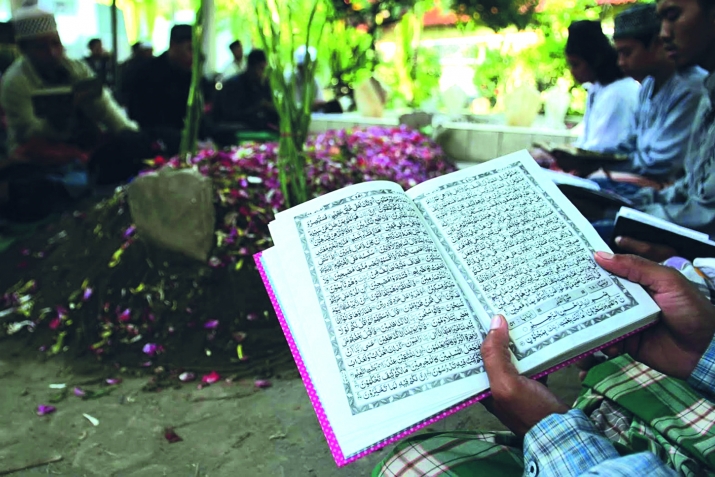
Are women allowed to visit cemeteries?
Men are not prohibited from visiting a cemetery; on the contrary, it is advisable for them to do so. The best and most popular time to visit cemeteries (az-ziyar) is after the al-’asr prayer on Thursday, Friday evening, all Friday and Saturday morning. Some scholars believe that Sunday to Monday evening is also a good time to visit the graves of the dead.
As for women, they are allowed to visit a cemetery by themselves, if it is located within the village. If it is outside its confines, then visiting it is allowed only in the presence of a man permitted by the Sharia and on the condition that this visit is made to the graves of prophets, theologians, saints (awliya), or close relatives. Visits by women to the graves of those who are not included in this list is undesirable (karaha) even within the confines of a given settlement. In addition, for women intending to visit graves, there are certain conditions, namely: it is necessary to have the permission of a husband or guardian, to be dressed only in clothes permitted by the Sharia, not to talk about worldly things in the cemetery, and not to sob and mix with men.
If the conditions listed here are not met, women are prohibited from visiting cemeteries. According to a hadith of the Prophet ﷺ, a curse befalls those women who violate the above conditions and still visit cemeteries. In short, the meaning of visiting cemeteries and graves is to appeal to the Almighty ﷻ with a prayer for the departed, to read, if possible, the Quran and remember impending death.
If women are allowed to visit cemeteries only by observing these conditions, then what about those of them who travel alone around the world for the purpose of trade? May the Almighty ﷻ help women to be content with what men provide them and stay at home!
For anyone who visits the graves of their parents on a Friday and reads the sura "Yasin" as many sins as there are letters and words in this sura are forgiven. If during his lifetime someone vexed his parents but repented after their death and asked the Almighty ﷻ to forgive them their sins, he will be like one who made his parents happy during his lifetime.
If someone reads the ayah "Al-Kursi" and asks Allah ﷻ to give a reward to everyone who is buried in the cemetery, then forty lights (nur) enter each of the graves and the graves become wider. Also, if someone reads the sura “Yasin” and gives the reward for it to the deceased, all of them will be relieved of torment and the person who reads it will receive as many rewards as there are people buried in the cemetery.
If you give the reward for reading the Quran to the deceased, will it reach him? Is it possible to increase the number of those who receive the reward for reading the Quran? Is it possible to give a reward to the deceased and can you charge a fee for reading the Quran?
For any good deed, be it prayer, fasting, pilgrimage, alms, reading the Quran, etc., a person has the right to give the reward to anyone. This reward will go to the deceased and, according to the people of the Sunna, the deceased benefits from it. Anyone who claims that the deceased does not receive a reward from reading the Quran is wrong and one should not listen to him. The fact that the deceased receives what the living give him is confirmed by many people who have known Allah (‘arifun) [1]. These are people who have the gift of true vision (kashf). There are many such examples; I will give a few of them.
Many are familiar with the name Rabi'a al-'Adawiyya [2]. She was a woman known for her holiness and true service to Allah ﷻ. After her death, a good man saw her in a dream. He asked very much from Allah ﷻ for her. In a dream, she said to him, "They bring your gift to me on a tray of light, covered with a silk scarf."
A great theologian named Ibn ‘Abdussalam said during his lifetime that the deceased did not receive a reward for the living for reading the Quran. After death, one who saw him in a dream asked, "Well, what do you say now, is the reward transferred to the deceased or not?" He admitted, "By Allah ﷻ, I was wrong, it turned out that it was transferred."
For those who claim that the deceased do not benefit, there is no argument other than the following verse. Its interpretation is canceled by another verse (nasih). The meaning of the first ayah is that a person will not gain anything else in eternal life other than that for which he has prepared in worldly life. Thus, one who has done good will find good. One who has done bad will find bad. There is no reward for the good done by others, just as there is no punishment for the evil committed by others. Everyone will be rewarded or punished according to their deeds. If these words are applied to our earthly life, then we can say, “What you do not sow in the spring, you do not reap in the fall”.
Does it make sense that it is impossible to get what another person gives you? Of course, the truth is that I cannot harvest more than I have sown. But it is not true that I cannot receive what someone else gives me. Those who try to assert that the deceased does not receive a reward for reading the Quran could say that the living cannot receive parcels sent to each other if they could not verify this for themselves.
Ibn Abbas said, "The second verse, which says that children can go to Paradise through the good deeds of their parents, cancels the previous verse." However, you need to know that this does not refer to those children who are far from Islam or who have died as apostates. You need to know this. The meaning of the second verse is that, if parents and children come from the same environment, they will enter Paradise together and that they can intercede for each other, if Allah ﷻ wills.
Intercession is all about helping. To those who belong to people who have the right of intercession, Allah ﷻ will certainly give the opportunity to intercede for each other, if He so wills. We hope so too. For people who understand, I will say that in the Holy Quran and the hadith of the Prophet ﷺ there are many arguments confirming this fact.
A woman asked the Prophet ﷺ, "Can my little son make the pilgrimage (Hajj), and will it be assessed to him?" The Prophet ﷺ replied, "Yes, maybe you will receive a reward for this, although his Hajj does not count for him as an obligatory pillar of Islam.”
Another person also asked the Prophet ﷺ a question, “My mother has died. If I give alms for her, will they reach her and will she benefit from it?" “Your mother will receive a reward for this and she will benefit from it,” the Prophet ﷺ said.
If you ask Allah ﷻ to give the entire ummah a reward for a perfect prayer, alms given and reading the Quran, then everyone will receive it without prejudice. The Almighty ﷻ will treat everyone equally, no one will receive less than anyone else because it is transferred to many. Just like the dead, the reward can be passed on to the living.
To be continued…
____________________________________
[1] ‘Arif (plural ‘arifun) - enlightened by divine knowledge
[2] Rabi’a al-‘Adawiyya (713 – 801 CE) was a prominent representative of the Basra school of ascetics (zuhhad), known for her piety and ascetic way of life. She spent several years in the desert, retired from people and subjecting herself to ascetic trials.
