
Satisfaction with the predestination of Allah and absolute submission to Him – the highest level of worship of the Lord
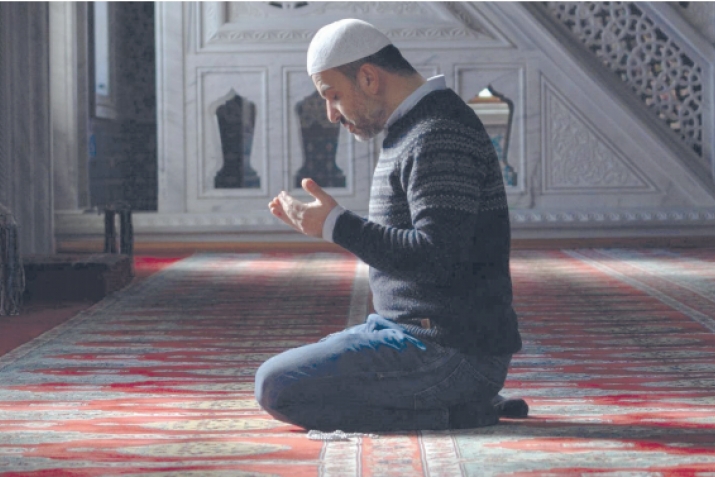
Contentment with all the predestinations of Allah and complete obedience to Him (taslim) is the highest degree of manifestation of slavery to the Lord and of worship of Him (`ibadah). It is precisely in these qualities submission and the entrusting of one’s affairs to the Almighty only that the perfection of Islam is consummated. Indeed, the possessor of the quality of submission, (even if the curse of Allah bears upon him as Satan) will still be pleased with such a predestination of the Almighty, as well as with his faith (iman) and Islam as a whole.
One who worships sincerely is always satisfied with the decision and predestination of Allah and not with his own actions. Thus, if a person finds himself in some unpleasant situation and this causes him concern, then in this instance he is a slave to his nafs. But if for him there be no difference whatever situation he finds himself in (pleasant or unpleasant), then he will truly be a slave to his Lord.
And this is the root and foundation of all matters. Therefore, you, O one who has entered the path of Allah, should constantly be a slave to the Lord, just as the Almighty and Pure Allah always remains your Lord. How beautifully this is written of in the following couplet:
“Reprimand and praise do you distinguish between them? If so, you liken yourself to non believers!”
Together, the above words express the foundation upon which the greatest sheikhs of all tariqats are in unanimous agreement.
Once, imam ash Shaarani asked his spiritual guide Ali alKhawwas , “What should I do with the poor: show generosity by giving them alms, or leave them in this state, displaying decorum (adab) towards Almighty Allah, who chose this poverty for them?” Ali alKhawwas replied: “In my opinion, it is better to observe ethics. Truly, when Almighty Allah makes a man materially poor, He does this because of wisdom He wants to show; so be aware of this.
Almighty Allah sees and hears everything in the universe, therefore show decorum to Him, leaving His creations in the state in which you find them. Do not try to change their condition without the explicit permission of Almighty Allah, because it may happen that you violate ethical norms in relation to Allah by asking Him to enrich a person whom He desired to make a pauper.
After all, the Almighty could then transfer the lot of this slave on to you, replacing what you love and are contented with by that which you do not love and you are dissatisfied with, just as you yourself tried to alter the pauper’s state which Allah desired for him. And if Allah forgives you and does not punish in this way, then this forgiveness will turn out to be a wily stratagem for you which you will not even sense and as a result you will fall into spiritual perdition together with those who have perished.”
Tranquility in complete submission
Know that the most abominable manifestation of disrespect on the part of a slave is when he insistently asks for something from the Almighty, and then, after the request has been fulfilled, asks the Creator for deliverance from the benefaction because of difficulties arising through the fault of the slave himself. But if a person had not asked for anything at all and thus manifested his modesty before Almighty Allah, then the Lord supporting His slave with a blessed outcome would endow him with much more even than this slave might have expected.
Therefore, it is preferable not to be insistent in your requests addressed to Almighty Allah. However, this stricture applies only to a supplicant’s praying for himself: as for the petitioning of blessings for others, there are no such prohibitions in this case.
Sometimes blessings are hidden in tribulations and tribulations in blessings. Thus, if we attempt to delve into the hidden meaning of blessings, we will find much which is troublesome in them.
The most minor of these troubles is the Almighty’s requirement of His slave, who possesses certain blessings, to fulfill his obligations with respect to that bestowed by the Almighty: that is, to constantly express gratitude for blessings not only with his tongue but also with his heart, ascribing these to Almighty Allah and also use them solely for purposes approved by the Creator.
But if we delve into the true meaning of troubles which have been sent us, we find that in them there are great blessings, because troubles induce in us feelings of regret, submission and humility and help us to free ourselves of arrogance.
Almighty Allah prescribed for us the performance of worship, in all its forms, and also to acquire knowledge solely so that we would fully turn to Him, the Almighty and Pure.
Accordingly, the nafs of the prophets and perfect righteous achieved the highest state of humility and submission by observing the prescriptions of Allah. That is why the nafs of those of this level are not tested by any vices and shortcomings.
Now reflect on the following. When a slave of Allah performs worship but does not cleanse his nafs, he will surely begin to admire his own actions, and then Almighty Allah (and only if He shows His Grace), may edify such a slave, for example, by urging him into the sin of adultery.
In such a way, the Almighty will humiliate this slave before his neighbors and acquaintances, despatching one to who will escort the sinner to the house of the ruler for punishment. And when they enter the name of this slave in the register of sinners, he will feel more despicable and worthless than a drop of sewage.
Once, imam ash Shaarani heard a voice in a dream: “O Abdulwahhab, hear these allencompassing words, which are the expression of all that was said in all the Divine Scriptures.” And in his dream the imam answered thus, «I listen in obedience.» And then was said: “A slave should not occupy his heart with thoughts about choosing anything, even the choice of inhalation for the next breath. However, he must honour any action that We have produced through him. And if this action is an expression of worship, then it is necessary to praise Us for it, asking for forgiveness for any omission or negligence.
But if this act is disobedience, then he should praise Us for it as a predestination (that is, a predestination of that which has happened by the will of the Almighty), asking for forgiveness for the transgression of Our command. And every carelessness or even omission should be replaced by good deeds. So We have provided you with a way to observe ethics (adab) in relation to Us in everything that We effect through your hands.”
Now you have learnt that each of our deeds is for us a medication. After all, the true disposition of a slave is that he is like a gatekeeper, standing at the gateway between the visible and invisible parts of the body and letting this or that deed pass through. And only a true slave honours every deed no matter what the situation and always remembers that he is a slave.
A person who has achieved perfection looks at the connections between things with eyes which are sound. As for faqih (experts in the explicit Sharia sciences) and murid they are blind in one eye. And everyone who considers that he can do something himself, albeit with flaws, equates himself as a companion to Almighty Allah.
Truly, Almighty Allah never requires us to do any act at all, He only says, “Do that of which I am the Creator and nothing else.” It follows from this that the degree of spiritual misgiving for the commission of a sin depends on the strength of the relationship between the act and the slave. So, in no case should a slave consider his sins to be insignificant but it is necessary to attribute extreme gravity to one’s sins as this strengthens the preparation of the heart and raises it up the steps of sincerity.
A slave who is at this level sees his sins as insignificant in comparison with the forgiveness of Almighty Allah, for then he realizes that only Almighty Allah is the true Creator and no one else. O Muslims, guard against urging a simple believer to that which relates to the level of attainment of truth by the heart do not call on him to not grieve over sins he has committed, as this will plunge him into ruin.
FROM THE BOOK “VIRTUES OF THE RIGHTEOUS” BY SHEIKH AHMAD-AFANDI, MUFTI DAGESTAN