

Before him, astronomers knew only one galaxy – the Milky Way
Seven centuries before Europe finally saw the Andromeda Nebula, a scientist from Isfahan, Abdurrahman al-Sufi, was the first in history to describe it.
Before him, the entire science of the stars was based on the work “Algamest” by the Alexandrian scientist Ptolemy (100-160); astronomers knew only one galaxy – the Milky Way.
In the 2nd century AD, Claudius Ptolemy worked in Alexandria, whose astronomical observations were reflected in his book “Algamest”, which for hundreds of years became the basis for all who wanted to delve into the science of the stars. And although the work was written in ancient Greek, Europe first became acquainted with it in the middle of the 12th century, translated from Arabic into Latin.
One of those who supplemented Ptolemy’s work and significantly expanded the boundaries of astronomical research was a scientist from Isfahan, Abdurrahman al-Sufi (903-986).
Abdurrahman al-Sufi wrote “The Book of Operations with the Astrolabe”, “The Book of Operations with the Celestial Globe” and “The Book of Introduction to the Science of the Stars and Their Verdicts”.
He revised and clarified Ptolemy’s work, established an exact correspondence between the Greek and Arabic names of stars and constellations, was the first to describe the Andromeda Galaxy and the first to mention the Large Magellanic Cloud, and made a significant contribution to the development of astronomy.
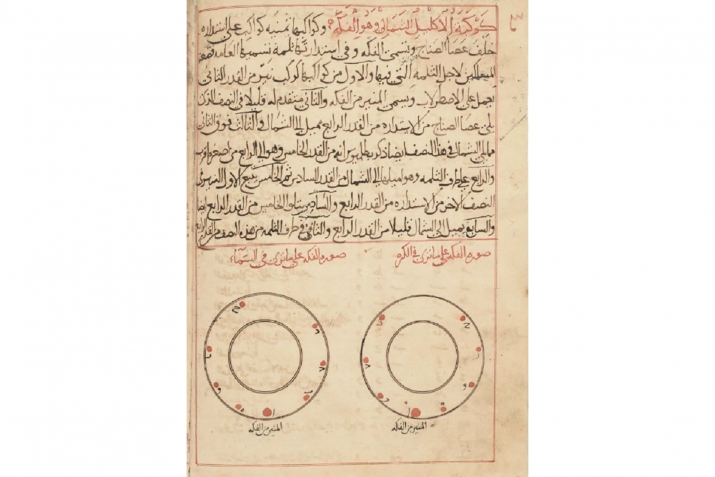
His “Book of Fixed Stars” is one of the oldest books on astronomy, in which the author described 48 constellations and mentioned 1017 stars. The original of this work from the era of scientific achievements of the golden age of Islam, unfortunately, has not survived.
Manuscript copies have reached us, one of which, made in the 15th century on the orders of the ruler Ulugbek, is now kept in the National Library of France in Paris.
Ulugbek himself is worthy of a separate conversation for his love of science and all kinds of support for scientists in his state. His famous observatory in Samarkand, in which he personally observed the stars, is known throughout the world. Therefore, it is not surprising that the manuscript of Abdurrahman al-Sufi, rewritten by his order, contains notes made by Ulugbek himself.
Two more copies of the “Book of Fixed Stars” are kept in the Bodleian Libraries in Oxford. One of them, made back in 1009, is slightly damaged and out of 48 constellations, only 43 have been described.
Another copy, from 1170, was made for the emir of Mosul, Sayf ad-Din Ghazi II. The manuscript was acquired by the library in 1693 from orientalist Robert Huntington. It has now been digitized.
“The Book of Fixed Stars” became the most important guide to the starry sky not only for the Islamic world, but for the entire human civilization.
