
A universal scientist: Ibn al-Haytham
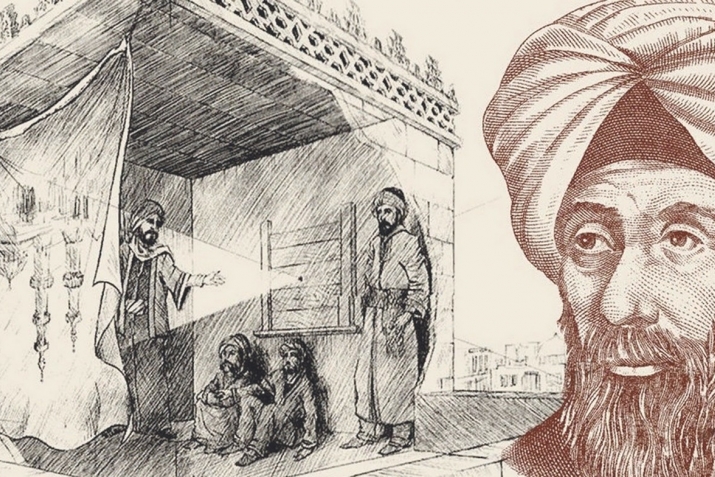
Abu Ali al-Hasan ibn al-Hasan ibn al-Haytham al-Basri (965-1039) was an outstanding Arab scientist who could be called a universal scientist: he made significant contributions to mathematics, mechanics, physics and astronomy.
In medieval Europe, his name became known in its Latinized form – Alhazen.
Ibn al-Haytham held the position of vizier in his hometown of Basra due to his outstanding talents but his true passion was science, which eventually forced him to leave this position. When information about Ibn al-Haytham’s project to regulate the waters of the Nile by building a dam below Aswan reached Caliph al-Hakim, he invited the scientist to Egypt.
On arrival, Ibn al-Haytham discovered that it was impossible to implement this project with the technical capabilities of the time (this happened almost a thousand years before the construction of the current Aswan Dam). Upon learning of this, the caliph became angry, placed the scientist under house arrest and confiscated his property. In order to save his life, Ibn al-Haytham was forced to pretend to be insane throughout the entire period of the caliph’s reign. After his death, under the new caliphs, he received freedom and respect, living in Cairo until the end of his days.
Ibn al-Haytham wrote 92 works, 89 of which concern mathematics, astronomy, optics and mechanics. In his research, he combined precise experiments with strict mathematical justifications, which gave him the opportunity to deservedly be called the “father of optics”.
In his treatise “On the Measurement of a Parabolic Body”, Ibn al-Haytham includes formulas for sums of squares, cubes, and fourth powers, as well as a number of other formulas for sums that allow calculations similar to definite integrals.
The scientist’s fundamental work is the “Book of Optics” (consisting of seven books). In the field of physiological optics, he describes the structure of the eye, relying on the works of the ancient Greek scientist Galen. Based on experience, he refutes the views of Plato and Euclid on light as rays emitted by the eye. Instead, Ibn al-Haytham puts forward his own theory, according to which “natural light and colored rays affect the eye”, and “visual perception is formed thanks to rays coming from visible objects and entering the eye”. It is noteworthy that as early as the 6th century BC, Pythagoras expressed similar (close to modern) ideas that objects become visible thanks to the particles they emit.
Al-Haytham assumed that each point of an object corresponds to a specific perceiving point in the eye, and gave the correct explanation of binocular vision. He also assumed that the speed of light is finite.
Among the experiments he conducted, the following stand out: experiments with a camera obscura, studies of the refraction of light, and experiments with various mirrors, developing the teachings of Diocles.
In the 12th century, his works were translated into Latin under the title “Treasure of Optics” (Latin: Opticae thesaurus) and had a significant influence on the development of optics in Europe. The first major European work on optics, Witelo’s Perspective, is largely based on the works of Ibn al-Haytham.
Among other things, the scientist wrote several treatises on burning glasses, as well as works “On the light of the Moon”, “On the Halo and rainbow”, “On the properties of shadows”. In addition, he wrote a number of studies on astronomy and geodesy.
A crater on the Moon was named after him. Ibn al-Haytham’s portrait adorns the 10,000-dollar banknote in Iraq.