
Does the Koran say that the Earth is flat?
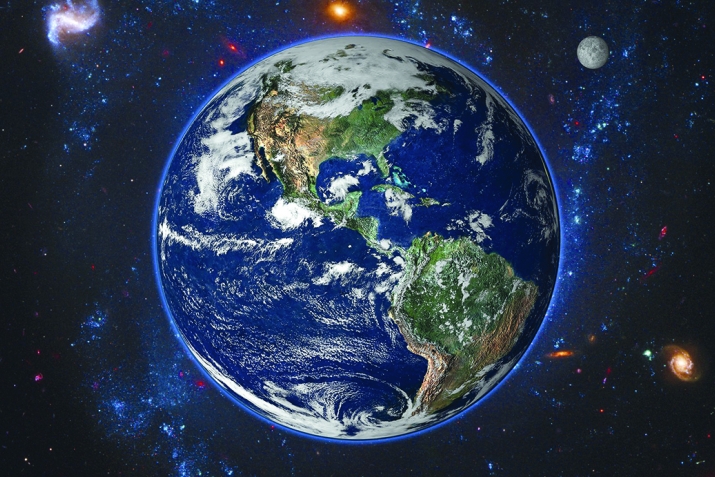
It was only in the twentieth century that mankind managed, as the saying goes, to see with his own eyes that the Earth is round.
However, the spherical form of the Earth is also described in the Holy Koran, which was revealed to the Prophet Muhammad (peace and blessings be upon him) more than 1400 years ago. In 1961, a human being made his first flight into space and circled the globe. This flight in fact proved the spherical shape of our planet.
However, there are still some people, including Muslims, who deny this fact and claim that the Earth is flat and not spherical. They not only adhere to this opinion, but also write articles on this issue in an attempt to prove (nowadays mostly on the Internet) that the Earth is flat.
There should be nothing untoward and strange in this matter, as everyone has the right to have his own opinion. However, the problem is that these people attribute the above mentioned statement to the Holy Koran and the Sunna of the Messenger of the God (peace and blessings be upon him).
This has given rise to opponents of the religion of God to claim that Islam makes unscientific claims and denies what is undeniable. For centuries people assumed that the Earth was flat. And many continued to think so, until scientific and technological progress found out that our planet is a ball that rotates around its axis at a speed of 1600 kilometers per hour. This is above the speed of sound, which is 1200 kilometers per hour.
However, Muslims thought differently even before science proved this fact: they knew that the Earth is spherical, because in the Holy Koran there is nothing confirming that the Earth is flat.
In the commentary of one of the ayah of the Koran, it says (meaning), “(Will they really not ponder) about the Earth, how vastly it is spread out.” (Sura Al-Gashiya, ayah 20)
The Almighty has spread and stretched the Earth in front of man, and no matter how much he walks on it, he sees it flat and planar. This is possible only if the Earth has a spherical shape.
The scholar al Alusi stated, “This ayah does not contradict the opinion that the Earth is a sphere or spherical in shape.” This ayah tells us that the surface of the Earth is flat and planar, therefore it is suitable for human habitation.
Another ayah says (the meaning of the commentary): “...He wraps the night around the day, and wraps the day around the night...” (Sura AzZumar, ayah 5)
The verb “kawwara” mentioned in this ayah of the Koran means “to round, to give a round, spherical shape.” The Arabs used this verb when they talked about wrapping a turban, and a turban is wrapped around the head. Imam al-Qurtubi in the book “Al-Jamiya al-Ahkam ilQuran”, commenting on this ayah, writes: “Abdullah ibn Abbas (may God be pleased with him), explaining this ayah, said:
“That which has gone from the night enters the day, and that which has gone from the day enters the night.” This is the meaning of the words of the Almighty: “He causes the night to enter the day (lengthening it), and He causes the day to enter the night (thus lengthening the night)...” (Sura Fatir, ayah 13)
This phenomenon can only take place if the shape of the Earth is spherical. If the Earth were flat, the transition from night to day and day to night would be sudden.
These and other ayats of the Holy Koran indicate that the Earth has a spherical shape. It is absurd to dispute this fact, given that science also proves the truth of this opinion. Therefore, the statement that the Earth is flat just looks silly.
NURMUHAMMAD IZUDINOV
Theologian, As-Salam newspaper writer