
Achievements of Arab scientists
Achievements of Arab scientists
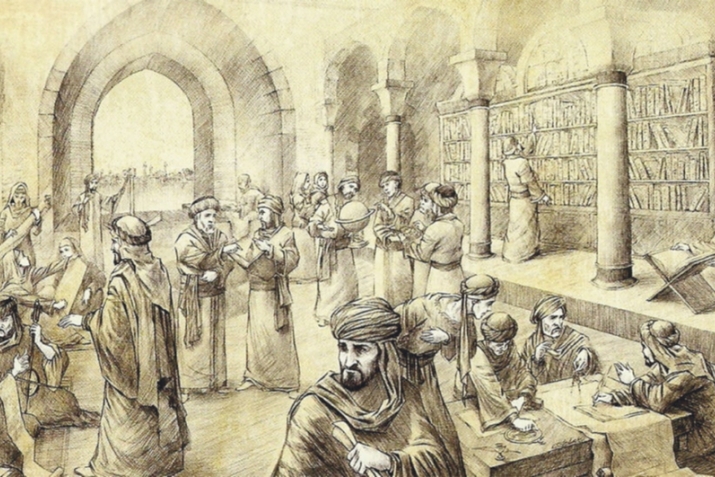
Let us remember the great European scientists, engineers, artists, and navigators who lived in the 8th-15th centuries. Unfortunately, this is generally not the case.
At that time, Europe was expe-riencing poverty, impoverishment, and degradation. It was insolvent. The Renaissance followed only as a result of many brutal crusades, which allowed Europeans to gain economic and political power. And with the beginning of geographical discoveries, a stream of wealth began to flow. Thus, due to the replenishment from enslaved countries, Europe began to develop. There was a flourishing of culture, science, and education.
At school, we were told only about the achievements of European celebrities. But not far from us, in the Middle East, Islamic scientists made many discoveries many centuries earlier, the results of which we still use today. Thus, back in the 9th century, Jabir ibn Hayyan Abu Musa developed the concept of atoms and predicted a nuclear reaction. He is the founder of the science of chemistry.
The Golden Age of Islam, or the Islamic Renaissance, is the period from the 8th to the 13th century, at the beginning of which the Arab Caliphate was the largest state of its time. In scientific and cultural development, the Caliphate was a century ahead of Europe. At that time, Islamic artists and scientists made many discoveries, playing a major role in the development of world science and culture. During the Islamic Renaissance, everything moved forward by leaps and bounds. Philosophy, medicine, physics, chemistry, and architecture were improved.
The achievements of Arab scientists helped the progress of all the peoples of the planet. Thus, in 859, the world’s first Al-Qarawiyyan University was opened in the Moroccan city of Fez, which is still operating today. Young men and women from different countries and different faiths studied there. Education was free, and the poor were paid a stipend, which became progress in the history of mankind.
This university was founded by a woman, a Muslim, Fatima al-Fihri. Deeply devoted to her faith and driven by a strong desire for knowledge, she decided to use her wealth to create charitable initiatives. This is how the legacy of Fatima al-Fihri was born, which has been preserved in the form of the University of Al-Qarawiyyin.
Scholars taught various subjects at the university: theology, grammar, foreign languages, Islamic jurisprudence, rhetoric, medicine, mathematics, astronomy, geography, history. The most valuable surviving attraction of the university library is the “Muwatta of Imam Malik” - the oldest tradition about the life of the Prophet Muhammad (peace and blessings be upon him), compiled by Malik ibn Anas al-Asbahi. As the story goes, the imam compiled this collection over the course of forty years. This university has maintained its status as an educational institution for over a thousand years, playing a key role in preserving and disseminating knowledge in such fields as Islamic, humanitarian, natural and legal sciences.
In 970, another university was opened in Cairo. In Europe, the first university only opened in Bologna in 1088: women were not allowed to study there and male students were only of the Catholic faith. In 1215, the Sorbonne University of Paris was opened. The first female student at the University of Lyon received a diploma on 17 August 1861. In England, women began to study at Oxford only from 7 October 1920. From the 6th to the 15th centuries, Europe experienced the Dark Ages, while in the East, scientists invented technologies without which it is impossible to imagine the modern world.
Amina Akhmedova
As-Salam writer