

Sultan Jahangir and the Art of Scientific Illustration
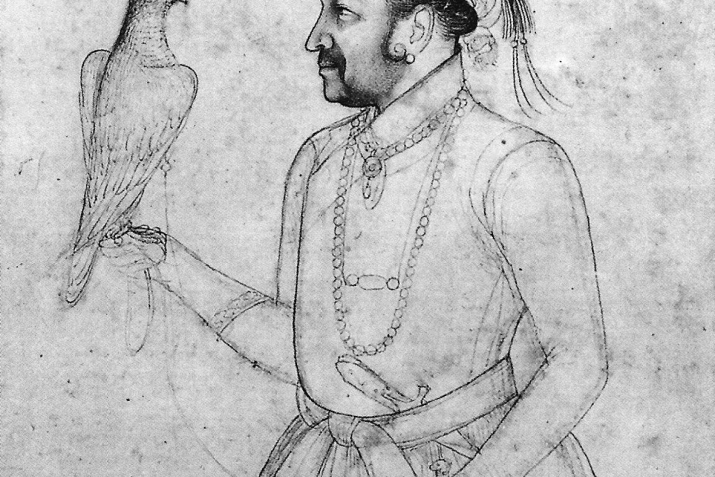
Jahangir (1569-1622), the fourth Emperor of Mughal India, and his court artists raised zoological and botanical scientific illustration to a sublime art, creating models of beauty and verisimilitude which have continued to inspire illustrators and scientists to the present day.
Throughout the long history of scientific inquiry, researchers and those commentating on science have used not only language to transmit their ideas and findings but also on visual aids. The manuscripts of the works of early Islamic scientists and Islamic translations into Arabic of their predecessors from antiquity in fields such as mathematics, physics, chemistry, astronomy, astrology, medicine and geography relied on graphic abstractions and diagrams as well as schematic pictorial imagery to help transmit their message.
However, it was really only after the Mongol invasions of the heartlands of the Islamic world and in the Persian cultural milieu that subsequently evolved that Muslim artists began depicting people and nature in the way our eyes actually perceive them.
In the early 16th century a major figure in contemporary Persianate culture was the Central Asian Babur (1483- 1530), who established Mughal rule across the northern Indian subcontinent. His autobiography, the Baburnama, reveals his deep interest in the beauties of the natural world which had become his domain but it was not illustrated. Babur’s successor, Humayun (1508-1556) commissioned paintings of particular birds which he believed were good omens.
Under his son, the great emperor Akbar (1542- 1605), birds and animals were rendered with great attention to detail in paintings made for him - but as components of larger pictorial compositions, rather than as individual portraits.
However, Akbar’s son, Jahangir (1569-1627) had a particularly avid and meticulous interest in natural history. Like Babur, he also compiled his own chronicle, known as the Jahangirnama. In it his personal responses are revealed to the beauties and wonders of the natural world he encountered. Jahangir actively sought and collected examples of species new to him and rulers and notables sent him curios of nature, for which he created special menageries and gardens. He commissioned the best artists in his realm to accurately record them individually in drawings and paintings.
Two of Jahangir’s court painters were, deservedly, his favourites – Abu’l-Hasan (1589 – c. 1630) and Ustad Mansur (flourished 1590-1624). Jahangir expressed his high admiration of both in the Jahangirnama, While Abu’l Hasan was capable of painting beautiful items of natural history, Mansur was Jahangir’s leading nature painter and produced work that rivals that of any European contemporary.
By the beginning of Jahangir’s reign, Spanish, Portuguese, Dutch and English ships were trading natural and manmade curios back and forth across the globe. In 1612 he received a consignment of animals and birds from Portuguese Goa; ordering his artists to include ‘portraits’ of these acquisitions in his illuminated copy of the Jahangirnama. These included a splendid painting by Ustad Mansur of the first American turkey brought to India.
The most famous of his bird paintings is that of the Mauritian dodo - he was the earliest artist to depict it in colour - but his work includes many birds from the Indian sub-continent as well – he was the first to illustrate the now critically endangered Siberian crane (snow crane Grus leucogeranus). The latter is in the collection of the Indian Museum, Kolkata (1625).
Jahangir took Mansur and other artists on his frequent travels across his empire, Mansur being in charge of the documentation of plants and animals. He was also a fine painter of flora but most of his flower paintings have, unfortunately, been lost over the centuries. Jahangir’s journal records that, during a trip into the Kashmir Valley, Mansur painted over a hundred different species of flowers.
Ustad Mansur’s careful depictions avoided all personal expression and are extremely valuable for their scientific accuracy, as well as their artistic perfection. In modern science the agreed procedure for documenting a type specimen for a newly identified species requires not only a precise verbal description but also an exacting visual depiction of it.
These scientific illustrations then become the point of reference for future comparison and diagnosis. Those of Mansur’s paintings which visually document species accurately for the first time are particularly important in the history of biological scientific illustration. Their subjects are, in modern taxonomical terminology, ‘type specimens’. Mansur was an inimitable master in this regard.
His painting of the flightless Mauritian dodo (Raphus cucullatus), was made from his own observations of a living bird in 1625, and is cited by biologists as the most accurate surviving representation. The species was hunted by Europeans and became extinct in 1681. Two live specimens were brought to India in the 1600s and the specimen depicted might have been one of these.
Mansur's depiction of the bird (together with four other bird species on the same page) was rediscovered in the collection of the Institute of Oriental Studies of the Russian Academy of Sciences (St Petersburg) and created a sensation when presented at the XII International Ornithological Congress at Helsinki in 1958.
Ustad Mansur also painted exotic animals, including a Burchell's Zebra (Equus quagga burchelli), which was given to Jahangir by Mir Ja'far, who had acquired it from Turks travelling from Ethiopia. The Jahangirnama records that the animal was presented to him during his Nowruz (New Year) festivities in March 1621. The painting is now in the collection of the Victoria and Albert Museum, London, UK.
Abu’l-Hasan became the foremost portrait painter of his day, his main task being the documentation of events at the imperial court. Although he appears not often to have painted individual being from nature, he was certainly capable of producing splendid works of scientific illustration, as we see in his manuscript painting (c.1610-1615) of an Indian bird called the Spotted Forktail (Enicurus maculatus).
This was included in the Shah Jahan Album (compiled for Jahanagir’s son and successor), which is now in the collection of the Metropolitan Museum of Art, New York. Jahangir ordered this depiction from the artist, its inscription stating that the emperor’s servants caught this particular bird.
Jahangir’s fascination with nature and the exacting likenesses of specimens of flora and fauna which Mansur produced for him set the tone for a tradition in Indian painting which continued to the age of photography and beyond. Over the next two centuries Mansur’s works were often emulated by other artists, especially in works intended for the well-developed European export market.
His style of nature painting ultimately contributed to the ‘Company’ school of natural history painting which became popular in British India and other European territories of colonial South Asia in the late 18th and 19th centuries.
By that time natural history depictions had become popular across the globe – in China, Japan, Europe and the overseas dominions of European powers and the USA – as represented by many astounding painters such those belonging to the Dutch school of still life painters in the 17th century and John Gould and John James Audobon in the 19th century.
All, ultimately, owe a debt to the artistic talents and scientific powers of observation of Ustad Mansur and Abu’l-Hasan and their sponsorship by the Mughal emperor Jahangir.
GUY (GHAYDAR) PETHERBRIDGE
Professor, Expert on cultural heritage and history of Islam, Australia, Russia
