
Nail dyeing and ablution
Ablution, Islamic wudu, is the minor ritual purification performed before prayers, circumambulation of the Kaaba, recitation of the Quran, etc. It is said that being purified is half of faith. Prayer without purification will not be accepted. That’s why I would like to speak about certain mistakes of Muslim women in performing ablution or prayer.
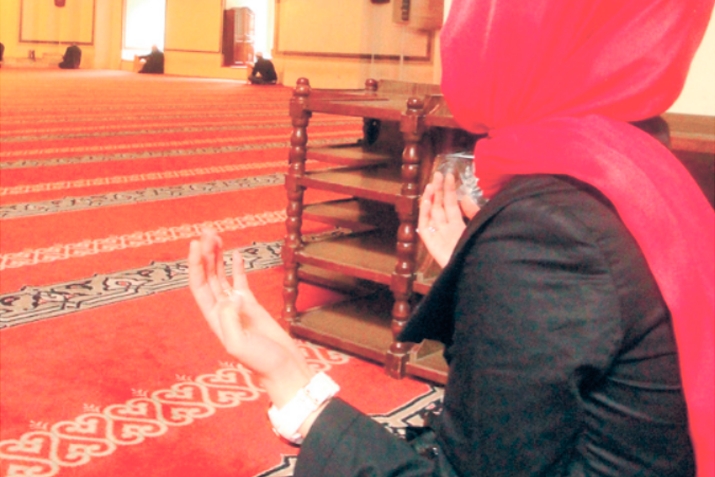
Sometimes while performing ablution and prayer in a mosque or in prayer rooms of markets or state institutions, we women accidentally notice certain mistakes of our sisters in faith, when they do not pay attention due to their ignorance or carelessness.
As we know, prayer is the first thing a person will be asked about for on the Day of Judgment. Therefore, as Muslims it is extremely important for us to perform our prayers correctly and in the proper way, as well as to perform ablutions with the same degree of responsibility. Al-Bazzar narrates the following hadith: “A person who omits prayer has no relation to Islam, and there is no prayer without ablution.”
At-Tabarani said: “There is no faith without honesty, no prayer without ablution, and no religion without prayer. Verily, in relation to religion prayer is like a head for the body. ”
In one of his hadith our beloved Prophet Muhammad (peace and blessings be upon him) tells us about the value and dignity of minor ablution: “Whenever a man performs his ablution when intending to pray and he washes his hands, the sins of his hands fall down with the first drop. When he rinses his mouth and nose, the sins of his tongue and lips fall down with the first drop. When he washes his face, the sins of his hearing and sight fall down with the first drop. When he washes his arms to his elbows and his feet to his ankles, he is purified from every sin and fault like the day he was born from his mother.” (Narrated by Malik and al-Nasai).
The minor ablution consists of obligatory elements (farz) which everyone must know and observe, for the prayer of those who does not follow them is not completed. They are:
- Intention (while washing the face).
- Washing of the face.
- Washing of both arms to the elbows.
- Wiping the head.
- Washing of both feet to the ankles (once).
- Following the exact order mentioned above.
The following are frequent mistakes made by Muslim women during ablution:
The intention for ablution is mistakenly made only when washing one’s hands, while it must be kept in one’s heart when washing the face as well;
The face is not washed completely, the area near the ears and the upper part of the forehead may remain entirely dry. The face must be washed thoroughly, including the ears and upper forehead;
Some women do not wash their arms to the elbows, as prescribed. Washing of arms includes the elbows as well;
Feet must be washed to the ankles; nevertheless some females wash only the feet.
Allah Almighty said (meaning): “O you who have believed, when you rise to [perform] prayer, wash your faces and your forearms to the elbows and wipe over your heads and wash your feet to the ankles.” (Surah Al-Maidah, verse 6).
There are situations when some women perform ablution with a makeup on their face. They do not wash off their makeup, forgetting that nothing should prevent the water touch the skin. The face and other ablution parts of the body must be entirely wet so that water drips from them. But as we know, modern cosmetics, waterproof mascara, lipsticks and wax gels, eyebrow pencils and foundations with a dense texture prevent the water touch the skin: this means that the ablution is not performed in proper way.
There are girls who perform ablution with nail polish. It is clear that such ablution is invalid. The washed parts of the body must be entirely clean from varnish, glue and paint - all that prevents water from touching the skin and nails in these areas.
When washing the front of the head (the upper part of the forehead), some use only two or three fingers and wipe with them the area between the eyebrows and a little bit above them, and thus do not touch their hair at all: this is also a mistake.
In cold weather, some females merely wipe their woolen socks instead of washing their feet (claiming that their husbands allowed them to do so). It is only allowed to wipe one’s socks during ablution if they (socks) are solid (without holes) and made of leather.
Moreover, it is not desirable to be involved with other affairs and talk during ablution. It is permissible to speak only in case of warning, e.g., when a blind man is approaching a drop or another dangerous place.
t is reported that Abu Hurairah (may Allah be pleased with him) said: “I heard my beloved friend (Prophet Muhammad, peace and blessings be upon him) say: “The adornment of the believer in Paradise will reach the places where the water of Wudu (ablution) reaches (his body).” (Narrated by Muslim). In other words, these adornments will cover those parts of body that the believer washed during minor ablution (wudu) before prayers, etc.
The following are frequent mistakes made by Muslim women during prayers:
Women must cover themselves, except their faces and hands, with material that covers the skin throughout the prayer. No hair should protrude from under the scarf. Unfortunately, not all of these requirements are observed: there are many examples of those who ignore not only a single, but leave a whole strand of hair against to their cheek. Others do not entirely cover the chin or part of the neck: this also makes the prayer invalid;
Revealing the arms is another frequent mistake made by sisters. When praying, you should wear clothes with long sleeves or with special coverings for the arms;
If the sleeves do not fit you closely, they may expose those parts of your arms that must be lowered during the prayer;
When bowing (ruku) or prostrating (sujood), some part of the back becomes exposed;
nother common mistake is wearing translucent headscarves, mesh work sleeves, loose socks or stockings that do not properly cover hair and skin. An obligatory requirement for prayer is the entire covering of awrah that is the whole body, except for the face and hands up to the beginning of arms.
When praying, one must not look behind or around, or make any gestures or signs. Nevertheless some worshipers neglect the rules and even try to talk during prayer. For example, I myself have heard praying sisters giving instructions to pick up their fallen mobile phone, or telling someone to leave the room, or during collective prayers have been teaching little girls the order of recited surahs and words of the prayer. As a rule, it is forbidden to pronounce even one extra letter during the prayer.
When prostrating, some people try to adjust their prayer mat with their hands or forehead: this is also absolutely forbidden.
When prostrating, we must touch the prayer mat with our forehead. But some sisters have their foreheads covered with scarves, which makes the prostration invalid.
In this article I have tried to review only some of the frequent mistakes that all of us may notice. However, Allah Almighty alone knows who reverently rises every day for prayer, and whose prayer is more valuable and beloved by Allah Almighty.
May the Almighty accept all of our fasting and prayers, forgive our sins, protect us from mistakes, increase iman (belief ) in our hearts and make us diligent in worship and striving to achieve the contentment of Allah. Amin.
BARIAT MAGOMEDOVA