
Flowers of Devotion: Women who Heal
“There is no disease that Allah has created for which He has not also created a remedy.” (Sahih al-Bukhari 5678)
In 1465, an elderly Turkish physician, Sherefi ddin Sabuncuoglu, presented a book he had written to Fatih Sultan Mehmet II in Istanbul, which he had conquered twelve years before. Sabuncuoglu had travelled there from Amasya in north central Anatolia, a favoured city of the ruling Ottoman dynasty with whom he and his family had. close connections as doctors and scholars. From the 9th century onwards, it was customary across the Islamic world to provide charitable facilities for public health care, physical integrated with spiritual, to all regardless of religion or ethnicity and to train medical personnel in these establishments. For many years, Sabuncuoglu had served as director of the hospital in Amasya, the Dar us Shifa (House of Healing), built in 1308-9 by Ildus Hatun, wife of the Il Khanid Sultan Olcaytu.
Sabuncuoglu’s book, Cerrahiyet’ul Haniyye (Royal Book of Surgery), is a landmark in the history of Islamic medicine. Written in the author’s own hand, it is an manual of surgery the first medical textbook to be written in Turkish rather than in Arabic or Persian and the first in the Islamic world to provide explicit illustrations (in this case by Sabuncuoglu himself) of how physicians should carry out the procedures described.
The manual is also unique in the history of pre modern Islamic medicine in depicting female as well as male doctors undertaking specialist operations. Although there is an abundant historical written record of Muslim women specializing in health care at all levels, women were infrequently depicted in medical contexts usually the birth of famous male figures in Islamic history or literature, such as Rustam. In all these cases, male doctors are doing the supervising with women in attendance.
Nevertheless, birthing and female health care in general was customarily the responsibility of women healers and midwives: there was a general discomfort in traditional Islam about male doctors examining or physically treating females, except in cases of extreme necessity, a perspective shared by a number of prominent Muslim scholars, including Ibn Hanbal, Ibn Khaldun and Ibn Al Jazzar.
Women as caregivers and healers are fundamental to human society. In Islam, women nurses were praised from the time of the Prophet Muhammad (pbuh) himself. By popular tradition, the first nurse (today we would call her a doctor) in Islamic history was Rufaydah bint Saad (also known as Rufaydah as Aslamiyyah).
Among the first in Medina to accept Islam, Rufaydah acquired medical knowledge and skills by assisting her physician father, Saad al Aslamy. She devoted herself to nursing and general medicine and would treat patients at the Mosque of the Prophet in Medina. In times of holy war she led volunteer nurses to treat the wounded in field hospitals to which the.

Prophet (pbuh) himself directed all casualties. Rufaydah also worked as a social worker, helping to address community health issues, orphans and other children in need, invalids and the poor: Arabic biographies describe her as an exemplary nurse: kind, compassionate, a good leader and a willing and effective teacher. A number of other Muslim women are remembered as nurses and doctors in the time of the Prophet (pbuh), including the learned AlShifa (Laila) bint Abdullah, Umm Attiyah (Nusayba bin Harith) al Ansari and Umm Umara alAnsariyah.
The first record of women actually working in a Muslim hospital are Sudanese nurses employed in the 9th century at the one of the first great hospitals of the Islamic world, ad Dimnah in Kairouan, Tunisia, which was built in 830 by the Aghlabid ruler of Ifriqiya, Ziyadat Allah I (r. 817-838).
Throughout pre modern Islamic history, women’s innate concern for the health of those closest to them was extended to society in general. Countless believing women sponsored the construction and ongoing operations of hospitals and medical schools.
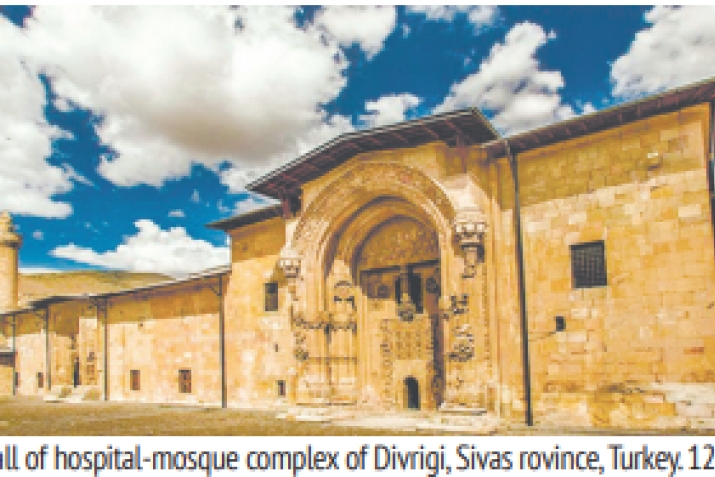
A paradigm of the many medical institutions sponsored by a woman is the magnificent mosque and hospital complex built in 1228-9 in the small town of Divrigi in Sivas province in central Turkey. The inscription on the hospital’s (Dar us Shifa) portal records its foundation by Turan Malik (“al malika al adila”, “the just queen”), the daughter of Fakhr al Din Bahramshah, ruler of the Mengujekid dynasty. The complex is among the most important Islamic monuments in Anatolia and was included in UNESCO’s World Heritage list in 1995.
The practices and institutions which for more than a thousand years provided health care in the Islamic world began to be challenged and eroded with the advance of western European powers and alternative approaches to medicine into the traditional Islamic world in the late 18th and 19th centuries.
New Western discoveries in biomedicine and medical treatment which were to have such a positive effect on the health of humanity were seen as contradicting rather than complementing traditional Islamic medical knowledge from which, paradoxically, they had grown in the mediaeval and renaissance periods.

Colonial assumptions of superiority over non Europeans were compounded by negative European conceptions of the nature of women and their place in society. All women be they colonizers or colonized were considered incapable of and barred from becoming doctors. It was not until 1849 that Dr Elizabeth Blackwell became the first woman to graduate from a medical school in the USA, while in England the first woman to do so was Dr Elizabeth Garrett Anderson in 1865 (later also becoming the first woman to obtain a medical degree from the University of Paris).
Even when these gender barriers had become broken down for Western women, prejudices continued to confront Muslim women in the colonial world well into the 20th century. A heroic example of one who prevailed against such obstacles was Dr Tawhida Belsheikh who became the first Tunisian Muslim woman to graduate as a physician under French rule.
In 1928 she became the first native Tunisian to receive a Baccalaureate degree and graduated in medicine in Paris in 1936, against strong objections from relatives to whom her mother firmly responded, “My daughter wants to study and learn and you know very well that this is required in Islam for both women and men.”
From the 1920s onwards, the USSR was notable for its constructive role in promoting equality of education, resulting in many women excelling in the medical professions across its vast Muslim majority regions, a legacy which continues today in the Russian Federation.
Recent UNESCO statistics have revealed that in a number of Muslim majority countries more women are graduating in science than men a trend reflected in those entering the medical professions. Today the challenges to Muslim women being professionally engaged in medicine are primarily those of economic and geographic access to education.
Dr Tawhida Belsheikh’s struggle in the first half of the 20th century can be contrasted with the opportunities open at the start of this century to Dr Iqbal El Assaad, a young Lebaneseborn Palestinian refugee who in 2013 at 20 years of age achieved international acclaim as the world’s youngest woman doctor after graduating from Cornell University’s Qatar branch. Since then she has qualified as a specialist in paediatrics at the Children’s Hospital, Cleveland, Ohio, USA, and is now a practicing paediatrician and already publishing research into paediatric cardiology.
She hopes to ultimately return to the Middle East to provide medical care to children in the camps of Palestinian refugees whose health concerns inspired her to become a doctor.
This article is the third in the series “Flowers of Devotion”, highlighting and honouring the many special achievements of women in Islamic society.
GUY (GHAYDAR) PETHERBRIDGE PROFESSOR, EXPERT ON CULTURAL HERITAGE AND HISTORY OF ISLAM, AUSTRALIA, RUSSIA