
Flowers of Devotion: Two Women Leaders in Mosque Design
Proposed design for Mosque and Museum of National Harmony, Pristina, Kossovo. Designer Zaha Hadid.
This article is the one in a series, Flowers of Devotion, devoted to the many and varied creative roles played by women in Islamic society internationally some long traditional and others in adaptation to our ever changing world.
In a worthy endeavour customarily the province of men that of the design of new mosques and religious structures women have nevertheless at times played a significant role; as sponsors or patrons, for instance, such as Fatima Al Fihri, who founded the mosque and madrasa of Al Qarawiyyin in Fez, Morocco, in 859. This madrasa is considered to be the oldest continually operating educational institution in the world and has produced numerous scholars who have strongly influenced the spiritual, intellectual and academic history of the Muslim world. The imperial mothers of the Ottoman court also were active sponsors of religious structures, the most significant being the Yeni Valide complex in Eminonu, Istanbul, built (1597-1665) by the mothers of sultans Mehmed III (Valide Salize Sultan) and Mehmed IV (Valide Kosem Sultan), the largest religious complex built in Istanbul in the post classical era.
Separate women’s mosques have existed in China for several hundred years. By the mid 17th century Muslim Hui minority communities in the provinces of Henan, Shanxi and Hebei had started to strengthen theological learning among the women. Quranic schools for girls were eventually transformed into mosques run solely by women either special separate buildings or mosques attached to an existing larger mosque. They continue today their congregations are led by women who are the wives of imams. They also are a part of the Dagestani tradition: there are two post medieval women’s mosques, for example, in Kubachi, Dakhadaevskiy region, a mountain village long famous for its craftsmanship in metal and carved architectural decoration in stone.
In recent years two Muslim women architect designers, Zeynep Fadıllıoğlu and Zaha Hadid have made a significant impact internationally in mosque building not as patrons or sponsors but in the field of mosque design and construction. Both have quite different styles but both combine a sophisticated mastery of contemporary building technologies with a noticeably feminine elegance in their design of modern places of worship within the Islamic tradition.
Zeynep Fadıllıoğlu (b. 1955) is a prominent Turkish architectdesigner. Educated at Inchbald School of Design in London, she has created a flourishing international design practice and is a recipient of a number of major international accolades, including the Andrew Martin International Design Award in 2002, and the Modern Designer of the Year Award at the Design and Decoration Awards of British Industry in 2005.
With the advancement of the Turkish economy and a resurgence of Islamic values in recent decades, there has been a correlated increase in the sponsorship of Islamic cultural projects in the country. Many of the great Ottoman mosques and religious sites have been carefully tended and conserved, whilst numerous new mosques and religious complexes have been constructed. Many of these conform to a conservative Ottoman formal tradition, whilst some are more adventurous in their design approaches.
A few of these new Turkish religious buildings are in the forefront of new perspectives on design and construction in the broader Muslim world internationally. Perhaps most noteworthy amongst these is the little mosque of Şakirin in the suburb of Uskudar on the Asian side of Istanbul.
Şakirin Mosque is located at an entrance to Karacaahmet Cemetery, one of Istanbul's oldest. It was built in memory of the philanthropists, İbrahim and Semiha Şakir (who are both buried in the cemetery), in gratitude by their children and was opened in 2009. The name Şakirin is also an allusion to the Arabic word for ‘thankful’.
The mosque's structural architect was Hüsrev Tayla, known for his work on Kocatepe Mosque in Ankara and for his architectural conservation work. However, as he left the mosque’s construction before its completion, its conclusion was entrusted to Zeynep Fadıllıoğlu, a great niece of Semiha Şakir. The mosque can accommodate up to 1,200 people: 250 in the main prayer hall, 150 on the specially designed balcony reserved for women, and 600 more in the courtyard.
The external corpus of this building is clad in a glistening aluminium composite in a fish scale pattern) and has two minarets. The fountain in the courtyard was designed by British sculptor, William Pye. The sleek, metallic form and dark grey Kayseri stones of the exterior complement and contrast with the light and space inside.
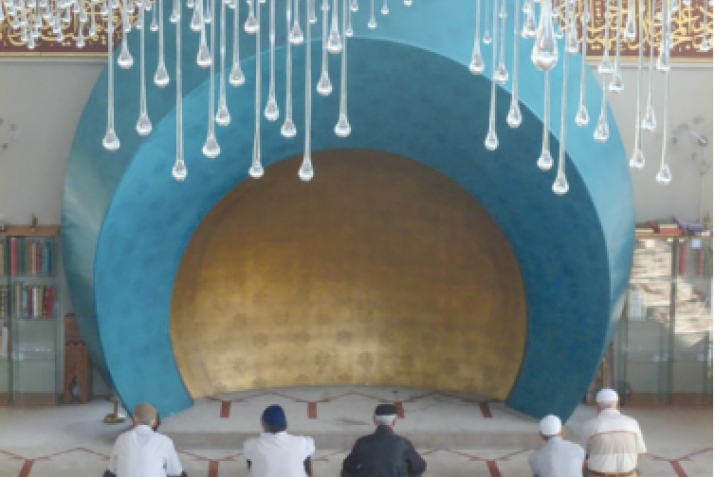
Fadıllıoğlu designed the interiors, combining modern technologies and materials with visual elements from traditional Islamic art. On entering the mosque one’s attention is immediately drawn to the mihrab, a graceful curved minbar and a massive chandelier with glass pendants. The prominent mihrab is a vibrant turquoise and gold. The gracefully curving minbar is made of cream colored acrylic with vegetal patterns representing the universe, the work of Tayfun Erdoğmuş. The hand knotted mosque carpet is of camel hair, with the places to perform prayers defined by burgundy lines.
The large chandelier consists of three of large nested circles and features God’s 99 names.
Its defining visual elements are hand-blown crystal drops by Nahide Büyükkaymakçı that give the impression of water flowing down gently like rain (Allah’s compassion) falling on those worshipping below.
Rather than solid walls, three sides of the prayer hall have huge windows covered in intricate metalwork were designed by Orhan Koçan. They allow light to stream in, «caressing you much like the pages of the Koran,» explains Fadillioğlu. The overall impression is one of light, space and elegance.

Conscious of the need to pay special attention to women, she has ensured that the women's upper gallery matches the men's area of the mosque in both size and beauty. It is separated from the rest of the mosque by a just a simple railing. When the time came for Fadillioğlu to craft the inside of Şakirin Mosque, she purposely placed the women's section in one of the most beautiful parts of the lightflooded dome. «I positioned them on the upper balcony, because during prayer the women must be behind the men,» she explained. «But I also decided to make the balcony level one of the most beautiful areas, with the chandelier crystal droplets just in front, and where you can see the mihrab from the best angle.»
After the mosque’s inauguration in 2009, Emine Erdogan, wife of the Turkish President, Recipe Tayyip Erdogan, said, “This art is the proof that there is no distance between women and mosque in Islam.” The Republic of Turkey has a policy of enhancing spaces for worship allocated to women. In 2011, Istanbul’s former deputy Mufti, Muslim jurist Kadriye Avci Erdemli, implemented the ‘Beautification of Mosques for Women’ campaign, which strove to improve the facilities and conditions of women-designated areas in the city’s mosques. Imams were also advised to educate their congregations on the roles of women in mosques. The result has been a reported rise in women’s attendance in mosques by 70 percent.
Commenting on her approach to mosque design, Fadillioğlu states: “All religious buildings have a common goal opening the path to believers to connect wıth their divinity;” Every place of worship has one thing in common, «Serenity;» «Beneath the big dome you feel humility.”
Following her work on the Şakirin project, Zeynep Fadillioğlu has had two major mosque design commissions in Qatar, the Friday Mosque and the Golden Mosque (Katara Cultural Village) in Doha.
Whilst the small Şakirin mosque serves a local community neighbourhood, British Iraqi architect Zaha Hadid has conceived a number of mosques designed to meet the needs of much larger congregations. Unlike those of Zeynep Fadıllıoğlu, however, none of these has yet been built.
Zaha Hadid was born in Mosul, Iraq, in 1950 to an industrialist and politician father and an artist mother. She studied at the American University of Beirut and then the Architectural Association School of Architecture in London, where her professor considered her the most outstanding pupil he ever taught. After graduation in 1977, she went to work for her former teachers in the Netherlands and opened her own architectural firm in 1980. She went on to lead one of the world’s largest and most successful architectural practices, with over 400 staff internationally.
She is the recipient of many of the world’s most prestigious prizes for architecture and was made a Dame Commander of the Order of the British Empire by Queen Elizabeth II in 2012 for her services to architecture. In 2008, she was ranked 69th on the Forbes list of «The World's 100 Most Powerful Women». In 2010, New Statesman magazine listed Zaha Hadid at number 42 in their annual survey of «The World's 50 Most Influential Figures 2010».
Zaha Hadid developed an adventurous, ground breaking style, and was described as the «Queen of the curve», who «liberated architectural geometry, giving it a whole new expressive identity.»