

Flowers of piety: muslim women And the business of pottery
Flowers of piety: muslim women And the business of pottery
Mankind has a unique relationship with clay: a number of times the Holy Koran reveals clay as a core element of our creation by the Almighty Allah 3:59; 6:2, 15:26, 20:55 and 55:14. The latter verse is considered to refer specifically to clay used by potters.
Clay is the core component of earthenware pottery one of mankind’s earliest and most significant inventions. Up until the period of the industrial revolution when pottery began to be factory mass-produced in Europe, it was made everywhere entirely by hand. The basic raw materials and fuels used were commonly available and no elaborate workshop equipment was needed.
For those with the necessary skills it was easy to produce multiples of the same pottery form which could thus be supplied to others. Pottery making thus became a business its products could be sold or exchanged for other goods. Being extremely durable, the remains of pottery left by our ancestors provide valuable archaeological evidence for understanding past societies. We all continue to use pottery in some form every day.
As Islam spread across Asia and Africa from the 7th century onwards, age-old pottery making traditions continued in many localities, while new processes and forms were also invented by Muslim craftspeople. Many of our places of worship were embellished with fine ceramics and the great museums of the world today proudly display Islamic ceramics from a diversity of places and periods as masterpieces of human creativity.
However, the ceramics most often admired, collected and displayed as pinnacles of Islamic art and design are works in glazed earthenware which were almost exclusively the products of male craftsmen.
They in no way adequately represent the complete past or present reality of pottery production and creativity in the Muslim world. The widespread (and continuing) traditions and outputs of Muslim women working with clay are almost entirely neglected in our commonly shared perceptions of what constitute the great crafts of Islam.
Up until the 19th century when ceramics began to be factory mass-produced in Russia, pottery was made by hand in many places throughout its expanding empire. Today, however, only one place remains in the Russia Federation where hand-made pottery production still flourishes in continuance of local traditions the village of Balkhar in Dagestan’s Caucasus mountains. Here pottery making has been a significant women’s business from time immemorial.
Elegant vessels are formed by hand on simple low turntables in a variety of forms and sizes. Folk toys are also made in fired clay. The craftswomen’s wares are not glazed but decorated with earthen slips in flowing patterns of ancient origin.
Across the Caspian Sea to the east beyond the deserts and steppes of western Central Asia rises another zone of high mountains the Pamirs. There in the Badakhshan region of Tajikistan in a natural and cultural environment remarkably similar to that of Balkhar in the Caucasus, Muslim women also produced pottery by hand for similar functions up to the mid20th century.
They too made toys for children. Fortunately, ethnographers were able to document their traditions and to deposit a rich collection of their achievements in the National Museum of Ethnography in Dushanbe.
In central Afghanistan in another region of mountain Tajik Muslim culture the famous pottery making village of Istalif perches high above the Shamol Plain some 35 km from Kabul.
Istalif is well known in Muslim history as a favourite retreat of Babur, founder of the great Mughal dynasty of India his mother is said to be buried there. There women are also involved in traditional pottery production. However, unlike their present and past sisters in Dagestan and Badakhshan, they do not make pots entirely themselves but in cooperation with the men of their family: their role is restricted to decoration.
Pots are turned by men using a kick wheel and, after drying, are coated with a thin clay slip and dried again. The women then inscribe designs through the slip layer to the body of the pot below geometric and vegetal motifs and minareted mosques are most popular today.
The men then coat the pots with glaze and fire them in a special kiln. In the finished wares the women’s flowing designs stand out as black under the lustrous turquoise glaze traditional to Istalif.
The potters of Istalif trace their ancestry to potters from communities of Central Asia to the north west, with whom they share common technical, social and religious craft traditions.
Throughout the Islamic period, pottery production in Central Asia was almost exclusively the domain of men working with the kick wheel and who belonged to religionbased pottery guilds which strictly controlled all aspects of the craft.
Women performed supporting roles but were not permitted to be engaged in actual pottery making, although in some places individuals specialized in producing traditional folk toys and whistles (particularly popular during the spring Navruz celebration). In the Soviet period some, such as Khamro Rakhimova of the pottery centre of Uba near Bukhara, achieved fame as craftswomen across the USSR.
A rare exception to the custom of the segregation of women in pottery making in Muslim Central Asia is among the Uighur potters of Kashgar in Xinjiang, western China, where women assisted their menfolk in the decoration of their wares (they also made a range of folk toys). This tradition continued until some ten years ago when the traditional pottery makers of the ancient urban heart of Kashgar were relocated: their current status is unclear.
The gender defined divisions in pottery making technologies in the Muslim world between women who hand build their wares and men who throw pottery on the kick wheel is found also in Anatolia. There pottery making in Muslim communities has been overwhelmingly the realm of men.
As in Muslim Eurasia, however, there are exceptions. Notable are the women potters of Sorkhun near Eskishehir in westcentral Turkey, who hand build a range of special vessels in which one of the country’s favourite dishes is cooked guvec (ovencooked meat and prawn stews).
Their wares are sold in Istanbul, Bursa and many other places. In Sorkhun, men assist the women in the finishing processes of making their pottery.
In the Muslim Middle East and coastal and lowland North Africa, male craftsmen have long dominated ceramic production. However, in the mountains of the northwest of the continent, pottery making is very much a female occupation.
While in urban centres of Tunisia, Algeria and Morocco male craftsmen continue to produce splendid glazed ceramics decorated using the ‘classic Islamic’ vocabulary of geometric interlaces and arabesques, women in northwestern Tunisia, Algeria’s Kabylia and the Rif mountains of Morocco work in completely different technical and aesthetic traditions hand forming their wares and decorating them with ancient indigenous motifs.
What is more, their products particularly those of the Moroccan craftswomen have caught the eye of the contemporary tastes of connoisseurs across the globe and have a respected and competitive place in the extensive international homewares market, contributing significantly to household economies in rural areas where the potters live and work.
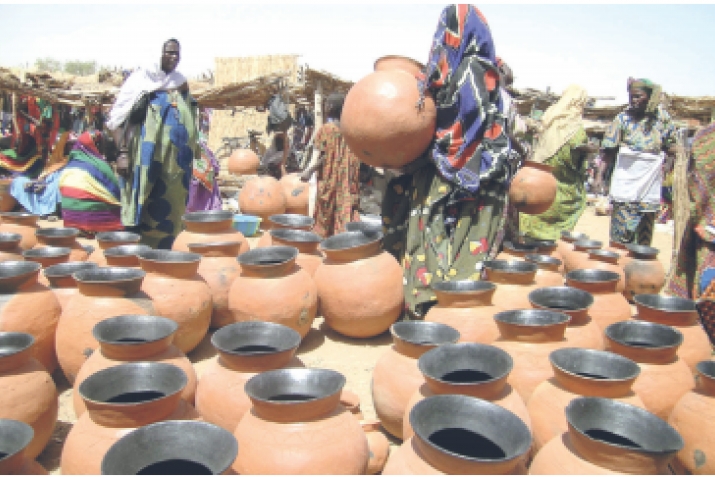
But there are other areas of the Muslim world where women potters can truly be said to reign in terms both of the volume of manufactures and their contribution to domestic incomes. In Islamic Africa south of the Sahara from Nigeria to Guinea literally thousands of Muslim women potters continue to produce hand built pottery in a great diversity of techniques and forms for local consumption and trade as artifacts central to traditional ways of life.
At the other end of the Muslim world in Indonesia home to the globe’s largest Muslim population, women also play an exclusive or primary role in traditional pottery production. Particularly noteworthy are the women potters of Lombok, the so called ‘Island of 1,000 Mosques’, just to the east of the famous resort island of Bali.
Here women maintain a flourishing and growing pottery industry, producing forms traditional to local needs as well as those specially tailored to trends in the international homewares market. In Lombok’s successful current venture in promoting itself as a Muslim friendly tourist destination, its many pottery centres are a major attraction.
Although we have no precise statistics, it appears that across the Muslim world, many more women than men are today are engaged in craft ceramic production. Many local, national and international organisations are supporting Muslim women craftsmen in the preservation of their traditions and their entrepreneurial endeavours.
The Turquoise Mountain Foundation in Afghanistan (supporting the potters of Istalif and Mazar iSharif) and the joint IndonesianNew Zealand government Lombok Crafts Project (begun in 1988) are examples, as is that of the initiatives of the Tunisian National Office for Crafts in supporting the traditional women potters of Sejnane in 2018 their craft was inscribed in UNESCO’s Representative List of the Intangible Cultural Heritage of Humanity.
Increasingly, public and private sector entities in the Muslim world are collaborating to advance businesses in which women play key roles in ceramic production. The Indian city of Jaipur provides an inspiring model: since the 1940s its famous blue ceramic wares have been revived and developed into a significant international commodity through the energies and inputs of women as artisans, educators, and owners and employees of innovative export enterprises.
In Islam, earning one’s living and supporting one’s family either through honest trade or skills in handicrafts are particularly lauded. In communities across the vast expanse of the Muslim world women continue to do both through their engagement in the business of pottery making as they have done from the beginning of Islam.
GUY (GHAYDAR) PETHERBRIDGE PROFESSOR, EXPERT ON CULTURAL HERITAGE AND HISTORY OF ISLAM, AUSTRALIA, RUSSIA
