
Dress code of muslim women
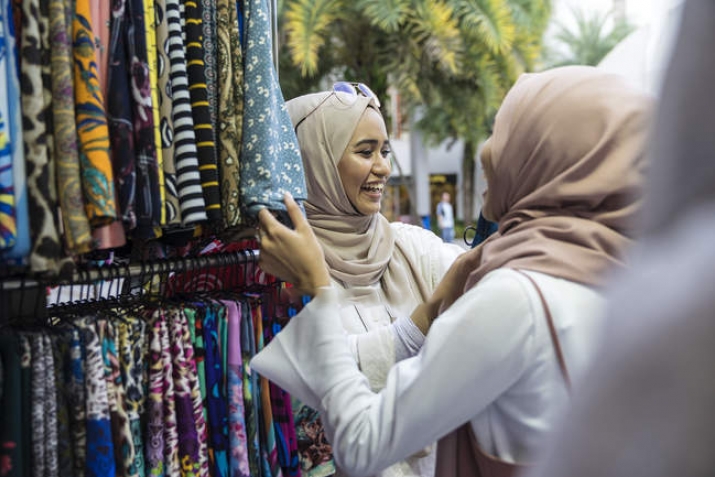
Islam is a complete way of life, every aspect of which is designed by the Creator to advance happy, healthy communities and ease the path to eternal bliss in the Hereafter. Modern society sees modesty as a sign of weakness or insecurity. This is not the case in Islam, where modesty is seen as a sign of respect for oneself and others.
Every human being is born with modesty that is seen as something to be treasured. In this regard Islam has a dress code for both women and men that is aimed at protecting the society as a whole and promoting modest dressing and behaviour. Islam holds women in very high esteem and the Islamic rules of covering are intended to protect and guard her dignity and honour. Today the way of covering of women is known as hijab. There are a lot of ayat of the Holy Koran and the sayings of the Prophet Muhammad (peace and blessings be upon him) concerning this.
“O Prophet! Ask your wives, daughters, and believing women to draw their cloaks over their bodies. In this way it is more likely that they will be recognized (as virtuous) and not be harassed. And Allah is All-Forgiving, Most Merciful.”(Sura Al-Ahzab, ayah 59). “And tell the believing women to lower their gaze and guard their chastity, and not to reveal their adornments except what normally appears...” (Sura An-Nur, ayah 31).
“When a girl reaches the menstrual age, it is not proper that anything should remain exposed except this and this. He pointed to the face and hands.” (Narrated by Abu Dawood).
The purpose of hijab is to cover the awrah. The definition of awrah is the parts of the body that should be covered and this does vary in different situations among different groups of people. Here below we are to list some conditions of hijab for a woman in public and amongst nonmahram men.
- The hijab must conceal the entire body except the face and the hands.
- It should not be translucent or tight. Tight clothes, even if they conceal the colour of the skin, still describe the size and shape of the body or part of it, and create vivid images.
- It should not attract the attention of the opposite gender; thus it should not be extravagant or excessively opulent. Nor should jewellery and makeup be on display.
- It should not be a garment worn because of vanity or to gain popularity or fame. The female companions were known to wear black and other dark colours but other colours are permissible; a woman must not however wear colourful clothes because of vanity.
- It should not be perfumed. This prohibition applies to both the body and the clothes.
- It should not resemble the clothing worn by men.
- It should not resemble the clothing that is specific to nonMuslims.
The Wisdom in the Islamic Dress Code
There is great wisdom in the Islamic dress code. In order to see and understand it clearly one must remember a few basic concepts. First and foremost, that Islam was revealed for all people in all places, at all times. Thus what is in or out of fashion is not relevant. Secondly, Islam is a holistic religion concerned with humankind’s physical, spiritual and emotional health and not just for each individual but for the community or society as a whole. This involves respect; for God, for each other and for oneself.
Thirdly, a dress code is required for both men and women, Islam does not put the responsibility entirely on one gender, and in fact the ayat referring to men were revealed first. However both men and women are commanded to lower their gaze and protect their modesty and both men and women are expected to create a healthy social environment with constructive morals, manners and values.
The term hijab is more than a scarf and more than a dress code. It is a term that denotes modest dressing and modest behaviour. For instance, if a Muslim woman was correctly covered but at the same time using bad language, she would not be fulfilling the requirements of hijab. If a Muslim man was covered from the navel to the knee but walking around in public calling attention to himself or behaving rudely he would also not be behaving in an appropriate manner.
Women who wear hijab point out many benefits to be gained from adhering to the Islamic dress code. Some describe wearing hijab as being “set free” from society’s unrealistic expectations. They are no longer thought of as sexual objects, but are desired for their intellect. They are no longer valued for their looks or body shape but for their personality and character. Women wearing hijab report that it minimizes sexual harassment in the workplace.
Many women report that people (both Muslims and non-Muslims) are more inclined to show good manners towards a woman in a scarf. Men open doors, give up seats on public transport, apologise for bad language and offer to carry groceries and many other small kindnesses that were once a normal part of life in most western communities.