

Largest muslim nation
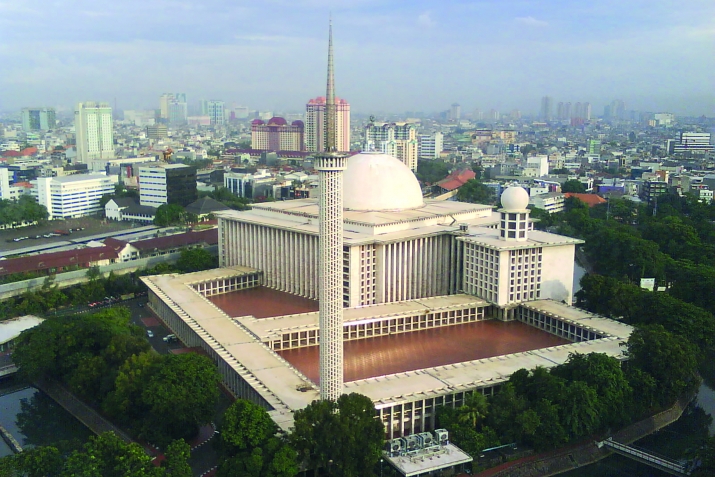
Indonesia is the most populous Muslim-majority nation in the world. Muslims account for nearly 88 percent of its population of more than 200 million.
Indonesians adopted Islam as early as the 11th century, although Muslims had visited Indonesia early in the Muslim era. The spread of Islam was driven by increasing trade links outside of the archipelago. In general, traders and the royalty of major kingdoms were the first to embrace Islam. Dominant kingdoms included Mataram in Central Java and the sultanates of Ternate and Tidore in the Maluku Islands to the east.
By the end of the 13th century, Islam had been established in North Sumatra; by the 14th in northeast Malaya, Brunei, the southern Philippines and among some countries of East Java; and in the 15th in Malacca and other areas of the Malay Peninsula. Islam became the dominant religion of Java and Sumatra by the end of the 16th century.
Bali and the outer islands adopted Islam in the 17th century. Despite being one of the most significant developments in Indonesian history, historical evidence is fragmentary. Ricklefs (1991) identifies two overlapping processes by which Islam came to Indonesia - Indonesians either came into contact with Islam and converted, and/or foreign Muslim Asians (Arabs, Indians, Chinese, etc.) settled in Indonesia and mixed with local communities. Islam is thought to have been present in Southeast Asia from early in the Islamic era, i.e. from the time of the third caliph of Islam, Othman Bin Affan (644-656 CE).
Muslim emissaries were arriving in China who must have passed along Indonesian sea routes from the Islamic world. It would have been through this contact that Arab emissaries between 904 and the mid12th century are thought to have become involved with the Sumatran trading state of Srivijaya. The most reliable evidence of the early spread of Islam in Indonesia comes from inscriptions on tombstones and a limited number of travellers’ accounts. The earliest legibly inscribed tombstone is dated 475 AH (1083 CE). The first evidence of Indonesian Muslims comes from northern Sumatra. Marco Polo, on his way home from China in 1292 CE, reported at least one Muslim town there.
The first evidence of a Muslim dynasty is the gravestone, dated 696 AH (1297 CE), of Sultan Malik Al-Saleh, the first Muslim ruler of Samudra, with later gravestones indicating continued Islamic rule. The presence of the Shafi’i school of theological jurisprudence was reported by the Moroccan traveler Ibn Battuta in 1346 CE. In his travelogue, Ibn Battuta wrote that the ruler of Samudera Pasai was a Muslim who performed his religious duties with utmost zeal.
Firmer evidence documenting continued Islamic cultural transitions comes from two late14th century gravestones from Minye Tujoh in North Sumatra, each with Islamic inscriptions but in Indian-type characters and the other Arabic. Dating from the 14th сеntury, tombstones in Brunei, Trengganu (northeast Malaysia) and East Java are evidence of Islam’s spread. The Trengganu stone has a predominance of Sanskrit over Arabic words.
Ma Huan’s “Ying-yai Sheng-Ian” (The Overall Survey of the Ocean’s Shores) (1433 CE), reports that the main states of the northern part of Sumatra were already Islamic. In 1414 CE, he visited the King of Malacca, who was Muslim as were also his people, who were very strict believers. The establishment of more Islamic states in North Sumatra is documented by late 15th and 16th century graves, including those of the first and second Sultans of Pedir, Muzaffar Syah, buried in 902H (1497 CE) and Ma’rufh Syah, buried in 917H (1511 CE). Aceh was founded in the early 16th century and the Aceh Empire’s first sultan was Ali Mughayat Syah, whose tombstone is dated 936 AH (1530 CE).
The book of the Portuguese apothecary Tome Piers documents his observations of Java and Sumatra from his visits there in 1512-1515 CE. At this time, according to Piers, most Sumatran kings were Muslim; from Aceh and south along the east coast to Pelambang the rulers were Muslim, while those south of Palembang and around the southern tip of Sumatra and up the west coast were not. In other Sumatran kingdoms, such Pasai and Minangkabau the rulers were Muslim although at that stage their subjects and people of neighboring areas were not; however, it was reported that the religion was continually gaining new adherents.
Founded around the beginning of the 15th century, the great Malay trading state of Malacca was, as the most important trading centre of the western archipelago, a centre of foreign Muslims and it thus appears to have been a supporter of the spread of Islam. From Malacca and elsewhere gravestones survive showing not only its spread in the Malay Archipelago but as the religion of a number of cultures and their rulers in the late 15th century.
When Indonesia declared independence in 1945, it became the largest Muslim-majority nation in the world. Muslims constitute a majority in most regions of Java, Sumatra, West Nusa Tenggara, parts of North Sumatra, most inland areas of Kalimantan and North Sulawesi. Together, the non-Muslim areas originally constituted more than one third of Indonesia prior to a massive transmigration effort to these regions sponsored by the Suharto government and recent spontaneous internal migration.
While government-sponsored transmigration from heavily populated Java and Madura to less populated areas contributed to the increase in the Muslim population in the resettlement areas, no evidence suggests that the government intended to create a Muslim majority in non-Muslim areas and most Muslim migration seems to have been spontaneous. Introduced piecemeal by various traders and wandering men of piety from India, Islam first gained a foothold between the 11th and 15th centuries in coastal regions of Sumatra, northern Java, and Kalimantan. Unlike coastal Sumatra, where Islam was adopted by elites and masses alike, in the interior of Java the elites only gradually accepted Islam.
The Constitution of Indonesia provides “all persons the right to worship according to their own religion or belief” and states that “the nation is based upon belief in one supreme God.” Although it has an overwhelming Muslim majority, the country is not an Islamic state. The Indonesian government organises the Hajj pilgrimage. Indonesian media reported in October 2008 that the government would build four accom-modation towers for Indonesian Hajj pilgrims in Saudi Arabia that would house 100,000 people, as there had been problems related to their stay during the pilgrimage.
The Indonesian government signed agreements twice with two property companies in Saudi Arabia. The first agreement was to build three towers with a rental cost of SR 1,650 per person. But the project could not be realised because of a land dispute. The second agreement was the most recent with a rental cost of SR1,800 per person. However, the construction plans at Haram in Mecca have changed again, with the rental costs rising to SR2.000 for the first three years and SR2.500 from the fourth to the tenth year. The price could be reduced or even increased by five% after negotiations in the 11th year.
