

Islam’s tolerance in a multi-confessional society
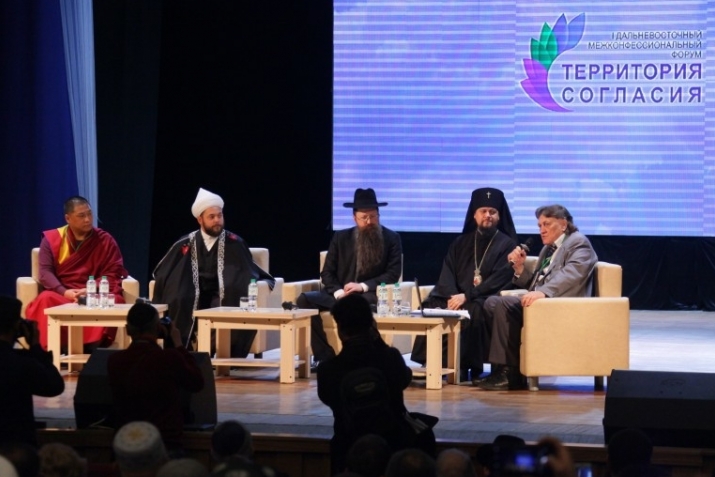
The attitude of Islam to representatives of other religions or the tolerance of Islam is one of the most important topics of our time. It is especially relevant for Russia, where people live together practicing different religions.
Religion is a system of divine principles that call people to do good according to their own will. Among religious principles one can always find such foundations that guarantee a person both spiritual and material development, and consequently, create prerequisites for both earthly happiness and happiness in Eternal life. All the heavenly religions preceding Islam were sent down to certain nations. Each of them was essentially national or later became one.
Islam came as a religion for all mankind, and the Prophet Muhammad (peace and blessings of Allah be upon him), according to the Holy Quran, is a Messenger directed not only to all mankind but also to the inhabitants of all worlds. Islam is a religion of monotheism, which in its worldview, outlook on life and in its social system imposes on people the duty to maintain unity, fraternity, equality of every human being in fundamental rights, and also categorically rejects divisions between people by language, confession, race and family-generic features.
Islam, which led to one denominator of national religions, calls on all people to live together, freely, under one set of laws. Islam forbade any manifestation of egoism, savagery, despotism, injustice and, by and large, eradicated them. Islam, without instilling political and social, moral and material, confessional, racial and class divisions, declared that all people are worthy of respect and determined a place for man above all other living beings.
Thanks to the high respect that Islam has bestowed upon every person, Muslims throughout history have carried and continue to bring justice, freedom, tolerance and philanthropy in those societies with which they come into contact. According to Islam, the property, life and honor of another person, even of disbeliever, are inviolable. Even in the presence of martial law, it is forbidden to touch those who are not directly involved in hostilities: women, old people and children. It is also impossible to infringe upon or flout the rights of an individual, even if it benefits the whole society. The rights of an individual are also honored and elevated, as are the rights of all people taken together.
Even non-Muslim researchers are forced to admit the tolerance of Islam, as we have noted repeatedly [1]. In particular, the Swiss orientalist Adam Metz (1869–1917) writes, “The presence of a huge mass of non-Orthodox constitutes the main difference between the Muslim empire and medieval Europe, which was completely under the shadow of Christianity ...”, “... the lives of those who are protected (the Jews and Christians —S.N.) were of equal value in the face of the law with the life of a Muslim ”,“ ... the most lucrative places were occupied by Christians and Jews who sat on them tightly and firmly.” Speaking of religious tolerance in the Arab Caliphate, Adam Metz notes that it is «... something unknown in medieval Europe» [2]. Indeed, history itself is vivid evidence of tolerance and respect for the religious beliefs of other believers. The legal framework governing these relations is the Quran and the Sunna of the Prophet (peace and blessings be upon him).
Thus, in the first treaty concluded with Nejran non-Muslims, which constitutes a solid example for every Muslim to follow up to the Day of Judgment, it was said:
“The protection of Allah and the intercession of the Prophet Muhammad (peace and blessings of Allah be upon him) to the people of Nejran and those in the district are the right of these people and this also extends to their property, life, religious sphere and practice, to those present and absent, for their families, their chapels, and their possessions, large or small. Not a single bishop will be forcibly sent outside his office, not a single priest will be evicted outside the church where he performs the service, not a single monk can be forced to leave the monastery in which he lives ... They will not oppress and repair injustice and will not be oppressed. None of them will be liable for a crime or an offense committed by another.” [3] It is known with what punctuality and responsibility the Companions of the Prophet realized his unshakable installations of religious tolerance, even in those historical times when they were at war. For example, the first Caliph of Muslims Abu Bakr (may Allah be pleased with him), when sending troops to Syria under the leadership of Osama, admonished him to strictly follow the precepts of the Prophet (peace and blessings of Allah be upon him). In particular, he said, “Do not break promises, do not create lawlessness, do not rob property, do not dismember bodies (of enemies who died in the war); do not kill children, old men and women. Do not destroy date gardens. And also do not touch fruit trees. Do not kill sheep, cattle and camels, unless you want to eat them. On the way, you may meet people who have retired to the chapels, do not touch them or interfere with their worship ...” [4].
And here is another example confirming the peace-loving and tolerant attitude of Islam to representatives of other faiths. It is known that non-Muslims in the face of Muslims found reliable defenders of their interests. “No Christian is obliged to come out with a Muslim army either against the enemy or to protect the borders; military affairs should not concern patrons, but Muslims should protect and protect them,” - written in the treaty issued by the Prophet (peace and blessings of Allah be upon him) about Christians. More than once, even pagans sought and found security and protection among the Muslims.
The Holy Quran says, “If one of the pagans comes and asks for patronage, be his patron until he hears the message of Allah. And if he does not believe, do not force him and escort him to a safe place.” And later, representatives of various denominations lived in the land of Islam in peace and harmony and the rulers of Muslims provided non-Muslims with the most favorable opportunities to preserve their religious, linguistic and ethnic identity. Perhaps the Ottoman Empire can serve as the most striking example of such peaceful coexistence can serve.
The seven hundred years rule of the empire in most parts of Asia Minor, the Middle East and many European countries was possible only due to respect and tolerance for all the multiethnic and religious groups that were part of the empire. Muslims brought their subjects betterment and peace, tolerance and respect [5].
To be continued…
References:
[1] Ramazanov K.A., Sultanmagomedov S.N.
IBRAHIM ABDULAEV Theologian
