

Pride of the ummah: Marjani
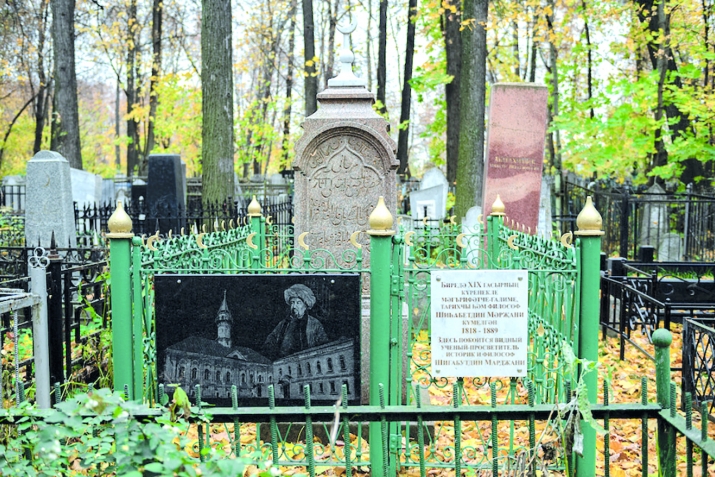
His personality in white turban and green chapan often attracted the attention of Russian scientists at the meetings of this Society. In 1877, the IVth All-Russian Congress of the Society was held in Kazan, attracting about 300 scientists from many cities of Russia and beyond its borders. At the congress on 13 August, Academician Radlov read in Russian the Marjani’s report on the history of Bulgar and Kazan and in 1884 was published in the materials of the congress in the Tatar and Russian languages.
The pedagogical work of Marjani represents another page of his enlightenment activity in the broadest sense of the word. On September 13, 1876 a Tatar school of teachers (providing eight years of education) was opened in Kazan.
The school trained primary school teachers from among the Tatars. Teaching was conducted in Russian, except for the Sharia classes. Marjani was the first of the Tatar Muslim clergy to agree to the proposal of the inspector of the school, V. Radlov, to teach theology. At the opening of the school, he delivered a welcoming speech, in which he called on the Tatars to study at this school. For nine years Marjani taught at the Tatar school of teachers and was a member of the Pedagogical Council.
However, as a result of disagreements with the inspector and certain teachers, he was forced to leave teaching. Because of this activity, conservative circles of the Muslim clergy called Marjani a missionary, a heretic, an apostate. In his madrasa Marjani conducted many classes according to his own programme. In the 1980s the scientific activities of Marjani himself were radically expanding, with philosophical and historical disciplines coming to the forefront.
During this period, he was working on the handwritten biographical dictionary «Wafiyatulaslaf wa tahiyatul-akhlaf» (Detailed information about predecessors and their greetings to descendants), which includes 6,057 biographies of scholars, writers, philosophers and social and political figures of the Muslim East.
Marjani wrote an introduction to «Wafiyatul-aslyaf», «Muqaddima», which was also published. In it, he describes the history of the origin of the sciences in the East, classifies them, supports them with references to statements by prominent Muslim cultural figures and examines the principal religious schools and directions in Islam. In fact, it is not only an historical but also a philosophical work devoted to various aspects and problems of the spiritual culture of the East.
During this period the most significant works of Marjani were published, among them: «Haqqulmārifa wa husnul-idrak» (Truth of knowledge and beauty of comprehension), 1880 - an essay on Muslim law (fiqh), in which the scholar sets out his socio-political views, in particular; «Mustafadulakhbar fi ahwali Kazan wa Bulgar» (A depository of information about the affairs of Kazan and Bulgar), 1885, volume 1 of an historical work on the Volga Bulgaria and the Kazan Khanate; «Kitabul-hikma albaligha al-janiyya fi sharhil-`aqaid al-hanafiyya» (A book on a mature philosophy that helps explain the teachings of the Hanafis), 1888 - an essay in which Marjani presents his religious views.
Marjani's intellectual enlightenment potential was greatly increased during his travels in the 1980s throughout Russia and the countries of the Near and Middle East. In search of material for historical research, he visited the ancient ruins of Bulgar, Tatar, Russian, Chuvash and Mordvin villages.
On August 31, 1880 he set out from Kazan on pilgrimage, during which he visited Istanbul, Izmir, Alexandria, Cairo, Suez and other centers of Muslim culture. In Istanbul, he met the author of the collection «Chagatai and Ottoman Languages», Kudratullah al-Kanduzi, and with the famous scholar Ahmad Jawadat Pasha and made copies of the inscriptions of the dome of the mosque of Sultan Salim.
In Cairo he visited the scholar Mahmud-bek al-Fallaki and took copies of the inscriptions on the walls of the mosque of Muhammad Ali Pasha. Marjani's educational ideas cover the most diverse aspects of the renewal of the social life of the Tatar people in the 1870s and 80s, including his thoughts on the need for secular education of the Tatar population and the assimilation of the progressive heritage of the past (ancient and Arabian thought) and present (Russian and Western European cultures). The scholar was also concerned with the issues of education of the national selfconsciousness of the Tatar people, concerned about their welfare, socio-economic and political situation.
Considering enlightenment as the most powerful tool of progress, the scholar tried to raise his people out of «dormancy». Marjani's outlook, combining religious reform and enlightenment syncretically, reflected the dialectic of the development of this period in the history of the Tatar society. It evolved from religious reformism - the period of his creative work until the 1870s - to the educational ideology of the 1870s-1880s.
The scholar aspired to answer many questions raised by Tatar society as it developed along the bourgeois path: «to renew faith,» to raise the socio-political and cultural level of the Tatar people, and to attach it to modern civilization.
The religious views of Marjani are manifested in the criticism of questions of Kalam (direction in Islamic theology). Kalam was cultivated in the Tatar madrasas in the eighteenth and nineteenth centuries and its knowledge was considered compulsory for students: it was included in the curriculum and was considered one of the main subjects.
Therefore, Marjani's appeal to Kalam was objectively conditioned by his time. It was necessary to reform the madrasa, the transformation of teaching.
Marjani explained the most detailed problem of Kalam in «Kitabul-hikma al-baligha ...». This is a religious work in which Marjani comments on the main provisions of the dogma of the Hanafis, which according to him were misinterpreted by some scholars.
«God with all His properties is necessary, eternal, infinite, created by no one, does not need anyone, His attributes are inseparable from His essence,» writes Marjani. Marjani was the forerunner of the Jadid movement in Russia, and it was he who laid its foundation - the reform of teaching in the madrasa and the assimilation by the Tatar people of the advanced achievements of world culture and science.
Marjani wrote more than 30 works, most of which was published in Arabic. Only a few works are written in Tatar in Arabic script. Not all works written by the scholar have yet been discovered. For example, «Risalatun fi masailin-nahw» (A Treatise on the Questions of Grammar), «Al-Tahrirat al-mufrada» (Separate Editions). The ideological and philosophical views of Marjani, his work as a teacher, religious figure, historian, educator and philosopher will remain as a notable phenomenon in national history.
AIDAR YUZEYEV
Doctor of Philosophy, Professor, Head of the Department of Social Disciplines of the Tatar State Humanitarian Institute
