
Rabi ul-Awwal: the month of birth of the Messenger of God ﷺ
Rabi ul-Awwal: the month of birth of the Messenger of God ﷺ
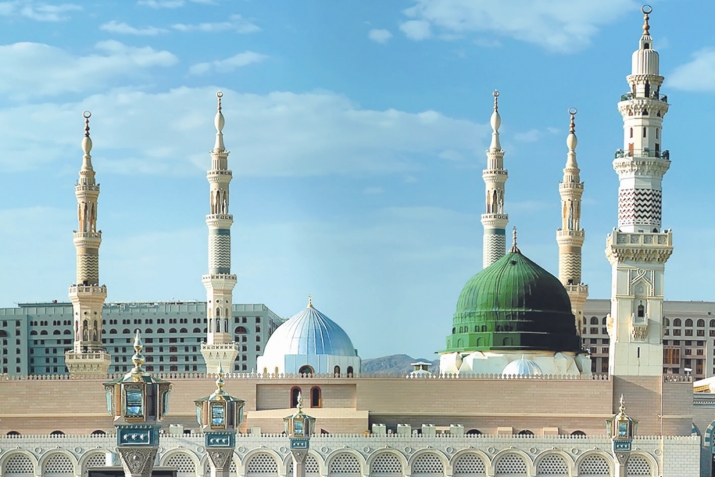
Rabi ul-Awwal (literally “the first month of spring”) is the third month of the Muslim lunar calendar and one of the most significant for believers.
According to generally accepted opinion, it was in this month that God the Most-High blessed humanity and all creation with the birth of the beloved Prophet Muhammad, God’s last messenger (peace and blessings be upon him).
This month is also rich in other events, including not only the birth of the Messenger of God ﷺ, but also his migration (hijra) with his companions from Mecca to Medina and the construction of the first Al-Quba mosque on the outskirts of Medina. In addition, Rabi ul-Awwal is significant in that it was in this month that the first Friday (juma) prayer was performed.
The Messenger of God ﷺ, the Mercy of the Worlds, was born in the holy city of Mecca, not far from the Kaaba, at dawn on the 12th of the month of Rabi ul-Awwal, or 22 April 571 according to the Gregorian calendar.
The Prophet ﷺ comes from the Arab clan of al-Hashim, belonging to the Quraish tribe, and is a direct descendant of the prophet Ismail (biblical Ishmael), the son of the prophet Ibrahim (Abraham). Muhammad’s father was Abdullah ibn Abdul-Muttalib (who died a few months before his son was born), and his mother was Amina bint Wahb.
According to legend, the birth of the future Prophet ﷺ was accompanied by numerous miracles. It is reported that shortly after his mother Amina became pregnant, she received news in a dream that she would give birth to a great man, the Prophet of the Most-High, who should be called Muhammad ﷺ (translated from Arabic as “Praised One”).
Ibn Hibban cites the story of Halima, the nurse of the Prophet ﷺ, who reports from Amina: “Truly, this son of mine is special. When I carried him in my womb, I did not feel the heaviness (which pregnant women feel). It was very easy for me. I have never seen a more blessed child than him. Then, when I gave birth to him, I saw a light like a bright star come out of me. He illuminated for me the necks of camels located in Basra (now a city in the south-eastern part of Iraq), and when the birth was completed, he did not lie down, as children usually lie down, but put his hands on the floor (resting his hands on the floor) and raised his head to the sky.”
Aisha, wife of the Messenger of God ﷺ, reports that there was a certain Jew in Mecca who came on his business in trade. On the night of the birth of the Prophet ﷺ, he saw the appearance of a new star, which is a sign of the birth of the Messenger of God ﷺ. After this, he went to a meeting of the Quraish and asked who had a child that night. He was told that a son was born into the family of Abdullah and Amina. Then he told them that this was a wonderful child who would be the last prophet. On his back there is a sign of prophecy - in the form of a mole covered with hair. At the request of the Jew, the people took him to Amina’s house, where she showed him her son. He looked at the boy and, seeing the seal of prophecy on him, told the people the following: “I swear by God ﷻ! The Arabs will receive honour and dignity through this prophecy. O tribe of Quraish! Rejoice! I swear by God ﷻ, you will become a force and might, the news of which will spread from east to west.” (Narrated by Al-Hakim).
We take many things in our life for granted: the sun that rises every morning, the rains that nourish the earth, the food that we have every day, etc. Behind all this, we rarely see the manifestation of the mercy of the Almighty towards us.
But material wealth is only part of the Creator’s mercy. How many spiritual benefits and happiness have been bestowed upon us, which we again do not notice and, therefore, do not appreciate! One of the main benefits is that the Almighty sent us the true religion through His chosen one - the Prophet Muhammad ﷺ. He is the one about whom God ﷻ said (the meaning of the commentary to the 107th ayah of Sura Al-Anbiya): “And We sent you (O Muhammad) only as a mercy for the worlds (people and jinn).”
Adil Ibragimov
Theologian