
Exploring Creation: Muslim Scientists investigate the Wonders of the Natural World
“Allah will exalt in degree those of you who believe, and those who have been granted knowledge.”[Koran 58:11] “Are those who know equal to those who know not?”’ [Koran 39:9] Scientific inquiry is at the core of what it means to be a profound Muslim.The Prophet Muhammad (pbuh) said: «The seeking of knowledge is obligatory for every Muslim.» [Al-Tirmidhi 74]
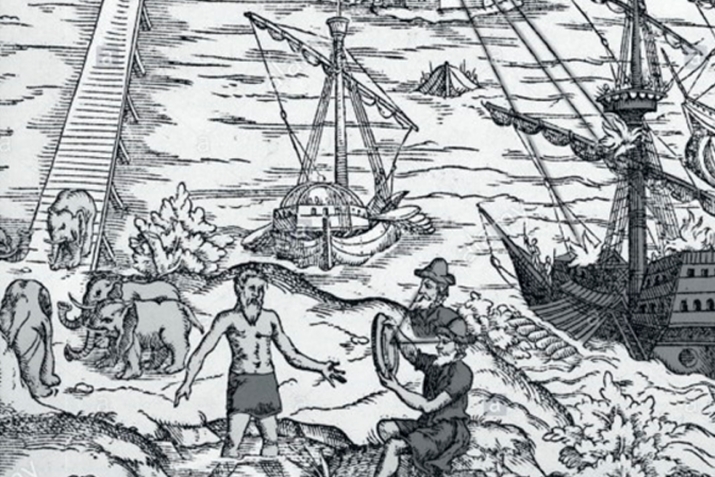
In Islam, science has two interconnected pathways in the pursuit and application of knowledge. Science explores, and strives to articulate as precisely as possible: (a) the underlying principles and the practice of the worship of Allah and (b) the characteristics of the Created natural world and how this knowledge may impact on the human condition and human endeavours.
Building on the scientific inquiries of generations and cultures preceding Islam, this knowledge underpinned researches and transformational discoveries by great Muslim scientists, such as Abu Ali al-Hasan ibn al-Haytham (905-1040), Abu Musa Jabir ibn Hayyan (722-804), Abu Rayhan al-Biruni (973-1048), Abu Ali al- Husayn ibn Abd Allah ibn al-Hasan ibn Ali ibn Sina (980-1037) and Muhammad ibn Musa al-Khwarizmi(750-850), in the fields of astronomy, physics, chemistry, medicine, mathematics and many more.
Spurred on by a sense of wonder in both the order and diversity of Creation, these early scientists were polymaths, who intertwined researches into multiple aspects of the natural world with strivings to articulate our understanding of the Islamic faith and its prescriptions. Islamic science and the systematic pursuit of knowledge (supported through the teaching institutions of madrasas and libraries) had a significant impact on Europe, mainly through the vibrant Muslim civilization in Andalusia.
Although the Mongol invasions of the 13thcentury and their aftermath had an impact on the scope and pace of scientific inquiry in the heartlands of Islam, such endeavours did not cease. Well before European science regained momentum in the Renaissance, we see, for instance, Ulug Beg (1394-1499), the grandson of Amir Timur, who was involved in significant astronomical activities through his observatory in Samarkand (he was acknowledgedby European scholars as among the “pantheon” of world astronomers). Across the Islamic world advances were continually made in the applications of science to technological solutions of practical, utilitarian problems.
As in the early days of Islam, there was continuing cross-fertilisation across civilizations and cultures. In the 18th century, as Europe launched the technological and manufacturing advances we now know as the “Industrial Revolution” and consolidated its colonization of large parts of the Islamic world, the greatest sustained Muslim power, the Ottoman Empire, increasingly turned to the European continent for scientific and technological inspiration and guidance. This asymmetrical transfer led to Muslim achievements in science being overshadowed by the historical and social narratives of the west. For some time thenceforth Muslim natural scientists did, indeed, play a diminished role and the pursuit of religious sciences dominated the inner worlds of conservative Muslim communities.
Eventually, and paradoxically perhaps, by the late 19th century educational advances in pedagogy in the west impacted on conservative Muslim societies (the Muslim Jadidist educators of Tsarist Russia, provide a significant example), stimulating new currents of inquiry for youth and opportunities to shatter the colonial mould. Muslims studied scientific disciplines in the west and in western institutions in the colonized worlds.
By the mid-20th century, a “cadre” of “western-educated” Muslim specialists had developed, a process in which USSR teaching and research institutions also played a significant role. The break-up of the colonial world following World War II provided new opportunities for Muslim scientists to actively engage with their colleagues in the west and in their newly independent home countries. A generation of Muslim scholars born in the 1930s and 40s has produced a significant number of world leaders in the natural sciences, including three Nobel laureates: Mohammad Abdus Salam (1926-1996) - – 1979 Nobel Prize in Physics; Ahmed Zuweil (1946-2016) – 1999 Nobel Prize in Chemistry; and Aziz Sancar (1946-) – 2016 Nobel Prize in Chemistry.
Two of these men, Abdus Salam and Ahmed Zuweil, have left personal written testimonies to the support of learning inherent in Islam to which they attributed their scientific successes

Abdus Salam grew up in Pakistan in the sphere of the Ahmadiyya or Badawiyya sufi order (tarikat) to which his community adhered. The founder of this tarikat was Moroccan Sheikh al-Sayyid Ahmad al-Badawi (1199-1276), who lived and died in Tanta, Egypt.
Abdus Salam saw his religion as a fundamental and integral part of his scientific work. He wrote that «the Holy Koran enjoins us to reflect on the verities of Allah’s created laws of nature; however, that our generation has been privileged to glimpse a part of His design is a bounty and a grace for which I render thanks with a humble heart.» During his acceptance speech for the Nobel Prize in Physics, Salam quoted the Koran, «You see not, in the creation of the All-merciful any imperfection, return your gaze, do you see any fissure? Then return your gaze, again and again. Your gaze comes back to you dazzled, wearied,» [67:3-4] and he stated that, “This, in effect, is the faith of all physicists; the deeper we seek, the more is our wonder excited, the more is the dazzlement for our gaze.”
While Salam grew up in the sphere of the Badawiyya tarikat, Egyptian Ahmed Zuweil grew up in that of a contemporary and pupil of al-Badawi, Sheikh al-Sayyid Ibrahim al-Desugi (1255-1296), another great Egyptian sheikh, who lived his whole life in a town close to where al- Badawi is buried. The memoirs of Zuweil are particularly instructive about the atmosphere of the societal respect for learning in which he grew up. Reading his words one feels swept back in time, as though hearing the boyhood reminiscences of a leading scholar of Islam’s Golden Age!
“I am very proud of the value system I was given by my family and the way I grew up as a Muslim in Egypt.” “With our smallness in the universe at large, I bear in mind the important role of faith and scholarship. Although I am concerned about injustice in the world today, I am an optimist. I believe that with the power of knowledge and rational thinking, we can – and should – build bridges between human, between cultures and between nations.”
He reminisced, “Much of the importance of Desuq where I grew up is that it has spiritual depth. In the centre of the town is the mosque of Sidi Ibrahim al-Desuqi, an Egyptian scholar and a sufi and a student of another famous sufi, Ahmad al-Badawi. The mosque was very important in my life because it defined my early childhood. When I look back at my life, I realize that this mosque was the nucleus for scholarship at that age. By this I mean that we used to go to the mosque to study, which is traditional in Islam. The mosque is not just for prayer; it is also for scholarship. It has a sacredness and, with its beautiful, spacious architecture of domes, columns, and minarets, it radiates the power of respect. The mosque was like glue, keeping everyone working and living together in harmony. The moral and ethical influence of the mosque created a simple and sheltered environment that was also exciting. I vividly recall the sunset during the month of Ramadan when people were hurrying home to the tranquil sound of prayer in the background, and all shops closed down for iftar just before the boom of the cannon signaled the time for us to eat.”
As youngsters we were attracted to, not repelled by, such an institution of faith, and the leaders of the mosque continually encouraged scholarship. We saw scholarship in thinking and analyzing and repeatedly we were told of the fundamental role of science and knowledge in our lives. After all, we were told again and again, the first message revealed to the Prophet begins with the word Iqra! (‘Read!’).”
Another generation of scientists from across the world of Islam continues to build strongly on the modern legacy of those like Salam, Zuweil and Sancar, underpinned by timeless Islamic values. Although their activities and achievements may not yet be sufficiently known by the general public, they are abundantly recognized by the international scientific community.
GUY (GHAYDAR) PETHERBRIDGE, PROFESSOR, EXPERT ON CULTURAL HERITAGE AND HISTORY OF ISLAM, AUSTRALIA, RUSSIA