
Alhambra: poetry in stone
In the 7th century, the Arab commander Tariq ibn Ziyad crossed the strait separating North Africa from the Iberian Peninsula and invaded the territory of modern Spain with his detachment. This is how its Islamic history began.
The current name of the strait, Gibraltar, is a Spanish translation of the Arabic term “Jabil Tariq”, which translates as “mountain of Tariq” – in honor of that same commander. Muslim rule lasted eight centuries. During this time, Spain became the centre of science and knowledge about the surrounding world for all of Europe. Many beautiful architectural structures in the new Islamic-Spanish style, called Moorish, appeared in the region and the Spanish language was enriched by more than 4,000 Arabic words.
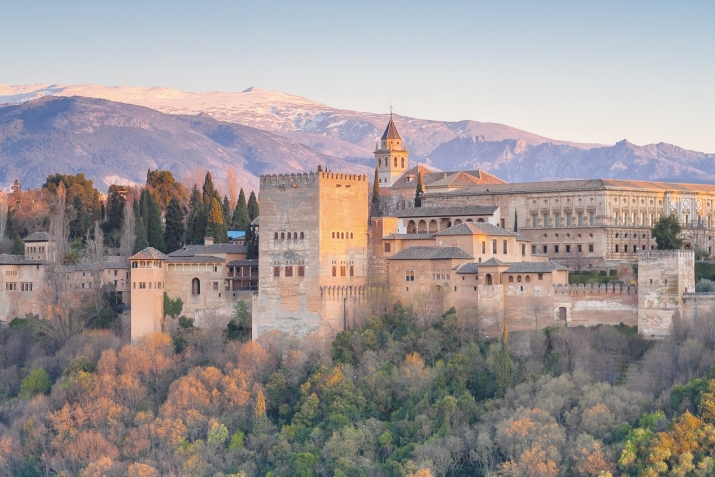
One of the beautiful examples of Moorish architecture is the Alhambra palace complex in the south of Spain. It was built gradually. On the basis of a fortress, the rulers of the local Granada Emirate completed it with palaces, parks and fountains.
In the 14th century, on the territory of the Red Castle, which is how “Alhambra” is translated from Arabic, there were mosques, baths, fountains and gardens, numerous towers with a fortress wall, the emir’s residence, his private chambers and much more, which, unfortunately, has not survived to this day.
Palace of the Lions
These are the emir’s private chambers, grouped around a marble courtyard, in the very center of which 12 lions Support a fountain.
Myrtle Courtyard
This is a 34-meter-long pool filled with water from marble fountains and surrounded by a hedge of myrtle - an evergreen woody plant.
Comares Tower
This is the tallest tower of the palace complex. The walls, arches, passages inside and the ceiling are very beautifully decorated with various inscriptions, carvings and stucco.
After the Reconquista, the reconquest of lands on the Iberian Peninsula occupied by the Moorish emirs, the Alhambra was partially destroyed, partially rebuilt and completed by new, Christian rulers. Some examples of Muslim architectural creativity were lost forever.
Now the Alhambra is a popular place among tourists. Inside there is an archaeological museum and a museum of fine arts of Granada.