
The spiritual meaning of sacrifice
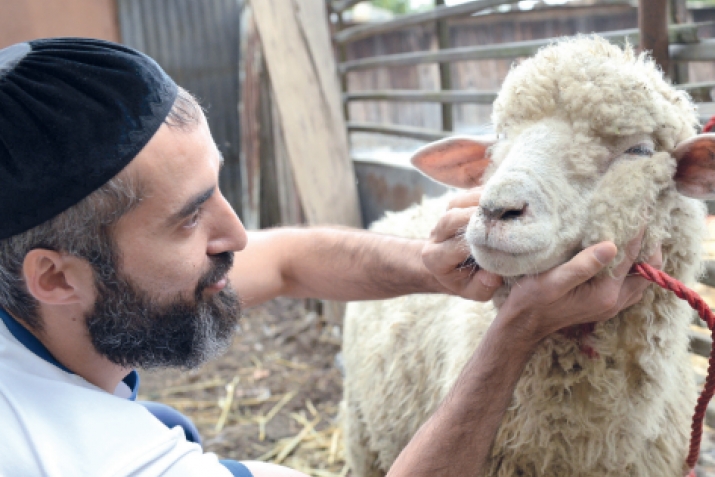
The historical background of Eid al Adha is that the Prophet Ibrahim (peace be upon him) had a dream in which he was sacrificing his young son, Ismail (peace be upon him). Prophet Ibrahim, a great believer in Allah, took his dream literally and wanted to sacrifice his son. But, according to the tradition, Allah the Almighty sent His angels and asked him to sacrifice an animal instead of his son.
During the celebration of Eid alAdha, Muslims honour and remember Ibrahim’s (peace be upon him) trials, by themselves slaughtering an animal such as a sheep, camel, cow or goat.
Allah has given us supremacy over animals and permitted us to eat meat but only if we pronounce His name at the earnest act of taking life. Muslims slaughter animals in the same way throughout the year. By saying the name of Allah at the time of slaughter, we are reminded that life is sacred. Life is to be valued with utmost action of piousness and holiness.
The meat from the sacrifice of Eid al Adha is mostly given away to others. One third is eaten by immediate family and relatives, one third is given away to friends and one third is donated to the poor. The intention is to divide it among those who honestly deserve a share of it rather than by consuming all of it amongst ourselves.
It is very important to understand that the sacrifice itself, as practiced by Muslims, has nothing to do with apologizing for our sins or using the blood to wash ourselves from sin.
This is a misunderstanding of those of previous generations, “Their meat will not reach Allah, nor will their blood, but what reaches Him is piety from you.” (Sura Al Hajj, ayah 37).
After the five pillars of Islam, Sunnat e Ibrahimi (sacrifice) is the most important deed. This sacrifice is the legacy of the prophet Ibrahim which combines the prophetic patronage of three religions i.e. Judaism, Christianity and Islam. The festival also symbolizes the trials of faith and loyalty towards Allah. It enlightens our path with the true spirit of righteousness and rectitude.
A sacrifice which usually taken to be the slaughtering of animals, is more than that. The physical act of sacrificing of the animals is just a ritual, just a tradition and is just a sacred practice whereas the essence lies far beyond it, the spirit of it going far beyond common human perception.
The act of sacrifice symbolises our will to give up some of our own bounties in order to strengthen ties of friendship and help those in need. It serves to train us in how to surrender ourselves to the will of Allah for the sake of the serving of humanity. We recognise that all blessings come from Allah and we that should open our heart and share with others.
Although Eid al Adha is celebrated for a finite number of days, its impact should last the entire year. Eid al Adha is like a symbolic rehearsal of high values and it is essential that these be translated into practical life all year round. We must be reminded in all moments of our living by how we have gone through the act of sacrifice as a religious duty.
Perhaps most of us think of spiritual sacrifice as giving something up, but we have to look inside ourselves to see why we are sacrificing something in the first place.
In fact, sacrifice is an act of submission to Allah. It is to submit to the will of the Almighty. Sometimes Allah asks us to sacrifice something which is important to us in order to learn that there is something greater beyond it. But sadly we fail to translate the essence of these sacrificial values in our life!
Furthermore, we need to practice the spiritual effect of sacrifice so that we learn to rely on Allah's provisions rather on than things we have built for ourselves. It is a part of submission to Him.
Eid is also a day on which Muslims remember the deceased, visit the sick, see relatives and friends, overlook grudges, help the needy and show kindness and generosity to all.
Overcoming common grievances against one other that hinder our mutual co existence is the ultimate spirit of sacrifice. Eid is also a day for rejoicing by engaging in good, clean and honest enjoyment.
Sacrifices contribute to the success of our struggle. They strengthen our inner spiritual and moral resources and develop qualities of character which are essential to our struggle at every level of our existence.
Every act of sacrifice nourishes and increases our Iman, ‘faith’, for it transforms a verbal confession and a mental conviction into a living reality. It confirms, and thus increases, our love for Allah, for through every step we give up something for the sake of His love.
It reinforces our loyalty and faithfulness to Allah, for all other loyalties become secondary as they are sacrificed for the sake of this loyalty. In short, sacrifices bring us nearer to Allah and develop a sort of invisible communication with the Creator. They makes us feel stronger and firmer.
The process is mutually interactive: the stronger the faith, the greater the will and capacity to sacrifice, the greater the sacrifices, the more internalized and deeper the faith. That is indeed the secret of good and balanced living.
Sacrifices are essential for the development of all moral qualities, but especially for the development of tolerance, strength, determination, firmness and purpose. These can be summed up in just one word patience (Sabr).
Every sacrifice reinforces the quality of patience, making it grow in quality and strength. Forbearance, in turn, sustains and increases the capacity to sacrifice.
All promises of help from Allah, all assurances of success in this world and rewards in the Hereafter, have been made conditional upon the attainment of sacrifice and patience.
Indeed, sacrifice is the essence of life and we should leave no stone unturned to sacrifice our money, comfort and time for the sake of Allah. We should make an effort to live in truth to the expectations of the spirit of sacrifice that the festival of Eid al Adha stands for.
MARYAM HEDAYAT