

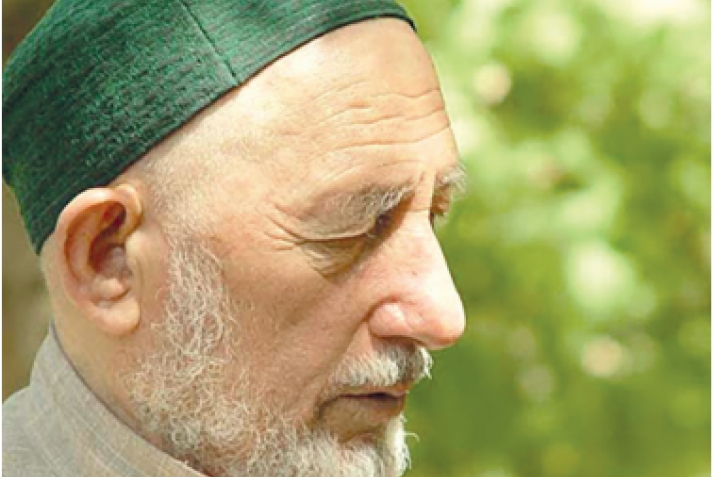
“Guide us to the true religion, o Allah” - Sheikh Said Afandi al-Chirkawi
“Guide us to the true religion, o Allah” - Sheikh Said Afandi al-Chirkawi
The expression “true path” means “the true religion Islam”.
The Muslim religion is called the true path, in that one who strives to become close to the Almighty and to know Him, will have to go through certain parts of the path, upon which he will have to deal with certain hardships which he must overcome.
Moreover, a slave’s turning towards Allah with prayer for guidance to the path of truth has several meanings, one of which is that after coming to know Allah and starting down the true path, a slave must know and observe the limits of every deed, whether it be worldly or performed for the sake of the hereafter.
For example, if some action is not carried out to the necessary level, it will be incomplete and insufficient. Performing the deed above the necessary level would likewise be exceeding the limit.
Neither one nor the other is desirable. That is why, on reading this ayah, a slave asks his Lord “Guide us, helping us to adhere to the proper standard in everything and in every action.” Observance of the golden mean everywhere and in everything, is a very difficult thing about which we will speak further, if Allah wills for us to do so.
The invocation “Show us the way!” is a prayer meaning “O Allah, let us know about Your essence, about Your qualities, and all the things that testify to the fact that everything has been created by You”, meaning, for instance, the movement of the son and the moon, the interchanging of day and night, the diversity of flora and fauna in water and on land, the vital functions, behavior, and structure and laws of the interactions of plants and animals. Reflecting on all this, we find in everything evidence of the existence of Allah, proofs testifying to the fact that everything is created by God.
Likewise, in his invocation “Guide us to the path of truth”, the slave asks Allah to distance him from everything other than Allah Himself, and make him submissive, resorting only to Allah.
By submissiveness, we mean the kind of submissiveness by which God’s slave carries out the commands of Allah, even if He commands him to sacrifice his son, as was commanded the Prophet Ibrahim, and is ready to sacrifice his very self, as was commanded the Prophet Ismail, or to jump into a river, as was commanded the Prophet Yunus, or to become the student of someone of a lower level, even if he is a prophet of a high level, as was commanded the Prophet Musa, or to call to goodness, even if he will be killed for it, as was commanded the Prophet Yahya, or to show patience, even if he is being dismembered, as was commanded the prophet Zakariya.
If God’s slave carries out God’s commands as the prophets carried them out, then that is true submissiveness to Allah and true faithfulness to that path of truth to which Allah has guided him.
The Groups of People Who are on The Straight Path
Those who are on the straight path fall into different categories based on their level of adherence to the path.
То the first category belong those who have righteous (istiqama) intentions, motivations of the heart and deeds. That is to those whose verbal utterances and deeds correspond to the righteous intentions and motivations of their hearts.
To the second category belong those who have righteous intentions in their hearts and do good deeds but say that which is not righteous.
Therefore, those of the first group are the possessors of a kind of total wellbeing, corresponding to the state of their heart. Those in the second category are those who are next after the first category in terms of wellbeing, inasmuch as the intentions of their hearts and the deeds committed by them are righteous. This for them is sufficient.
To the third category belong those who have deeds and words which are righteous to the exclusion of the intentions of their hearts. It will be considered that they have some hope to receive benefit from their righteous deeds and words, a hope that they will not be left without recompense. For example, to such a category may be attributed a good deed which has been done without any intention to perform it in the name of Allah. The truth is known only to Allah.
There are even a few more categories:
Those whose hearts and speech are righteous but not their deeds;
Those whose speech alone is righteous but not their hearts or deeds, that is those who are only righteous in word but do not perform good deeds or think of doing good;
Those whose hearts are righteous but what they do and say does not conform to what is in their hearts;
Those who perform righteous deeds but their hearts and speech are not righteous.
As far as the deeds of those of the last four categories are concerned, they receive no benefit from them, only harm.
It is said, that righteousness of speech is not limited to the abstinence of the tongue from slander (Ghibat) and defamation (Buhtan). The purpose of observing righteousness of speech is the guidance of others to the path of truth, that is rendering help to others.
For example, if someone has learned to pray and afterwards has taught it to another, then such a person is considered to be observing righteousness in speech. If, when the time for namaz comes, he performs namaz, observing its conditions and performing all of its necessary elements, then he is considered to be observing righteousness in speech as well as in deed. Further, if he, having come to know that the purpose of the performance of namaz, that is its significance before Allah, is huzur and he performs his namaz with huzur, then he will be considered to be observing righteousness in word, deed and intention.
How could it not be difficult to adhere to the mean in everything, namely, the observance of righteousness, of which we have spoken above, if the Prophet , after the revelation of sura Hud said, “Sura Hud has caused me to age”.
In this sura the Almighty says these meaningful words, “O Muhammad, adhere (strictly) to Islam, act in accordance with it and call the people to it”.
In other words, after you have come to know about past communities, about the prophets, your brothers, sent to call these communities to monotheism, about those who believed in those prophets, and about those who did not believe in them and who opposed them concerning monotheism, about the hardships these prophets went through while I had not yet made it easy for them, and how they showed patience you likewise show constancy in righteousness, and call the people to that which your Lord has commanded you to call.
The Lord commanded the Prophet to adhere to the path of truth, not because he left the path, but because He commanded him to show constancy and to pay no attention to the polytheists. This is like when a standing person is commanded to stand. The following ayah is likewise from among those that make the call to adhere to the mean in everything.
And although this ayah is directed towards the Prophet as well, its purpose is the guidance of others, for verily the Prophet never put anything off until the next day. Almighty Allah calls to the ummah, to teach it, just as parents teach their children.
This ayah gives us guidance, “In the giving of alms, don’t be like one whose hands are tied, nor be like one, who has completely opened his hands”. In other words, “Do not give away everything that you have leaving nothing for yourself, since, when you are left with nothing, you will be overcome with grief.”
In sura Shura Allah says to the Prophet , “Adhere to the truth, as the message commands, and do not follow the polytheists”.
Such proclamations of the Almighty to the Prophet correspond to his level of understanding. In a hadith the Prophet explains to the ummah with consideration for the people’s weakness of intellect, “Behave righteously and in accordance to the command of Allah”. We are not strong enough to strictly adhere to the most righteous lifestyle, this only the prophets and the greatest awliya can do.
The great sheikh Ibn Ataillah says, “Istiqama that is the need of the slave for Allah in every moment of his life, by which he disavows his own strength and ability».
Another great Sheikh Abu Ali Jurjani says, “Be eager for righteousness (istiqama) and do not be eager for miracles (karama) and karama that is what your nafs demands of you but Allah demands of you righteousness”.
When it was said to the great sheikh Abu Said that somebody walks on water, he answered “Sure, fishes and storks also move about in the water”. When he was told that someone flies in the air, he answered “and birds also fly in the air”. And when he was told that someone traveled from East to West in the blink of an eye, he said “Well Iblis travels the same way”. Then he was asked “So what do you consider to be a miracle?” he answered “A miracle is the ability to visibly be with the creation and to secretly be with the Creator”.
Really, think about it, has Allah ever said anywhere in the Koran, or the Prophet Muhammad ever said anywhere in the hadiths that we need to strive to perform miracles? Have you ever heard anything about that? As fоr righteousness, does not that demand from us Islam? To that we must pay special attention.
About that, inshAllah, we will speak in the future but for now, we will stop at this.
Taken from “Motivation to follow the Koranic appeal”, Vol 1 by Sheikh Said Afandi al Chirkaw.
