

“The Little Alhambra”: The Tordesillas Palace of Pedro I and Spain’s Enduring Islamic Architectural Legacy
“Oh my warriors, where would you flee? Behind you is the sea, before you the enemy. You have left now only the hope of your courage and your constancy. … The Commander of True Believers, Al-Walid, son of Abd al-Malik, has chosen you from among all his Arab warriors … and he promises that you shall become his comrades and shall hold the rank of kings in this country. Such is his confidence in your intrepidity. The one fruit which he desires to obtain from your bravery is that the word of Allah shall be exalted in this country. …”
With these words in 711 the Muslim general, Tariq ibn Ziyad, standing on the shores of Gibraltar, spurred on his forces to begin the conquest of the Iberian Peninsula and the establishment of the Emirate of Al-Andalus, the most advanced society in Europe in the early Middle Ages.
Many have elucidated the achievements and events of Islamic Spain, summarized by the 13th century Spanish Muslim writer, Ibn Said, thus, “Andalus, which was conquered in the year 92 of the Hijra, continued for many years to be a dependency of the Eastern Caliphate, until it was snatched away from their hands by one [Abd al-Rahman I in 750] of the surviving members of the family of Umeyyah, who, crossing over from Barbary [North Africa], subdued the country, and formed therein an independent kingdom, which he transmitted to his posterity.
During three centuries and a half, Andalus, governed by the princes of this dynasty, reached the utmost degree of power and prosperity, until civil war began breaking out among its inhabitants, the Muslims.
Weakened by internal discord, they became everywhere the prey of the artful Christians, and the territory of Islam was considerably reduced, so much so that at the present moment the worshippers of the crucified hold the greatest part of Andalus in their hands, and their country is divided into various powerful kingdoms, whose rulers assist each other whenever the Muslims attack them.”
Ibn Said’s description captures the turbulence of what became known as the “Reconquista” as the Muslim civilization, which had created the glories of the Great Mosque of Cordoba, the splendid royal capital of Madinat al-Zahra and the great intellectual centre of Toledo, was breaking apart and being subsumed by Christian rulers from the north.
By the 13th century, only one Islamic kingdom remained, that of the Nasrids in southern Spain, who established their rule in 1232. In spite of Christian territorial gains and power, this region of the peninsula continued to flourish as an intellectual and artistic centre, the Nasrids building an exquisite complex of palace buildings and gardens around an existing hilltop fortress dominating their capital, Granada.
Known as the Alhambra from the Arabic word for ‘red’, the colour of its outer walls, this creation quickly became the most recognizable symbol of the sophistication of late Islamic civilization in Spain. The late 13th and 14th centuries were a period of consolidation of Christian territory and power, and a period when its rulers began embarking on building programmes of their own.
Most noteworthy were the palace constructions of Pedro I (1334-1369) located in key positions across the length and breadth of his kingdom, Castille, which occupied all of Spain except that of Aragon to the north east.
Despite territorial and confessional rivalries the materials, techniques, designs and decoration of the buildings of the new Christian rulers largely continued the accustomed Hispano-Musulman style developed over the centuries in the Islamic world they had overcome and using the skills of the Muslim artisans who had remained (in Arabic called “mudejar”).
Pedro I’s first commission was the construction in 1364 of his palace (Alcazar – from the Arabic al-Qasr) in his capital Seville. Political and religious antagonisms between Muslims and Christians during this period did not impede strategic alliances and practical day to day interchanges.
Under the spell of the beauties of the Alhambra, Pedro I requested the Nasrid ruler Muhammad V (who had just completed the Alhambra’s magnificent Hall of the Ambassadors and had recently regained his throne with the aid of the Christian king) for craftsmen to help execute his plans.
The resulting Alcazar of Seville adheres to an Islamic model, with open courtyards, fountains and elaborate decoration similar those of the Nasrid palace. It is even prominently embellished both with Arabic praises to God and blessings upon the Christian “Sultan”.
This use of Arabic epigraphy (long accepted in in the peninsula as an expression of heavenly and temporal power) was to be repeated in many Christian buildings of the period built in the Hispano-Musulman style. Today, the grand Alcazar of Seville is the best and most complete surviving example of Hispano-Musulman civil architecture and the oldest royal palace in continuous use in Europe.

Among the outstanding monuments of Hispano-Musulman architecture, greatly overlooked is the architectural gem of the Palace of Pedro I in Tordesillas, Valladolid, evocatively named by some “The Little Alhambra”. Situated in northcentral Castille far from the Andalusian south, Tordesillas was long favoured by Castillan royalty and nobility.
There, in a dominating position above the Rio Duero, the father of Pedro I, Alfonso XI (1311- 1350), built a palace to commemorate an important victory against the Muslims. After attaining the throne and commencing the construction of his Alcazar in Seville, Pedro positioned three other palaces at key points across his kingdom as symbols of political power and cultural prestige, using the HispanoMusulman architectural vocabulary long familiar to the inhabitants of the peninsula.
Foremost among these buildings was the palace which he erected between 1354 and 1361 as an extension of his father’s, decorated in Andalusian style but adapted to the colder and wetter northerly climate.
The result is an exceptional page in the history of Spanish architecture. In 1363 Pedro gave the palace to his daughter, Beatriz, for conversion into a convent for the Order of Santa Clara to which she belonged, when it became known as the Real Monasterio de Santa Clara.
In the process of conversion, many changes were made to the palace; nevertheless, sufficient remains to savour its elegance and refinement. The palace had a classical Islamic courtyard plan. It is entered through a delicately carved stone façade in a style clearly emanating from the world of the Nasrids and Seville.
Through a vestibule with vestiges of its rich original decoration, one gains access to an interior courtyard flanking which were the palace’s principle rooms. To the west is attached the little “Patio Arabe” with horseshoe and poly-lobed arches and tilework, richly decorated in the Granadine style, as is the Sala del Aljibe with its intricately decorated entrance archway.
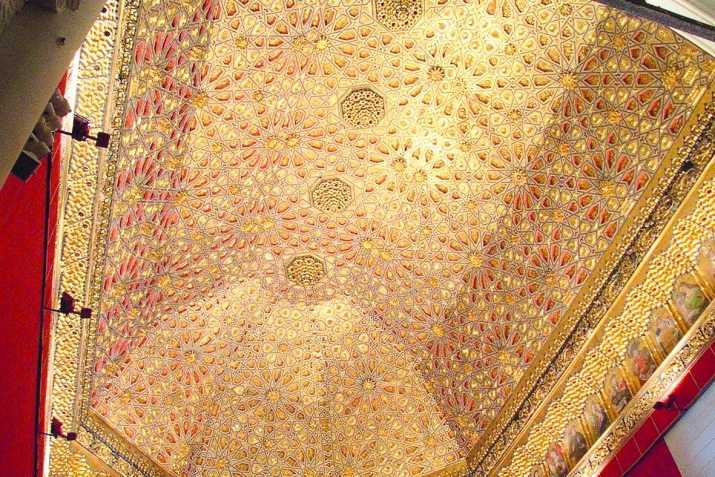
Above the main choir of the late 14th and 15th century Gothic church constructed on the southerly foundations of the palace, is an elaborate 14th century Hispano-Musulman wooden “artesenado” ceiling, famed as the richest and grandest in the whole of Spain.
Attached to the palace complex from its inception were its “Arab” baths, which are amongst the best conserved of their kind.
Nasrid rule of Granada ended in 1492. The style represented by the palaces of Pedro I continued to be favoured by Spanish royalty and nobility until by the end of the 16th century a fashion for Renaissance features began to take precedence.
This was at a time when the Spanish Inquisition was allpowerful, when the Jewish population was expelled (to be given refuge in the Muslim Ottoman domains), and when forced conversions of Spain’s Muslims were taking place, leading ultimately to their expulsion from the peninsula.
Nevertheless, by that time the elements of Hispano-Musulman art and architecture had become so fully assimilated by Spanish Christian society generally that, paradoxically, in the Spanish colonies the style became a major feature of the architectural language of religious buildings and an important component of Spain’s colonial visual identity.
The legacy of Hispano-Musulman or Mudejar art and architecture continues to hold a valued place in Spain’s cultural identity, reflected, for example, in the considerable number of UNESCO World Heritage Sites which preserve this inheritance and the role it plays in Spain’s flourishing cultural tourism sector: this as Spain continues to interconnect with the Muslim world in positive ways, ranging from humanitarian responses to desperate migrants fleeing North Africa to innovative commercial projects such the high speed rail system for the Hejaz in Saudi Arabia which is now coming into full operation.
GUY (GHAYDAR) PETHERBRIDGE
