
The Lost Minaret of Tatartup: Religious Devotion and Coexistence in the Northern Caucasus
In the early summer of 1869, the English mountaineer Frederick William Freshfield, sailed from Trebizond on the north-east Turkish coast to the port of Poti in Georgia: “We came on deck at sunrise, so as to lose nothing of our approach to the Caucasian shores. The steamer was running quickly across the fine bay which forms the eastern end of the Black Sea … before us rose ridge behind ridge, until behind and above them all towered the peaks of the central chain of the Caucasus, scarcely telling their height to the eye uninitiated in mountain mysteries, but showing us plainly enough that we were in the presence of an array of giants, armed in like panoply of cliff and ice to those we had so often encountered in the Alps. One great dome of snow, which conspicuously overtopped all its neighbours, we hailed as Elbruz.”
Like many travelers long before and after him, Freshfield was taking one of the many routes through the Transcausus which led to the Darial Pass (known to Strabo and others in antiquity as the ‘Caucasian Gates’) the principal passage northwards through the centre of the Great Caucasus Range stretching from the Taman Peninsula on the west to Derbent on the Caspian Sea to the east. He was aiming to climb Europe’s highest peak, the volcano of Mount Elbrus and Mount Kazbek, the source of the Terek River which taps major tributaries from the range’s northern slopes to become the principal river system in the north central Caucasus.
Lower downstream the Terek passes through another lesser defile known as the Elkhotovoski Gate to water the fertile plain lands of Kabardia, the territory of the ancient Alans. Here in what was to become known as the Julat region, a settlement was established by the Alans in the 10th century on the southern approaches to the strategic pass.
The town grew quickly and by the beginning of the 13th century had become an important centre and market along the north–south trade route - a major conduit not only for goods but also for beliefs and ultimately for the message of Islam, which in the 13th – 14th century became the prevailing religion in the Northern Caucasus.
In 1238-39 the Julat region was conquered by the Mongols. The city of Upper Julat was ravaged but quickly recovered and in the 14th century became the Golden Horde’s principal centre on its southernmost periphery. Under Tokhta Khan (1292-1312) the pass through the Darial gorge was re-opened for trade. Building activities in the Julat region which had been initiated during his rule increased under Uzbek Khan (1313-1342), the first Mongol ruler to make Islam the state religion.
In 1395, a massive army of Amir Timur decisively defeated Tokhtamish, Khan of the Golden Horde, on the plain between the Terek and Kuma Rivers, a prelude to the demise of the Golden Horde. However, the life of the city of Upper Julat continued unharmed although changes occurred in the makeup of its population. In the 14th century Dagestani chronicle ‘Tarikhi Derbend-name’ it is said that a large part of its inhabitants were Tatars coming from Crimea. Thus Upper Julat became more generally known as Tatartup.
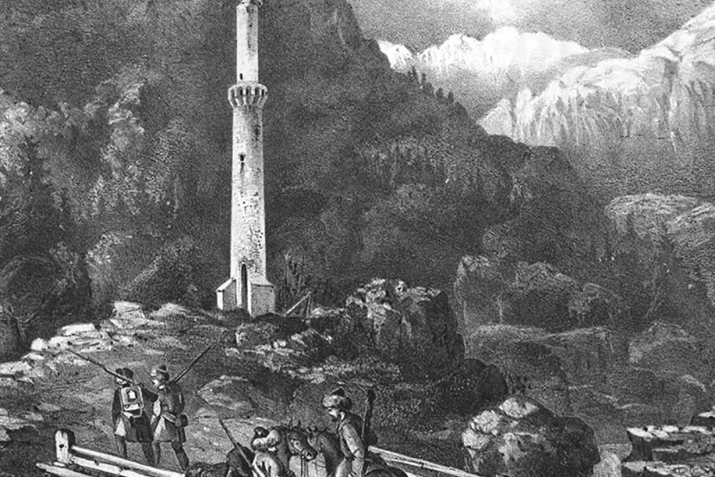
As in the past, the cultural and economic heartland of the North-Central Caucasus in the following 15th-19th centuries continued to be Kabarda spread along the uplands of the Terek River system. Tatartup, however, was gradually surpassed by other regional centres and by the 20th century all that remained was the great minaret of its principal mosque – the tallest in the Caucasus.
Since 1958 archaeological research by the Northern Caucasus Expedition of the Archaeological Institute of the Russian Academy of Sciences has enabled the creation of a general picture of the life of this important regional city in its heyday. Excavations have focused primarily on the ruins of two mosques and four minarets (including one 6 km away from Tatartup) and three churches.
The largest (Juma) mosque was of rectangular plan with a flat roof and with its shortest axis directed towards Mecca. 300 metres away was a smaller mosque, also rectangular in form but apparently roofed with two cupolas. Both mosques are considered by archaeologists to have been built at the end of the 13th-century- early 14th century, probably during the time of Uzbek Khan.
Alexander Pushkin recorded his impressions of Tatartup in his ‘Travels in Arzrum’, published in 1829: “The first remarkable place is the minaret fortress. Approaching it, our caravan rode along a charming valley between mounds overgrown with linden and plane trees. These are the graves of several thousand who died from the plague. Flowers from the tainted ash sparkled.
The snowy Caucasus shone on the right; a huge, wooded mountain towered ahead; behind it was a fortress. Around it you can see traces of a devastated aul, called Tartartub and once the principal one in Big Kabarda. A light, lone minaret testifies to the existence of the disappeared village. It rises gracefully between heaps of stones, on the banks of a dried-up stream. The inner staircase has not yet collapsed. I climbed up it to the platform, from which the mullah's voice is no longer heard. There I found several unknown names scrawled on bricks by travelers seeking fame.”
By that time Tatartup with its great minaret had become both a symbol of Islam and of regional identity generally and was a sacred place accorded great reverence throughout the Muslim Northern Caucasus. It is frequently mentioned in the folklore of the Kabardians and Ossetians and neighbouring mountainous Georgia. There, it was considered forbidden to commit any violent acts and was a place were serious oaths were taken.
However, the history of Upper Julat/Tatartup was not exclusively one of Islam and Muslims. It was also a unique centre of Christianity in the Northern and Central Caucasus and of remarkable confessional coexistence, attested to by the archaeological record which reveals an equal number of mosques and churches in the city as well as written records. In 1410, a German Johann Shultberger travelled from Derbent to Tartary, visited on his journey the mountain country of Julad, populated by a large number of Christians who had a bishopric there.
“Their priests belonged to the Carmelite order, who do not know Latin but pray and sing in Tatar so that converts would be stronger in their faith. For this reason many heathens take the Holy Cross as they understand what the priests read and sing.”
Archaeological evidence dates the Upper Julat churches to the end of the 13th or first half of the 14th century and their material and construction techniques indicate that they were built by Muslim craftsmen, thus connecting them with the Muslim monuments in a distinctive united historico-cultural complex - the churches of Upper Julat cannot be viewed in isolation from its Muslim buildings.
Of the four churches excavated, of particular interest is the presence of domed crypts under the altars of two of them - unique architectural features in the Northern Caucasus and are a feature connected with Latin-Catholic worship. Of even more interest is that the crypts are of a dome form and construction type exclusively used in Muslim structures in other regions of the Golden Horde.
In the 1260s the Genoese and Venetians began commercial expansion in the northern Black Sea region. There is abundant documentary evidence of their activity in the Western Caucasus, the steppe lands north of the Caucasus Range, as well as in Dagestan and the Transcaucasus. Roman Catholic missionaries were also active. Their congregations are reported in the Caucasus from the 13th up to the 15th century. Therefore, there is nothing really surprising about the appearance of Latin Christian churches and congregations in Tatartup. As late as the beginning of the 19th century, Circassian legends were still being passed on that the churches of Tatartup were built by Franks who had settled among the Tatars.
In 1771, the Baltic German Johann Anton Guldenstadt reported two churches as still functioning in Tatartup whereas in 1745 three had been recorded by Russian-Georgian missionaries. As happened with the mosques of Tatartup, its churches too were ultimately abandoned as the community ceased to be viable, leaving only its great minaret standing. In the 20th century a road was built close by. The vibrations of increasing passing traffic in the 1970s led to stresses in the structure and, despite attempts to stablise it, the minaret totally collapsed in the early 1980s. Today Tatartup lies invisible beneath cornfields.
In recent years there has been a strong revival of local interest in this important vestige of the cultural heritage of the Northern Caucasus. As a source of regional pride, increasing archaeological research into Tatartup is being supported by the Council for Cultural Heritage of the Republic of North Ossetia with sponsorship from the local Tatartup Fond.
Community activists are engaged in caring for the site and regional news media are regularly covering developments there. There are hopes that it might be transformed into a historicalarchitectural park and a regional focus for ethnocultural tourism and as an exemplary witness to the way Muslims and Christians of diverse origins and affiliations lived in constructive harmony during a formative period in the history of the Caucasus.
GUY (GHAYDAR) PETHERBRIDGE Professor, Expert on cultural heritage and history of Islam, Australia, Russia