
The unique lost islamic landscapes of the west caucasus
The unique lost islamic landscapes of the west caucasus
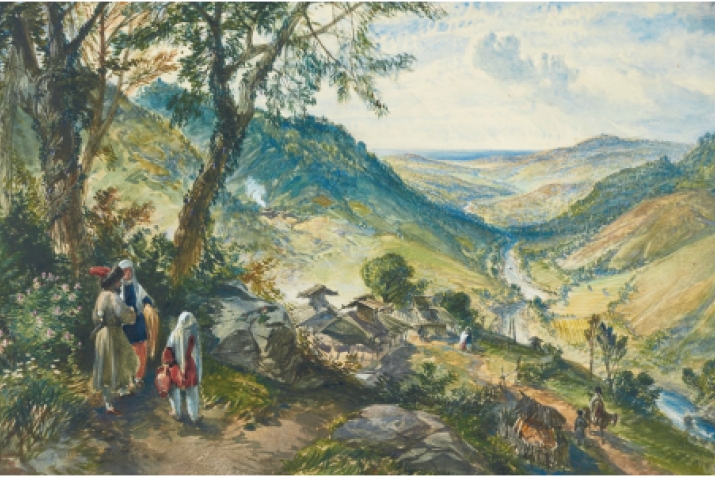
On a fine calm day in late July 1836, at the order of Tsar Nicholas, the government steam-boat, “Peter the Great”, set out eastwards from Yalta on a voyage around the Black Sea. On board were Mikhail Semyonovich Vorontsov, Governor-General of Novorossiya, Count de Witt, Commander-in-Chief of the Russian Cavalry, Prince Galitzin, Prince Tchetrerchinski, Mr. Yeames, Consul-General of England, M. St Saveur, Consul-General of France, other imperial officials and guests including the Englishman Edmund Spenser. In command was an American, M. Sontag, a rearadmiral in the Russian navy.
Edmund Spenser has left us with a detailed account of the voyage. After the expedition visited sites in eastern Crimea, he records, “At the dawn of the following day, I was aroused by the sailors crying “Tcherkesse! Tcherkesse!”, and I caught for the first time a view of the Caucasus, piled up in all their varied forms to heaven.”
The first port of call was the fort of Anapa, at that time the sole permanent Russian stronghold along the Black Sea coast as far as Georgia: the rest of the western Caucasus region south of the River Kouban being the still independent homelands of local peoples who had progressively converted to Islam following the domination of the Crimea and environs by the Ottoman Sultan Fatih Sultan Mehmet II in the late 1470’s.
Departing Anapa, the fine weather continued and the steam-boat was able to travel close in to the Circassian shore. Spenser enthused, “the superb prospect of this Eden-like country … for beautiful coast scenery, has no parallel upon this planet of ours.” “The mountains were covered with verdure from the highest peak to the water’s edge, and whether the eye wandered along the shore, up the bosomy hills, or through the fertile valleys, numerous flocks of snow-white sheep were seen quietly grazing, mingled with herds of buffaloes, superb oxen and jetblack goats. Nor must we forget the numbers of beautiful half-wild horses, proudly tossing their curved necks and flowing manes while bounding like deer through the valleys and long the steep sides of the hills.”
“As our vessels glided slowly forward, we distinctly saw the little cots of the Circassians, with their smoking chimneys and farm-yards surrounded by groves of fruit-trees, appearing as the very abodes of contentment and peace; shepherds in their picturesque costume, with long spears in their hands, tended their flocks and herds; the agricultural fields were filled with men, women and children, cutting down the waving corn; and camels and buffaloes, loaded with produce, were slowly winding their way homeward through the deep valleys.
It was indeed a lovely picture, which blended the most sublime and picturesque scenery with the beauty of romantic rural life, and realized all that the most lively invention of a poet could create of Arcadia.” As the voyage continued, these impressions were further reinforced, drawing analogies with the most admired landscapes of European culture and forming “a picture which excited the lively admiration of our whole party.”
Prior to the early 19th century, the inhabitants of the west Caucasus region strongly discouraged strangers into their hinterlands. However, as the might of Russia encroached, foreigners began to be permitted limited access, if sponsored by a local leader.
Noteworthy in providing the outside world with its initial glimpses of indigenous culture were visits undertaken by the French nobleman Chevalier Taitbout de Marigny, Consul of the King of the Netherlands in Odessa, the recently founded capital of Novorossiya. In 1818 he commanded the schooner, “Circassian”, in a venture conceived by the Duc de Richelieu, first Governor-General of Novorossiya, supported by Tsar Alexander and under the protection of the Circassian Prince Mehmet Indor Oglou to initiate a process of peaceful dialogue with the region’s inhabitants.
De Marigny described his first visit to a local homestead, “We entered into a charming plain, where a stream wound its course under the shade of the plane, the ash, the yoke elm, and the wild apple and pear-tree, mingled with the vine, which crept up to their summits. … Having reached … a habitation composed of four cabins, surrounded with trees, we entered the nearest of them, which was appropriated for strangers.
It consisted of one room, plastered within and without with clay: a great chimney in the Tatar fashion stood at the extremity, and on either side were two sorts of sofas covered with matting; saddles, bridles, and arms adorned the walls.” This description of the typical homestead or hamlet is repeated with minor variation and depth of detail by subsequent visitors to the region. They were seldom composed of more than five or six single-roomed houses, and always included a “guesthouse, where strangers are received and entertained in the most liberal manner.”
Unlike the peoples of the Caucasus to the east, those of the westerly regions determinedly rejected all building in permanent materials. Spenser observed, “There is one singular trait in the character of the Circassians – a strong repugnance to houses built with stone, which they regard as intended for no other purposes than to hold them in subjection,” and that homesteads “were built, according to their custom, of the most frail materials [and interior furnishings were minimal], that in case of a necessity arising to destroy them [in the face of an hostile incursion providing the enemy with no material gain], the loss might be trifling.” J. A. Longworth, another Englishmen, who spent the year 1840 in the region, recorded that, “All manner of building is of basket work. It is speedily set fire to, and almost as speedily rebuilt. … a man feels less reluctance in deserting and firing with his own hand his habitation, the preservation of which, in more civilized countries, so commonly involves the sacrifice of liberty.”
These attitudes were intimately interlinked with unique Circassian attitudes to property, James Stanislaus Bell, who resided in the territory between 1837 and 1839, recording that, “The tenure of land seems to be here on a remarkable primitive footing, no one appearing to have conceived the notion of calling a greater extent of land his own than what he can usefully occupy; in fact no more than what he has enclosed for immediate culture. The soil in fact is considered national property, and occupancy the only transient title of any individual to any portion of it.”
Anapa was the only place in the Caucasus in the first half of the 19th century to the west of Soukoum-Kale (modern-day Sukhumi, Abkhazia) which had mosques and minarets built of permanent materials. Indigenous mosques were simple buildings of traditional vernacular construction like the houses, as described by Bell when staying with the judge and imam Hadji Ismael, “We were shown into a small hurdle-fenced paddock with a neat clay cottage in the midst [which] we found to be the mosque.
” The traditional guesthouses themselves were used for worship, Bell noting for instance, “There was a Mollah of a noble family, hired by our host to say prayers in his family during Ramazan. During this season wherever a Mollah lodges, all the males in the hamlet who say prayers assemble at sunset to say them along with him.”
Following the definitive Russian absorption of the region in 1864, most of the Muslim population of the western Caucasus left to resettle in South-Eastern Europe or Turkey and beyond. Their unique cultural landscapes, ephemeral by their very nature and by the strategic defensive intent of their creators and permeated by Islam, vanished forever, retrievable only via the few empathetic written accounts of foreign guests and their even more limited visual depictions. Perhaps most hauntingly evocative of this lost world – unique in all Islam - is the following description by Bell, of the maghrib azan in a distant Circassian twilight, “
“The shades of evening had begun to deepen around us when we reached the beautiful hamlet called Abun Bashi where there stands a mosque, which, though of the simplest structure, being built entirely of wood, bears, nevertheless, both in size and materials, the same proportion to the houses as churches do elsewhere. The minaret to it consisted of a tall poplar, up which the Muezzim ascended, by notches cut in the stem, to a basket that served as a gallery at the top. He had just taken his station there, and was chanting his summons to the house of prayer, as we arrived.
The sounds were familiar to us; they were such as hallow the vesper hours all over the East; but which, often as I had heard and been impressed by it, had never raised the emotion produced by the cry in the wilderness; loud, thrilling, and prolonged, it proclaimed amidst its rocks, caverns and forests, now sinking into deeper shadow, the unity and greatness of the living God, and invited all who heard it (and one would have thought there were few in such a place) to his worship.”
GUY (GHAYDAR) PETHERBRIDGE