

The name of a fairy-tale hero on a coin
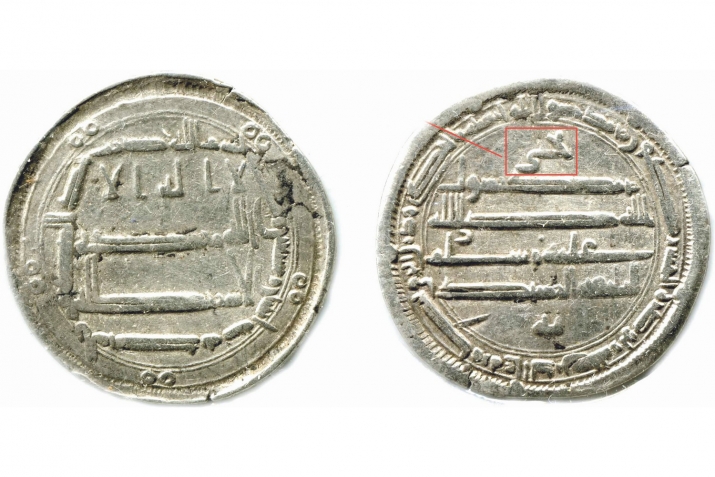
I have a coin in my collection that has a proper name written on it – Ja’far.
Over the 600 years of minting Kufic dirhams, this name was minted on a silver coin only once. This name unmistakably indicates that the dirham was minted during the reign of Caliph Harun al-Rashid.
Unfortunately, not everyone can read or discern where this name is written on the coin. It is written in the Arabic alphabet in Kufic script. However, if someone does read it, it turns out that few people remember this man who left his name on a coin more than a thousand years ago.
At best, they will remember the vizier Ja’far, the hero of Arabian fairy tales. Thanks to the wide popularity of the fairy tales “1001 Nights” and now the huge number of feature films and animated films based on the adventures of the main characters of the work - the caliph (ruler of the Muslims) and his vizier Ja’far - the whole world knows both.
There are also real historical figures who became the prototypes of fairy tale characters.
Yes, the caliph Harun ar-Rashid and his vizier Ja’far ibn Yahya were real historical figures. They became the prototypes of the fairy tale characters.
Let us start with the fact that the caliph al-Mahdi and his wife Khayzuran had two sons: al-Hadi and ar-Rashid. While still young, by order of their father, they were recruited for state military and civil service.
It is not known for what reason, but the mother believed that the husband should transfer his power not to the eldest but to the youngest son. Al-Mahdi agreed with her, but he could not immediately inform his eldest son al-Hadi about the change in his first decision, because he was on a military campaign at the head of the Caliph’s army in Jurjan on his father’s orders.
Then al-Mahdi went to him for a personal meeting but fell ill on the way and died on the 22nd of the month of Muharram, 169 AH (Muslim calendar), which corresponds to 4 August 785 CE, near the village of Mazebdana in the vicinity of Khulwan in Media.
After the death of al-Mahdi, al-Hadi became the caliph but a year later he died as a result of a palace coup. After the death of his brother, Harun ar-Rashid became the ruler of the Muslims.
The history of the viziers from the Barmakid clan is inextricably linked with the history of the family of caliphs. The authentic story begins with Khalid ibn Barmak, to whom the Caliph al-Saffah entrusted the management of the army and land tax (al-jund wal-kharaj) and appointed him vizier.
A vizier is an official who runs the government of a state and is a trusted person of the ruler himself, implementing his wishes. A candidate for vizier must be a true Muslim, a person close and devoted to the ruler, possess spiritual and moral qualities, an outstanding mind, be well educated and know the existing administrative rules. In the Barmakid family, all men were prepared for this position from early childhood, specially trained and educated.
After the death of Caliph al-Saffah, when Caliph al-Mahdi came to power, Khalid ibn Barmakid continued to be a vizier at his palace. The son of the vizier Khalid, Yahya, was brought up at the court of the caliphs, received an excellent education. Yahya’s wife (Zainab) and the wife of the Caliph al-Mahdi (Khayzuran), who had two sons each, nursed and raised them together. Yahya was officially appointed as the tutor of the future Caliph al-Rashid, supervised his education and governed Azerbaijan, Armenia, Syria and Africa on behalf of the young prince.
Harun al-Rashid, having become the Caliph, entrusted the governance of the state to his tutor Yahya, appointing him vizier. Thus, the name Yahya appeared on the reverse side of silver dirhams minted in different years at one of the central mints of the Caliphate of Muhammadiyah (modern Tehran).
Illustration No. 1. Yahya Muhammad Rasulullah ﷺ al-Khalifa ar-Rashid
The circular inscription on the reverse side of the coin is the 33rd verse of Surah At-Tawba (the meaning of the commentary): “He (Allah ﷻ) is the One Who sent His Messenger (Muhammad ﷺ) with the right guidance and the true religion, to exalt it above other religions, even if (this) is not liked by the pagans.”
In the centre of the front side of this coin is an inscription in three lines: “There is no god but Allah ﷻ He is One, and there is no one equal to Him.”
In the circular inscription: “With the name of Allah ﷻ, this dirham was minted in Muhammadiyah in 172.”
Yahya immediately, from the first days, involved his sons Fazl and Ja’far in the management of state affairs, endowing each with certain duties of a vizier. Thus, the name Ja’far appeared on coins.
Illustration No. 2 Muhammad Rasulullah ﷺ amir al-mu’minin al-Amin ibn Muhammad Ja’far
The circular inscription on the reverse side is the 33rd verse of the Sura “At-Tawba” (the meaning of the commentary): “He (Allah ﷻ) is the One who sent His Messenger (Muhammad ﷺ) with the right guidance and the true religion, to exalt it above other religions, even if (this) is not liked by the pagans.” In the centre of the obverse of this coin is an inscription in three lines: “There is no god but Allah ﷻ He is One, and there is no one equal to Him.”
In the circular inscription: “With the name of Allah ﷻ, is the indication that this dirham was minted in Muhammadiyah in 172.”
