
4 Beautiful Pieces of Islamic Architecture around the World
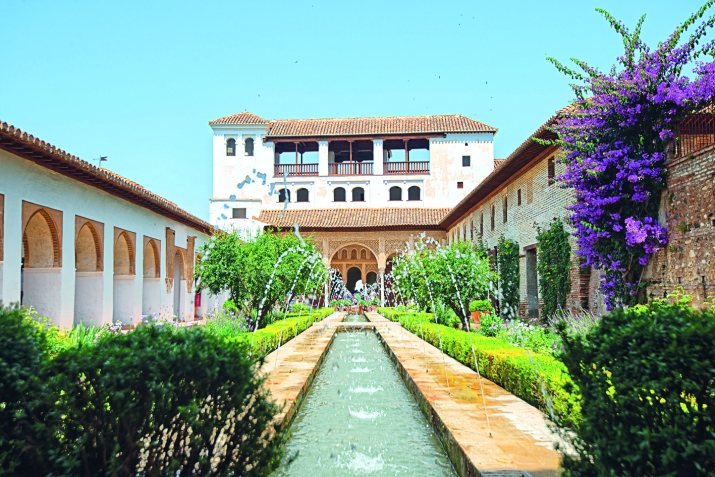
1. The Alhambra
Alhambra (Spanish rendering of the Arabic words “qa’lat alHamra”, meaning “red castle”) is an architectural palace complex located in the eastern part of the Spanish city Granada. Initially built as a fortress it later became a royal residence and nowadays it functions as a museum.
The Alhambra was renovated and rebuilt in the mid-13th century by the Arab Nasrid emir Mohammed ben AlAhmar of the Emirate of Granada, who built its current palace and walls. Over time, some parts of the palace have been demolished.
Today, there are three remaining parts: a fortress on the west end of the hill, a princely residence to the east and a group of pavilions and gardens known as the Generalife (the Arabic Jennat al Arif, “Garden of the Architect”). One can easily identify the courtyards and spaces of the Alhambra: they are beautifully decorated with coloured tiles, geometric forms, carved wood and impressive calligraphy.
2. Sultan Amir Ahmad Bathhouse

The Sultan Amir Ahmad Bathhouse is a very unique example of Persian architecture and decoration. It is located in the historical area of Kashan in Iran. This ancient public bathhouse covers an area of over one thousand square metres.
Notable in the interior of the bathhouse are its vaulted ceilings, exquisite mosaics and paintings. It represents one of the most beautiful examples, in terms of architecture and decorations, of an ancient public bathhouse visible today in Iran.
Its name derives from the nearby shrine-mausoleum of Sultan Amir Ahmad. Its construction dates back to the 16th century during the period of Safavid government. The bathhouse is registered as a national heritage site.
3. The Dome of the Rock
The Dome of the Rock in Jerusalem was built by the Umayyad caliph ‘Abd al-Malik ibn Marwan in the late 7th century CE and is one of the earliest surviving Islamic monuments.

The structure of Dome of the Rock comprises an octagonal base topped by a gilded wooden central dome. The whole building is approximately 65 feet in diameter and is mounted on an elevated drum, rises above a circle of 16 piers and columns. Surrounding this circle is an octagonal arcade of 24 piers and columns. The outer walls also form an octagon, with each of the eight sides being approximately 60 feet wide and 36 feet high. Both the dome and the exterior walls contain many windows.
The interior and exterior of the structure are decorated with marble, mosaics, and metal plaques. The mosaics of the Dome have no representations of human or animal forms, instead featuring Arabic script and vegetal patterns intermixed with images of items such as jewels and crowns. The site is very sacred to both Islam and Judaism.
4. Suleiman Mosque
One of the most prominent features of Istanbul is the towering dome of the Suleimaniye Mosque complex. The mosque was built by the Ottoman emperor Suleiman the Magnificent between 1550 and 1557.
It is the largest and most impressive of the mosque complexes in the city. It was designed by the Ottoman master architect Sinan and is considered one of his masterpieces. Around the mosque itself you can find a hospital, several religious schools, a row of shops, a mausoleum, and a bath. The structures within the complex include the tombs of the mightiest Ottoman Sultan Suleiman the Magnificent and his wife Hurrem Sultan.

MUHAMMAD YUSUF As-Salam correspondent