
The path to medicine in the Ottoman Empire
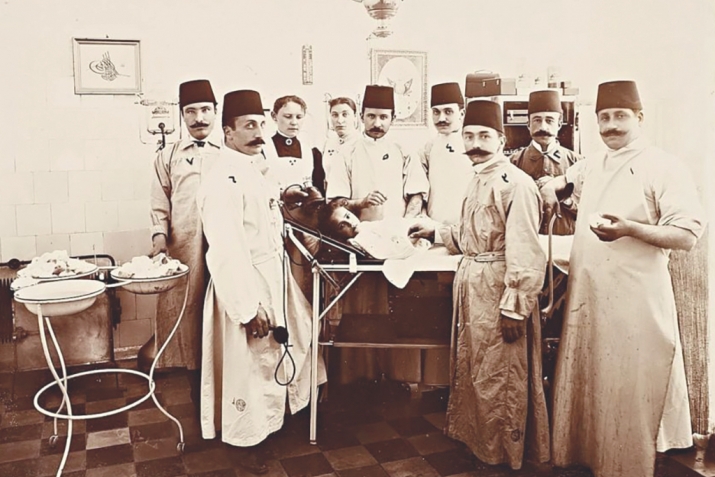
Medical education in the Ottoman Empire had its own unique structure, influenced by both Islamic and classical traditions.
The system of medical training was not limited to a single profession: in addition to tabibs (specialists in internal medicine), there were other specialists, including surgeons, ophthalmologists, orthopedists, herbalists and others. Each of these categories had its own teaching methods, adapted to the specifics of their profession.
Education through madrassas and hospitals
The foundation of medical education was formed by madrasas and dar al-shifa (hospitals), which also served an educational function. In these institutions, future doctors received both theoretical knowledge and practical experience. This dual system (instruction in the classroom and at the patient’s bedside) ensured a comprehensive training of specialists.
An apprentice who was assigned to a master to learn a particular subject was called a “chiraq” or “shakird”. In a broader sense, students were called “talibs”, while those mastering the art of medicine were called “shakird” and “tabib”. Until the mid-19th century, medical training took place primarily in hospitals, where students could observe the progression of diseases and participate in the treatment of patients. At the same time, they studied medical theory in madrassas.
Libraries at educational insti-tutions played a special role, they housed medical treatises, including translations of classical and Arabic authors. These manuscripts served as a valuable source of knowledge, allowing future doctors to draw on the experience of many generations.
Examples of the clinical school
One of the most striking examples of the organization of medical education in the Ottoman Empire is the Yıldırım Dar ash-Shifa Hospital, founded in 1395 in Bursa as part of an architectural complex (kulliye) built by order of Sultan Bayezid Yıldırım. Here, future doctors were trained at the Dar at-Tib Medical School, which was located right on the hospital grounds. Education was conducted in specially equipped classrooms and the educators were practicing physicians – specialists who imparted knowledge directly at the patient’s bedside.
A similar model of medical education was implemented in other famous complexes: for example, in Istanbul the Kulliye of Sultan Mehmed II Fatih, opened in 1470, as well as the famous Süleymaniye, built in 1557 under Sultan Suleiman the Magnificent. The hospitals of both also served as training grounds for medical personnel.
Historical sources attest to the existence of a medical training institution in Edirne as well: a school called the Atibba Madrasah operated at the hospital founded by Sultan Bayezid II in 1484. It served the same function: training future doctors, combining academic knowledge with clinical practice.
From theology to therapy: how a medical career began
The path to medical education in the Ottoman Empire began with the classical madrassa: an educational institution where future medical students learned the fundamentals of Islamic jurisprudence (fiqh), theology, philosophy, and literature, as well as Arabic and Persian languages. Education was gradual: after mastering a particular book, the student received an ijaza (a kind of permit) granting the right to teach the contents of that work. They then moved on to another teacher (mudarris) to continue their studies at the next level.
The final point of this academic journey was the final ijaza, after which the student received the official qualification of mudarris (teacher) or qadi (judge). This system opened a wide range of career paths for physicians. They could work not only in medicine, but also in law, religion, and the administrative system, becoming imams, qazakers (military judges), or madrasa teachers.
Moreover, Ottoman students often traveled abroad to broaden their horizons and deepen their knowledge. Medical education was often continued in the madrasas of Syria, Egypt and Iran, which also boasted strong scientific schools.
Palace schools and craft workshops
There was another route to training physicians, particularly surgeons and ophthalmologists: through the palace craft corporation, the Hassa Ahlul Hiraf. This was a privileged organisation of artisans at the Sultan’s court, which selected the most talented young men. There, they underwent professional training under experienced practitioners, mastering specific medical specialties, primarily surgery and ophthalmology.
Private and family education
In addition to madrasas, hospitals and palace structures, another form of medical education existed in the Ottoman Empire: the master-apprentice model. Young men could study privately with an experienced physician outside of hospitals or official schools and upon completion of their training, they also received an ijaza, which granted them the right to practice medicine. This form of education became especially widespread in the 17th and 18th centuries, when the quality of madrasa education began to decline.
Furthermore, there were families in which the medical profession was passed down from generation to generation: younger members learned from their elders, absorbing knowledge from an early age.
Control over medical practice
To protect society from non-professionals, the state periodically conducted examinations of doctors. Special decrees required all practicing specialists (from surgeons and ophthalmologists to herbalists) to confirm their qualifications. Only those who successfully passed the examination received an ijaza; others were prohibited from practicing medicine.
Medical education in the Ottoman Empire was a complex yet flexible system, combining religious scholarship, practice, mentorship and even family traditions. This allowed for the training of physicians in various fields, from court surgeons to village healers, and the maintenance of a high level of medical culture for centuries.