
Mariam al-astrolabi: a female scientist
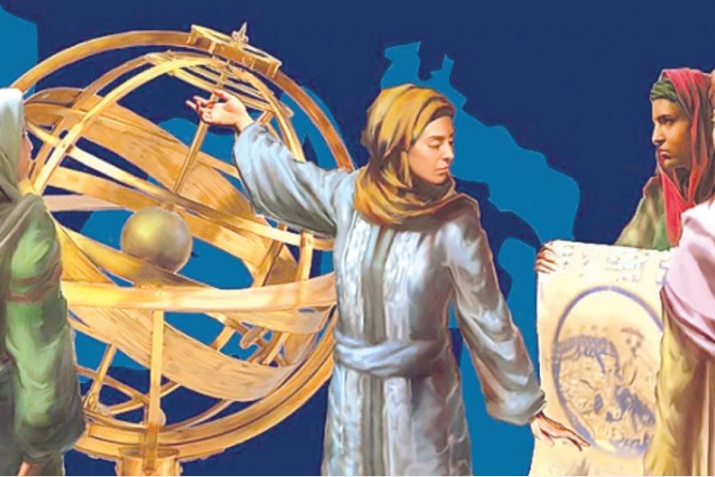
Mariam Al-Ijiliya lived in tenth century Aleppo, Syria. History gives a glimpse of her reputation as the chief astrolabe manufacturer of her time.
Mariam came from a family of engineers and manufacturers. After her father, she became the apprentice of Bastulus, the noted compiler Ibn Al-Nadim. Bastulus was a well-known astrolabe manufacturer in Baghdad and the scientist on record as having created the world’s oldest surviving astrolabe. It seems that Mariam’s hand-crafted designs were so intricate and innovative that she was employed by Sayf-AlDawla, the Emir of Aleppo, serving him from 994 AD until 967 AD.
Tools that caused her to be named “Al-Astrolabi”
Astrolabes are useful tools in the science of celestial objects and helped scientists’ research in astronomy, astrology and horoscopes. These global positioning instruments determine the position of the sun and planets, tell time and navigation by finding location by latitude and longitude. Not only in science are these tools helpful. In Muslim society, astrolabes find the Qibla, prayer times, and determine starting days for Ramadan and Eid. In both science and Islam, astrolabes played a vital role, thus, making such instruments was a prestigious career. To top that career, in 1990, the main-belt asteroid 7060 ’Al-‘Ijliya’, discovered by Henry E. Holt at Palomar Observatory, was named in her honour.
Inspiration for Okorafor’s novella ‘Binti’
In 2016, the science-fiction writer Nnedi Okorafor revealed that Mariam Al-Astrolabi was the inspiration for her protagonist in her science fiction novella Binti. The eponymous main character is a young woman who is an expert at crafting astrolabes. The author stated that she learned of Al-Ijliya at a book festival in the United Arab Emirates. Mariam’s name was woven into Binti’s longer name and Binti’s father also makes astrolabes, both a nod to her inspirational influence.
A wish upon a star?
Historical records of Mariam AlAstrolabi are scarce and none of her astrolabes have ever been discovered, since it appears she did not sign her instruments. People online even try to debunk her existence! It seems the odds are seemingly against her. Although Mariam might be a dead star in our history, her legacy may still live on in a character like Bint and hopefully her light will be seen by many more as a result.
Source: Agencies